Get your free plan → Six short steps for your house: what to fix first, the tests to ask for and the programs open to you. No email.
Common problems
Window condensation
Water, fog or frost on the inside of windows on cold mornings, sometimes with mold on the sills and frames. Or dew on the outside of the glass on cool, humid mornings, which is a different thing.
What it usually means
- Condensation forms when moist air touches a surface colder than its dew point. In winter, window glass is usually the coldest surface in a room, so it’s where too much indoor humidity shows first.
- Water on the inside points to indoor moisture (cooking, showers, laundry, people, plants, an unvented dryer or a damp crawlspace) with too little ventilation. Single-pane and aluminum-frame windows get cold enough to condense much sooner than efficient ones.
- Dew on the outside of the glass on cool, clear, humid mornings is normal with efficient, low-e windows: the outer pane stays cold because the window insulates well. Fog between the panes means a failed seal, and that glass unit needs replacing.
Where it’s most common
Our climate research lists this as a common problem in these metro areas. Each guide covers what homes there need, local audit programs and rebates.
Somewhere else? Find your metro guide.
Likely causes, by climate
The same symptom has different causes in Miami, Phoenix and Minneapolis. Find your climate below; the tag marks the climates where this problem is most common.
Hot and humid Florida, Texas and the Gulf Coast
Condensation inside on windows is uncommon; dew outside efficient windows on spring and fall mornings is normal. Sweating supply vents and damp ceilings around them are the hot-climate version: humid air reaching surfaces chilled by the AC, often from attic air leaking around duct boots or indoor humidity above 60%.
Hot and dry the desert Southwest and inland Southern California
Rare, because desert air is dry. If you see it, look for an evaporative cooler running with the windows shut or a big indoor moisture source.
Mixed the Mid-Atlantic, St. Louis and the Southeast Piedmont
Winter condensation shows up on single-pane, aluminum-frame and older windows, and in rooms with lots of moisture, like bathrooms and kitchens. Summer dew on the outside of efficient windows is normal.
Cold the Northeast, Great Lakes, Upper Midwest and Colorado Front Range Common here
The colder it gets outside, the colder the glass, so the lower indoor humidity has to be to keep windows dry. In cold spells, keep humidity at the low end of the 30–50% range and turn humidifiers down. Frost on the glass and mold on sills are the warning signs.
Marine and mild coastal the Pacific Northwest and coastal California Common here
Long, cool, damp winters make condensation inside windows very common in Seattle and Portland, especially in tighter homes without steady ventilation. Using bath and kitchen fans, venting dryers outdoors and adding balanced ventilation usually fix it.
Not sure which climate you’re in? Your metro guide says, and the climate zone entry explains the map builders use.
How an audit confirms it
Guessing is how people end up with new equipment that doesn’t fix the problem. These tests measure the cause. Ask for them by name when you book; each guide explains what the results mean and what to do next.
- Mold and humidity check Measures indoor humidity, finds moisture sources and checks sills, frames and walls for mold.
- Blower door test Shows how tight the house is, which tells the auditor how much ventilation it needs.
- Combustion safety test A furnace or water heater that spills its exhaust adds moisture as well as carbon monoxide; this test checks the venting.
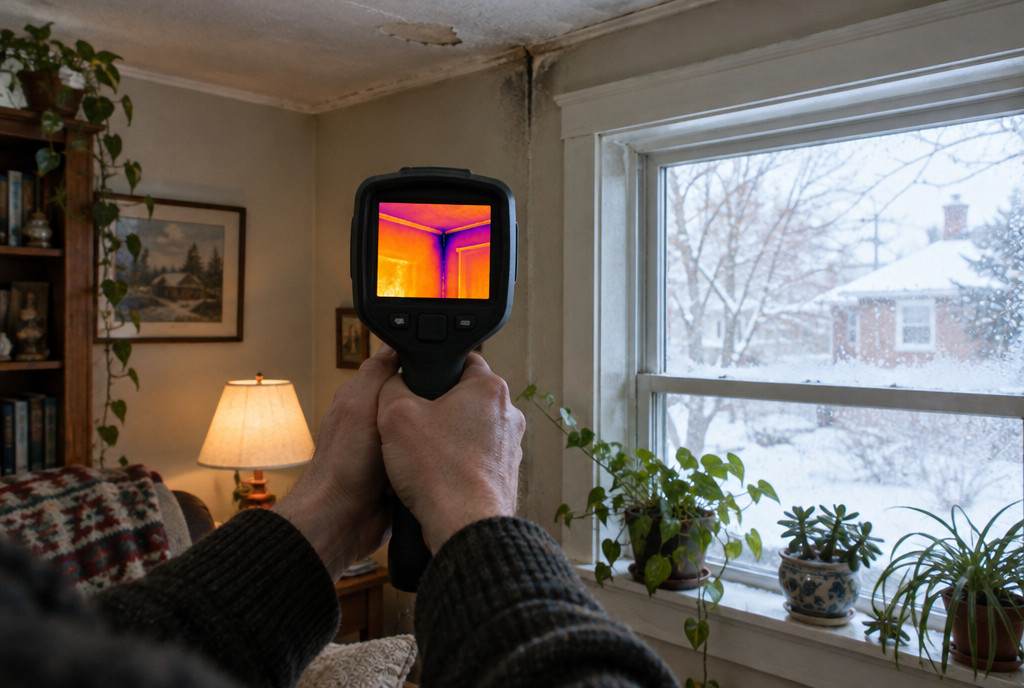
- Infrared (thermal) scan Shows cold window frames, air leaks around windows and cold wall corners where condensation and mold form.
Try first (cheap or free)
- Measure humidity with a digital hygrometer. In winter, aim for the low end of 30–50%, and lower in very cold weather.
- Run bathroom fans during and after showers and the range hood while cooking, and make sure both vent outdoors.
- Check that the clothes dryer vents outdoors, and turn down or stop using a humidifier.
- Open curtains and blinds during the day so room air can warm the glass.
- Wipe sills dry, and clean small mold spots with detergent and water.
The fix ladder
From the cheapest step to the biggest. Work up only as far as you need to, and test again after.
- A hygrometer, exhaust fans used and vented outdoors, the humidifier turned down
- Quiet, timer-controlled bath fans that ventilate steadily
- Fix moisture sources: a crawlspace vapor barrier, the dryer vent, plumbing leaks
- Storm windows, or new glass units where seals have failed
- Balanced ventilation (an HRV or ERV) in a tight home, or efficient replacement windows with a low U-factor
When to call a pro
- Mold keeps coming back on sills and walls, or covers more than about 10 square feet.
- Water runs down walls or window frames are rotting.
- You’re tightening the house or adding a heat pump. Ask the auditor about ventilation, and about combustion safety if you have fuel-burning appliances.
Common mistakes
- Running a humidifier in very cold weather without watching the windows and a hygrometer.
- Air sealing a home without a ventilation plan: a tighter house holds onto the moisture you make indoors.
Paying for the fixes
Utility programs often pay toward audits, duct sealing, insulation and heat pumps, and some require an audit first. Your metro guide lists the programs near you, and your state’s page covers state and federal rebates.
Words worth knowing
- Condensation
- Water that forms when humid air touches a surface colder than its dew point, on windows, cold pipes or hidden inside walls and attics.
- Dew point
- The temperature at which air becomes saturated and water starts to condense on surfaces, like water beading on a cold glass.
- Relative humidity (RH)
- How much moisture the air holds compared with the most it could hold at that temperature, shown as a percentage.
- Hygrometer
- An inexpensive gauge, often combined with a thermometer, that shows a room's relative humidity so you can keep it in a healthy range.
- Low-e glass
- Window glass with a thin, invisible metal coating that reflects heat, keeping more warmth in during winter and out in summer.
- U-factor (U-value)
- How fast heat passes through a window, door or wall assembly; lower is better, the opposite of R-value.
- HRV (heat recovery ventilator)
- A ventilation system that swaps stale indoor air for fresh outdoor air while transferring heat from the outgoing air to the incoming air.
- ERV (energy recovery ventilator)
- Like an HRV, but its core also transfers some moisture between the outgoing and incoming air, which helps manage humidity.
- Air sealing
- Blocking the hidden gaps where air leaks in and out of a house, which cuts drafts, heating and cooling costs, and moisture problems.
The glossary explains every term on the site.
Common questions
Is condensation on the outside of my windows a problem?
No. Dew on the outside of the glass on cool, humid mornings is normal with efficient windows: the outer pane stays cold because the window insulates well. It clears as the sun warms the glass.
What humidity stops window condensation?
It depends on how cold it is outside and how well your windows insulate. EPA advises keeping indoor humidity below 60%, ideally 30–50%. In very cold weather you may need to stay at the low end of that range, or below it, to keep windows dry.
Do new windows fix condensation?
Efficient windows stay warmer on the inside, so they condense less, but the cause is indoor moisture. Use exhaust fans, fix moisture sources and add ventilation first, and replace windows when they’re failing anyway.
Related problems
Sources
Where each problem is common comes from our regional climate research (NOAA climate normals, EPA, PNNL, FEMA and others), cited on each metro guide. The guidance on this page follows these sources, checked October 26, 2026:
Want it diagnosed properly?
Tell us your ZIP code and what you’re noticing. A person reads every message and replies with certified auditors who can test for this in your area.