Energy test guide · verified October 12, 2026
Combustion safety test: the check that belongs with air sealing
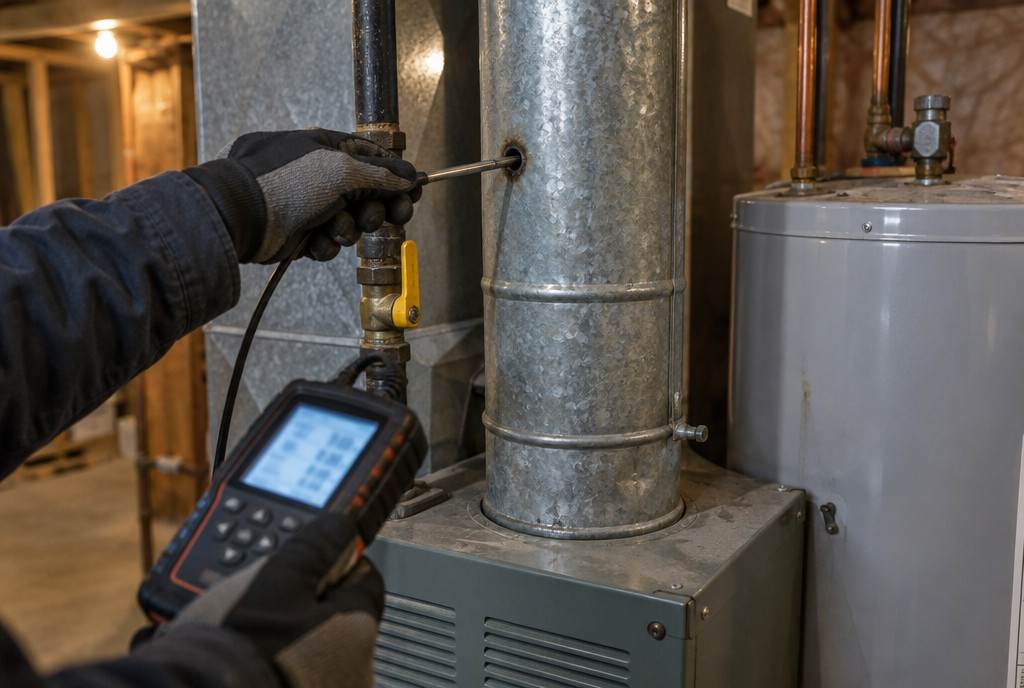
A combustion safety test checks whether furnaces, boilers and water heaters vent properly when the space around them is under the most suction the house can create, and measures carbon monoxide along the way. DOE’s Building America Solution Center calls for it in homes with natural-draft appliances, especially during air sealing.
Typical cost
Not published
What the test involves
-
Safety checks first
Before testing, the auditor confirms combustible gas is below 10% of the lower explosive limit and carbon monoxide in the air is below 70 ppm.
-
Set up the worst case
The auditor creates the greatest depressurization achievable in the combustion appliance zone (CAZ) for the conditions.
-
Check spillage and CO on natural-draft appliances
Spillage and CO are measured on natural-draft appliances (barometric draft control) and Category I appliances (draft hood or natural-draft vent).
-
Measure CO on the rest
CO is also measured on gas ovens and on direct-vent or vent-free equipment.
Source: ANSI/BPI-1200-S-2017 ↗ · verified October 12, 2026
What the CO readings mean
| CO in the air | What the auditor does |
|---|---|
| 9 to 35 ppm | Advises checking the sources and ventilating |
| 36 to 69 ppm | Ventilates and shuts off the sources |
| 70 ppm or more | Stops work, evacuates and calls emergency services from outside |
Source: ANSI/BPI-1200-S-2017 ↗ · verified October 12, 2026
The standards behind it
- ANSI/BPI-1200-S-2017, Standard Practice for Basic Analysis of Buildings, is still listed on BPI’s standards page. Its Section 7 adopts the combustion appliance inspection requirements of BPI-1100 Section 7 and adds to them.
- ANSI/BPI-1100-T-2023, the Home Energy Auditing Standard, is the current BPI-1100.
- DOE’s Building America Solution Center cites NFPA 54 for combustion air.
- For ENERGY STAR homes that keep non-direct-vent appliances in climate zones 1–3, it cites RESNET Section 805 and ANSI/ACCA 12 QH-2014 Appendix A (a CO test and a CAZ depressurization test).
Sources: BPI standards ↗, DOE BASC, CAZ testing ↗ · verified October 12, 2026
How to get it done
Ask auditors whether their assessment follows BPI-1200, which includes the combustion appliance inspection, and whether they’ll test at the end of each day of air sealing, as DOE describes. What it costs: no official source publishes a price, so we don’t quote one.
Sources: BPI standards ↗, DOE BASC, CAZ testing ↗ · verified October 12, 2026
If an appliance fails
- At 70 ppm or more in the air, everyone leaves and emergency services are called from outside, per BPI-1200.
- If an appliance spills or produces high CO, have it serviced or replaced by a qualified technician and retested before more air sealing is done.
- Make sure CO alarms are on every level and outside sleeping areas, as CPSC recommends. See the carbon monoxide guide.
Sources: ANSI/BPI-1200-S-2017 ↗, CPSC CO questions and answers ↗ · verified October 12, 2026
Common questions
When does a home need a combustion safety test?
DOE’s Building America Solution Center calls for combustion appliance zone (CAZ) testing in homes with natural-draft furnaces, boilers or water heaters, especially during air sealing, when it should be done at the end of each workday.
Source: DOE Building America Solution Center ↗ · verified October 12, 2026
My appliances are direct-vent. Is the test still useful?
The standard test still measures carbon monoxide on direct-vent and vent-free equipment and on gas ovens. The spillage part applies to natural-draft and Category I appliances.
Source: ANSI/BPI-1200-S-2017 Standard Practice for Basic Analysis of Buildings ↗ · verified October 12, 2026
What CO level is dangerous during an audit?
BPI-1200 sets ambient CO action levels: 9 to 35 ppm, advise checking sources and ventilating; 36 to 69 ppm, ventilate and shut off sources; 70 ppm or more, stop, evacuate and call emergency services from outside.
Source: ANSI/BPI-1200-S-2017 Standard Practice for Basic Analysis of Buildings ↗ · verified October 12, 2026
Is this the same as having a CO alarm?
No. The test checks how your appliances vent under worst-case conditions on the day of the audit. CPSC recommends CO alarms on every level of the home and outside sleeping areas as well.
Source: CPSC ↗ · verified October 12, 2026
What does a combustion safety test cost?
No official source publishes a price, so we don’t quote one.
Sources
Every source below was opened and checked on October 12, 2026. A date in a source’s name is the “last updated” date shown on that page.
- BPI: Standards (ANSI/BPI-1100-T-2023, ANSI/BPI-1200-S-2017, BPI-2400) ↗
- ANSI/BPI-1200-S-2017 Standard Practice for Basic Analysis of Buildings (PDF) ↗
- DOE Building America Solution Center (PNNL): Combustion Appliance Zone (CAZ) Testing ↗
- DOE Building America Solution Center (PNNL): Enclosure Leakage Test ↗
- CPSC: Carbon Monoxide Questions and Answers ↗
Air sealing a home with gas, oil or propane appliances?
Tell us your ZIP code and what you’re planning. A person reads every message and replies with certified auditors who run combustion safety tests in your area.