Home health test guide · verified October 12, 2026
Mold: fix the water first, then decide whether testing tells you anything
EPA doesn’t regulate mold in indoor air, and there are no federal limits for mold or spores, so a mold test can’t tell you whether your home “passes.” What matters is the water problem feeding it, and the cleanup.
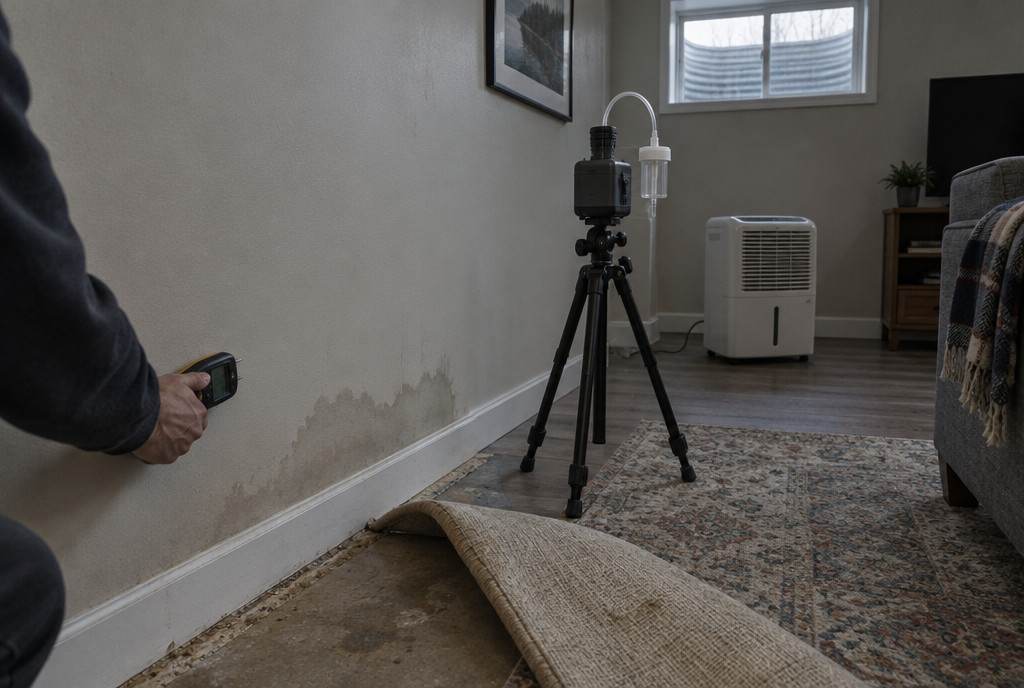
What testing can and can’t tell you
Because there are no federal limits, sampling can’t show that a home meets any federal standard. EPA says sampling is usually unnecessary when mold is visible. Surface sampling can help confirm that an area was cleaned, and should be done by experienced professionals.
Source: EPA, mold, moisture and your home (updated Feb 18, 2026) ↗ · verified October 12, 2026
Cleanup, the EPA way
-
Fix the water problem
Stop the leak or the source of dampness before anything else.
-
Dry everything
Get wet materials and the area dry before cleaning.
-
Scrub hard surfaces, toss what stays moldy
Use detergent and water on hard surfaces. Throw out porous materials such as ceiling tiles or carpet that stay moldy.
-
Don’t paint or caulk over it
EPA says not to paint or caulk over mold.
-
Know when it’s too big for DIY
Under about 10 sq ft (roughly 3 ft by 3 ft), you can usually handle it yourself. For larger areas or significant water damage, follow EPA’s “Mold Remediation in Schools and Commercial Buildings.”
Source: EPA, mold, moisture and your home ↗ · verified October 12, 2026
State licensing
Does the state require a license or a named credential to assess or remediate mold? Illinois has a law authorizing a registration program, but none was confirmed operating, so it isn’t counted. Kentucky sets minimum practices for remediation companies but has no license.
| State | Credential required? | What the rule says | Source |
|---|---|---|---|
| Arizona | None found | No mold licensing law found. | Environmental Law Institute ↗ |
| California | None found | No mold licensing law found. | Environmental Law Institute ↗ |
| Colorado | None found | No mold licensing law found. | Environmental Law Institute ↗ |
| District of Columbia | Required | DOEE licenses assessors and remediators; rentals need licensed professionals at 10 sq ft or more. More detailDOEE licenses individual mold assessors and remediators (exam, 2-year license, $1M insurance; D.C. Code 8-241.01-.09; 20 DCMR ch. 32). In rentals, landlords must use DOEE-licensed assessors and remediators for mold areas of 10 sq ft or more; smaller areas may be cleaned by unlicensed workers. | DC DOEE ↗ |
| Florida | Required | DBPR license. More detailDBPR licenses mold assessors and mold remediators (F.S. 468.84-.8424; F.A.C. 61-31). Licenses expire July 31 of even years (latest deadline July 31, 2026). | Florida DBPR ↗ |
| Georgia | None found | No mold licensing law found. | Environmental Law Institute ↗ |
| Illinois | None found | A statute authorizes a registration program, but none was confirmed operating. | Environmental Law Institute ↗ |
| Maryland | None found | No mold licensing law found. | Environmental Law Institute ↗ |
| Massachusetts | None found | No mold licensing law found. | Environmental Law Institute ↗ |
| Michigan | None found | No mold licensing law found. | Environmental Law Institute ↗ |
| Minnesota | None found | No mold licensing law found. | Environmental Law Institute ↗ |
| Missouri | None found | No mold licensing law found. | Environmental Law Institute ↗ |
| New Jersey | None found | No mold licensing law found. | Environmental Law Institute ↗ |
| New York | Required | NY DOL license (Labor Law Art. 32). More detailNY DOL license required to work, advertise or hold out as a mold assessor or mold remediation contractor; abatement workers are also licensed (Labor Law Article 32, sections 930-948). The same person may not do both assessment and remediation on one property; owners working on their own residential property are exempt. | New York State DOL ↗ |
| North Carolina | None found | No mold licensing law found. | Environmental Law Institute ↗ |
| Oregon | None found | No mold licensing law found. | Environmental Law Institute ↗ |
| Pennsylvania | None found | No mold licensing law found. | Environmental Law Institute ↗ |
| Texas | Required | TDLR license. More detailState license from TDLR required for mold assessment and mold remediation (Occupations Code ch. 1958; 16 TAC ch. 78). One licensee may not do both assessment and remediation on the same project (school-district employees excepted). Exemptions include visible mold under 25 contiguous sq ft and some owner/building exemptions (for example, residential buildings with fewer than 10 units). Assessors must give clients a Consumer Mold Information Sheet. | Texas TDLR ↗ |
| Virginia | Required | The Consumer Protection Act requires remediators to hold a national certification (not a state license); a 2025 study of licensing had a report due Jan 1, 2026. More detailIt is a prohibited practice under the Consumer Protection Act to sell professional mold remediation for a home without a mold remediation certification from a nationally or internationally recognized body, or to skip EPA's Mold Remediation in Schools and Commercial Buildings, ANSI/IICRC S520 or an equivalent standard (Va. Code 59.1-200(A)(81)). Not a state license. 2025 HB 2195 had DPOR study whether to license mold inspectors and remediators (report due Jan 1, 2026); outcome not verified. | Va. Code 59.1-200 ↗ |
| Washington | None found | No mold licensing law found. | Environmental Law Institute ↗ |
State rules verified October 12, 2026 against the source linked in each row.
Other states with mold rules
| State | What the rule says | Source |
|---|---|---|
| Connecticut | Not mold-specific: residential mold remediation over $200 counts as 'home improvement', so the contractor needs a Home Improvement Contractor registration from DCP (C.G.S. 20-419 to -420), per ELI. | Environmental Law Institute ↗ |
| Louisiana | LSLBC Mold Remediation license required for remediation projects worth $7,500 or more; the qualifying party needs 24 hours of training in mold remediation and basic mold assessment (La. R.S. 37:2150.1, 2156-2158). The same contractor may not do both assessment and remediation on one property. | Louisiana LSLBC ↗ |
| New Hampshire | Paid residential mold assessment requires a valid national third-party mold assessment certification (RSA 310-A:189-b). Not a state license; professionals whose main contracted work is not mold assessment are exempt. | New Hampshire RSA 310-A:189-b ↗ |
| Tennessee | Not mold-specific: mold remediation falls under the contractor board's Specialty/Environmental license classification (Tenn. Code 62-6-112; Tenn. Comp. R. & Regs. 0680-01-.16), per ELI. | Environmental Law Institute ↗ |
State rules verified October 12, 2026 against the source linked in each row.
Source: ELI state mold law database (laws through June 2026) ↗ · verified October 12, 2026
Getting help, and what it costs
- In a state that licenses mold work, use licensed assessors and remediators. Texas assessors must give clients a Consumer Mold Information Sheet.
- In DC rentals, landlords must use licensed assessors and remediators for mold areas of 10 sq ft or more.
- Where no license exists, ask what standard the remediator follows. Virginia’s law names EPA’s “Mold Remediation in Schools and Commercial Buildings” and ANSI/IICRC S520.
- No official source publishes typical prices for mold assessment or remediation, so we don’t quote one.
Sources: Texas TDLR mold FAQ ↗, DC DOEE mold licensing ↗, Va. Code 59.1-200(A)(81) ↗ · verified October 12, 2026
Common questions
Should I get a mold test?
Usually not, if you can see the mold. EPA says sampling is usually unnecessary when mold is visible, and because there are no federal limits for mold or spores, a sample can’t show that your home meets any standard. Surface sampling can help confirm an area was cleaned, and should be done by experienced professionals.
Source: EPA ↗ · verified October 12, 2026
Can I clean up mold myself?
If the moldy area is less than about 10 square feet (roughly 3 feet by 3 feet), EPA says you can usually handle it yourself. For larger areas or significant water damage, follow EPA’s guide “Mold Remediation in Schools and Commercial Buildings.”
Source: EPA ↗ · verified October 12, 2026
Can I paint or caulk over mold?
No. EPA says not to paint or caulk over mold. Fix the water problem, dry everything, scrub hard surfaces with detergent and water, and throw out porous materials such as ceiling tiles or carpet that stay moldy.
Source: EPA ↗ · verified October 12, 2026
Do I need a licensed mold company?
It depends on the state. Texas, Florida, New York, Louisiana and DC license mold professionals in some form; Virginia and New Hampshire require national certifications for certain work; Connecticut and Tennessee cover remediation under general contractor rules. We found no mold licensing law in the other jurisdictions we checked. See the table on this page.
Source: Environmental Law Institute ↗ · verified October 12, 2026
Can the company that tests for mold also fix it?
Not in every state. In Texas, one licensee may not do both assessment and remediation on the same project; New York and Louisiana bar the same person or contractor from doing both on one property.
Sources: Texas TDLR ↗, New York State DOL ↗, Louisiana LSLBC ↗ · verified October 12, 2026
Sources
Every source below was opened and checked on October 12, 2026. A date in a source’s name is the “last updated” date shown on that page.
- EPA: A Brief Guide to Mold, Moisture and Your Home (updated Feb 18, 2026) ↗
- Environmental Law Institute: State IAQ Law Database, Mold Excerpt (laws through June 2026) ↗
- Texas TDLR: Mold FAQ ↗
- Florida DBPR: Mold-Related Services ↗
- New York State DOL: Mold Program ↗
- Louisiana LSLBC: Types of Licenses (Mold Remediation) ↗
- DC DOEE: Mold Professional Licensing ↗
Chasing a damp or musty problem?
Tell us your ZIP code and what you’re seeing. A person reads every message and replies with the certified auditors and, where your state licenses them, mold professionals who serve your area.