Home health test guide · verified October 12, 2026
Radon: the test EPA says every home needs
Radon is a radioactive gas that builds up indoors. EPA estimates about 21,000 radon-related lung cancer deaths a year, and it says there is no known safe level. High readings turn up in all three of EPA’s radon zones, so the only way to know your home’s number is to test it.
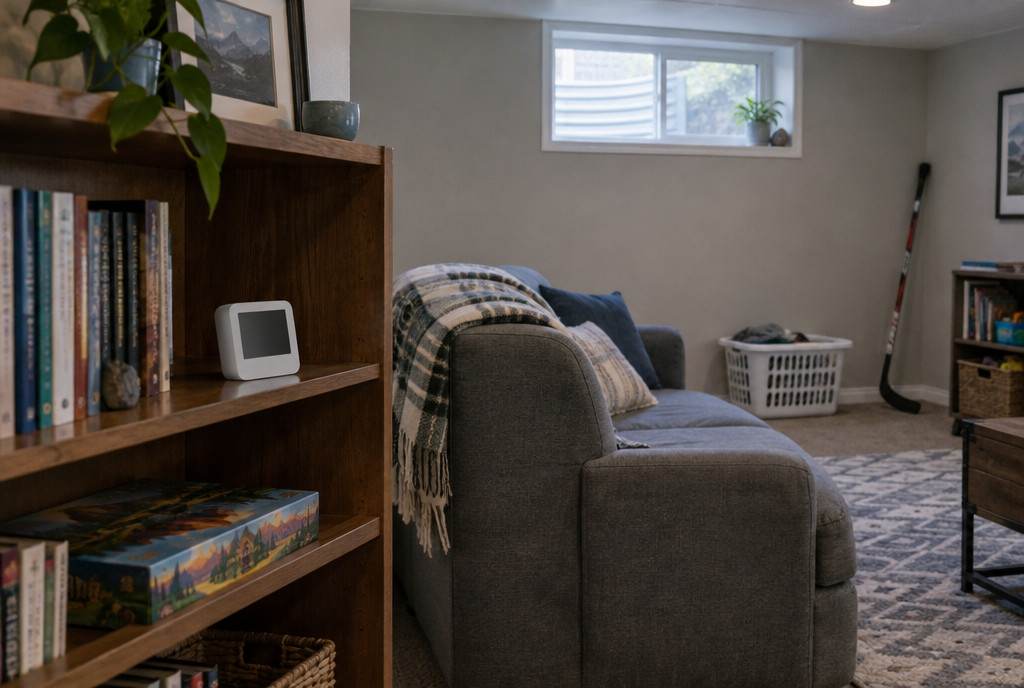
What a radon test tells you
A radon test measures the concentration of radon in your home’s air, reported in picocuries per liter (pCi/L). EPA puts the average indoor level at about 1.3 pCi/L (50 Bq/m³) and outdoor air at about 0.4 pCi/L (15 Bq/m³). Your home can be well above or below that, and EPA says even your county’s radon zone can’t tell you which.
Sources: EPA action level ↗, EPA health risk ↗ · verified October 12, 2026
The EPA numbers
4 pCi/L or more
Fix the home
EPA’s action level. EPA gives the equivalent as 150 Bq/m³; the exact conversion is 148, since 1 pCi/L = 37 Bq/m³.
Source: EPA action level ↗ · verified October 12, 2026
2 to 4 pCi/L
Consider fixing
75 to 150 Bq/m³. Levels below 4 pCi/L still carry some risk, and EPA says most homes today can be brought to 2 pCi/L or below.
Source: EPA action level ↗ · verified October 12, 2026
No known safe level
About 21,000 deaths a year
EPA’s estimate of radon-related lung cancer deaths each year.
Source: EPA health risk ↗ · verified October 12, 2026
How to test, step by step
-
Start with a short-term test
Short-term tests stay in the home 2 to 90 days: charcoal canisters, alpha track, electret ion chamber, continuous monitors and charcoal liquid scintillation. Long-term tests (alpha track, electret) stay more than 90 days and better reflect the year-round average.
-
Put it in the right spot
The lowest lived-in level, in a room you use regularly (not a kitchen or bathroom), at least 20 inches above the floor, away from drafts, heat, humidity and exterior walls.
For a 2- to 3-day test, keep windows and doors closed starting at least 12 hours before, and don’t run it during severe storms or high winds.
-
At 4 pCi/L or higher, test again
Follow up with a long-term test for a better year-round picture, or a second short-term test if you need the answer faster. If the first result was more than twice 4 pCi/L, do the second short-term test right away.
-
Decide
EPA says to fix the home if the long-term result is 4 pCi/L or more, or to consider fixing if the average of the two short-term tests is 4 pCi/L or more.
Source: EPA Citizen’s Guide to Radon ↗ · verified October 12, 2026
What your radon zone means (and doesn’t)
EPA’s Map of Radon Zones, developed in 1993, gives every county a zone based on predicted average indoor radon. It exists to help national, state and local organizations target resources and adopt radon-resistant building codes. EPA says it must not be used to decide whether to test a home: high levels turn up in all three zones.
The zone shown for each metro below is for its principal county; other counties in the same metro can differ. Check yours on EPA’s map page ↗ or the county list ↗.
Zone 1Zone 1 (red), highest potential: predicted average indoor level may be above 4 pCi/L
Zone 2Zone 2 (orange), moderate potential: predicted average 2 to 4 pCi/L
- Baltimore · Baltimore city, MD
- Chicago · Cook County, IL
- Los Angeles · Los Angeles County, CA
- Miami · Miami-Dade County, FL
- Phoenix · Maricopa County, AZ
- Portland · Multnomah County, OR
- Riverside · Riverside County, CA
- San Francisco · San Francisco County, CA
- St. Louis · St. Louis city, MO
- Tampa · Hillsborough County, FL
Zone 3Zone 3 (yellow), low potential: predicted average below 2 pCi/L
- Austin · Travis County, TX
- Boston · Suffolk County, MA
- Charlotte · Mecklenburg County, NC
- Dallas–Fort Worth · Dallas County, TX
- Detroit · Wayne County, MI
- Greater Houston · Harris County, TX
- New York City · New York County, NY
- Orlando · Orange County, FL
- Philadelphia · Philadelphia County, PA
- San Antonio · Bexar County, TX
- San Diego · San Diego County, CA
- Seattle · King County, WA
- Washington, DC · District of Columbia, DC
Sources: EPA radon zone definitions ↗, EPA county list ↗ · verified October 12, 2026
Do it yourself, or hire a certified pro
You can run a short-term test yourself. EPA’s locator lists test kits and professionals; National Radon Program Services at Kansas State University sells discounted kits, and some states give kits away free or at a discount.
For a professional, two national programs certify radon measurement and mitigation pros: the National Radon Proficiency Program (NRPP), accredited by ANAB to ISO/IEC 17024 with renewal every two years, and the National Radon Safety Board (NRSB). EPA requires states that receive indoor radon grants to keep a public list of credentialed providers. Where a state licenses radon work, the state list decides who may legally work there.
Sources: EPA locator ↗, NRPP ↗ · verified October 12, 2026
State licensing rules
Does the state require a license, certification or a named national credential to test or mitigate? Twenty jurisdictions we checked in full:
| State | Credential required? | What the rule says | Source |
|---|---|---|---|
| Arizona | None found | No radon-specific credential found (ELI database through June 2026); ADHS notes contractors are licensed by the Registrar of Contractors and offers free test kits. | Arizona DHS ↗ |
| California | Required | Providers must hold NRPP/NRSB certification and be on CDPH's list (H&S 106750); mitigators also need a CSLB license. More detailNo one may provide radon measurement or mitigation services to the public unless they hold NRPP or NRSB certification and are on CDPH's certified list (Health & Safety Code 106750-106795; certificate copy submitted to CDPH, renewed every 2 years, no state fee). Mitigators must also hold a CSLB contractor license (B, C20, C36 or D64). | California Dept. of Public Health ↗ |
| Colorado | Required | DPO license since July 1, 2022; SB 23-206 radon disclosures for sales and leases. More detailState license (Division of Professions and Occupations, DORA) required for radon measurement and mitigation professionals since July 1, 2022 (C.R.S. 12-165-101 to -113); per AARST, private certification is required to qualify for and keep the license; work must follow ANSI/AARST standards. Exempt: people testing or mitigating a single-family home they own and occupy, or a unit they lease/occupy. | Colorado DORA press release ↗ |
| District of Columbia | Required | NRPP/NRSB certification or EPA proficiency listing required for fee-based testing and mitigation (D.C. Code 28-4201). More detailAnyone conducting radon screening, testing or mitigation for a fee must be listed as proficient by EPA or certified by a Mayor-approved organization (D.C. Code 28-4201); DOEE rules (20 DCMR 3250) require NRPP or NRSB certification. | D.C. Code 28-4201 ↗ |
| Florida | Required | FDOH certification; a radon notice must appear on sale and rental documents (F.S. 404.056). More detailState certification by the Florida Dept. of Health for radon measurement and mitigation businesses and individuals (technicians, specialists); all mitigation must be done by state-certified professionals (F.S. 404.056; F.A.C. 64E-5 Part XII). | Florida Dept. of Health ↗ |
| Georgia | None found | UGA's state radon program says no law requires mitigator certification. | UGA Extension Radon Program ↗ |
| Illinois | Required | IEMA-OHS licensing; Radon Awareness Act disclosure at sale; new homes need passive radon-resistant construction (420 ILCS 52). More detailIEMA-OHS license required to perform radon measurement or mitigation (professional and technician licenses; Radon Industry Licensing Act, 420 ILCS 44; 32 Ill. Adm. Code 422). Active mitigation systems in new homes must be installed by licensed radon contractors (Radon Resistant Construction Act, 420 ILCS 52). | Illinois IEMA-OHS ↗ |
| Maryland | None found | No state license; Environment 8-305 only requires radon testing businesses to use EPA-listed analysis facilities and give written results. | Maryland Code, Environment 8-305 ↗ |
| Massachusetts | None found | MDPH says the Commonwealth does not certify radon professionals and lists NRPP/NRSB-certified ones. | Massachusetts DPH ↗ |
| Michigan | None found | EGLE says radon testers and mitigators are not licensed or regulated in Michigan. | Michigan EGLE ↗ |
| Minnesota | Required | MDH licenses professionals, companies and labs; Radon Awareness Act disclosure at sale. More detailMDH license required for measurement professionals, mitigation professionals, mitigation companies and radon analysis labs (Minnesota Radon Licensing Act, Minn. Stat. 144.4961, signed May 2015); installed systems get an MDH mitigation system tag. | Minnesota Dept. of Health ↗ |
| Missouri | None found | No licensing; HB 2730 (2026), which would have created licensing, died in committee; DHSS recommends NRPP/NRSB professionals and says professionals must test for legal transactions, and offers free kits. | Missouri DHSS ↗ |
| New Jersey | Required | NJDEP certification for all testers and mitigators; sellers must give buyers any radon test results at contract (per ELI). More detailAll radon testing and mitigation businesses and individuals must be certified by NJDEP; only certified individuals or the homeowner may test or mitigate a home (N.J.S.A. 26:2D-70 to -80; N.J.A.C. 7:28-27). Labs are certified under N.J.A.C. 7:18. | New Jersey DEP ↗ |
| New York | None found | NYS DOH says New York does not certify or license radon mitigators; no tester licensing found. | New York State DOH ↗ |
| North Carolina | None found | Voluntary state approval of certifying programs (10A NCAC 15.1801, final May 2025); no individual certification required. | NCDHHS ↗ |
| Oregon | None found | No state license found; OHA lists NRPP/NRSB-certified companies. | Oregon Health Authority ↗ |
| Pennsylvania | Required | DEP certification for testing, mitigation and labs. More detailDEP certification required to place/retrieve radon test devices, to mitigate, and to analyze radon devices received from the public (25 Pa. Code ch. 240). | Pennsylvania DEP ↗ |
| Texas | None found | No state certification requirement (Texas Tech, which now runs the state radon program). | Texas Tech University ↗ |
| Virginia | Required | NRPP/NRSB certification required by statute (Va. Code 32.1-229.01). More detailRadon testers and mitigators must hold current NRSB or NRPP certification to legally test or mitigate (Va. Code 32.1-229.01); per ELI, contractor licensing also has a radon mitigation specialty. | Virginia Dept. of Health ↗ |
| Washington | None found | No state license found; DOH points to NRPP/NRSB search tools (ELI lists no Washington licensing law). | Washington DOH ↗ |
State rules verified October 12, 2026 against the source linked in each row.
Other states with radon credential laws
| State | What the rule says | Source |
|---|---|---|
| Connecticut | Radon mitigators must hold NRPP or NRSB certification and a Home Improvement Contractor registration from the Dept. of Consumer Protection (C.G.S. 20-419 to -420). No state credential for radon testers was found. | Connecticut DPH ↗ |
| Indiana | Anyone doing radon testing, analysis or mitigation in homes must be certified by the Indiana Department of Health (410 IAC 5.1); tester categories: laboratory, primary, secondary; plus mitigator. | Indiana Dept. of Health ↗ |
| Iowa | Iowa HHS certifies radon measurement specialists and laboratories and credentials radon mitigation specialists (Iowa Code 136B; 641 IAC chapters 43 and 44). | Iowa HHS ↗ |
| Kansas | All persons performing radon testing or mitigation must be certified by KDHE (Kansas Radon Certification Act, passed 2010, effective 2011): measurement technicians, mitigation technicians and measurement laboratories. | Kansas KDHE ↗ |
| Kentucky | Radon measurement, mitigation and laboratory businesses/contractors must hold NRPP or NRSB certification (since June 2019) and register with the Kentucky Board of Radon Safety (KRS 309.430-.454; Board created July 2022). | Kentucky Board of Radon Safety ↗ |
| Maine | Radon testers and mitigators must register with Maine DHHS (Radon Registration Act, 22 M.R.S. 771-784; 10-144 CMR ch. 224). | Maine DHHS ↗ |
| Nebraska | Anyone working in a radon occupation must be licensed by DHHS (measurement and mitigation specialists), as must measurement and mitigation businesses (180 NAC 11; Radiation Control Act). | Nebraska DHHS ↗ |
| New Hampshire | Anyone designing or installing airborne radon mitigation systems must hold current NRPP or NRSB certification (RSA 310-A:189-a, effective Jan 1, 2015). No state credential for radon testers was found. | New Hampshire RSA 310-A:189-a ↗ |
| Ohio | Ohio Department of Health licenses radon testers, mitigation specialists and mitigation contractors (ORC 3723.02); per ELI, laboratories are also licensed (ORC 3723; OAC 3701-69). | Ohio Revised Code 3723.02 ↗ |
| Rhode Island | State certification or licensure of radon measurement and mitigation professionals and radon analytical services by RIDOH (R.I. Gen. Laws 23-61; 216-RICR-50-15-2). | Rhode Island DOH ↗ |
| Utah | Installation, repair or replacement of a radon mitigation system must be done by a licensed Utah contractor (SB 163, effective May 12, 2009; Utah Code 58-55-305); DEQ advises also checking for NRPP certification. No testing credential. HB 563 (2026), which would have added radon mitigation training/certification, failed (per a third-party bill tracker). | Utah DEQ ↗ |
| West Virginia | State licenses required for radon testers, mitigation specialists, mitigation contractors and radon laboratories (W. Va. Code 16-34-3). HB 5625 (2026), a Department of Health bill amending the licensing article, was reported from committee Feb 24, 2026; final status not verified. | West Virginia Code 16-34-3 ↗ |
State rules verified October 12, 2026 against the source linked in each row.
Not counted as licensing: Maryland (testing businesses must use EPA-listed analysis labs and give written results, but there’s no state license), Montana (an EPA proficiency exam is needed only to be publicly listed), North Carolina (voluntary approval of certifying bodies) and Delaware (which says it doesn’t certify radon contractors). Missouri’s HB 2730 (2026), which would have licensed radon professionals from 2027, did not pass.
Source: ELI state radon law database (laws through June 2026) ↗ · verified October 12, 2026
Buying or selling a home
EPA’s Home Buyer’s and Seller’s Guide (revised March 2024) accepts three short-term options: two passive tests side by side for at least 48 hours, two back-to-back passive tests of at least 48 hours each, or a continuous monitor for at least 48 hours. Fix the home if the average is 4 pCi/L or more, and take steps to prevent or detect interference with the devices.
Sellers: test before listing, and test the lowest level a buyer might use. Expect buyers to ask for a new test if the last one is more than about two years old or the home has been renovated.
Source: EPA Home Buyer’s and Seller’s Guide ↗ · verified October 12, 2026
No federal radon disclosure rule appeared in the EPA materials reviewed. AARST counted ten states with homebuyer radon awareness-notification laws as of June 2024: Colorado, Delaware, Florida, Illinois, Iowa, Kansas, Minnesota, Montana, New Hampshire and Rhode Island. Some state rules in more detail:
| State | Rule | Source |
|---|---|---|
| Illinois | Radon Awareness Act (420 ILCS 46): sellers give buyers the IEMA pamphlet “Radon Testing Guidelines for Real Estate Transactions” and a signed “Disclosure of Information on Radon Hazards” before the buyer is obligated. No test is required; units on the third floor or higher are exempt. | Illinois Radon Awareness Act, 420 ILCS 46 ↗ |
| Minnesota | Radon Awareness Act: before a purchase agreement, sellers disclose known tests, the most current records, any mitigation system details, a radon warning statement and MDH’s “Radon in Real Estate Transactions.” Testing is not required. | Minnesota Dept. of Health ↗ |
| Colorado | SB 23-206: sales contracts carry a bold radon warning; sellers disclose known results and mitigation and give the CDPHE radon brochure. Landlords make similar pre-lease disclosures. Tenants may void a lease if the landlord fails to disclose, or fails to make a reasonable effort to mitigate within 180 days of a reading of 4 pCi/L or more; from Jan 1, 2026 that right doesn’t apply to leases of one year or less. | Colorado SB 23-206 ↗ |
| Florida | A radon notification statement must appear on at least one sale or rental document (F.S. 404.056). | Environmental Law Institute ↗ |
| New Jersey | Sellers give buyers copies of any radon test results on entering a contract (N.J.S.A. 26:2D-70 et seq., per ELI). | Environmental Law Institute ↗ |
| Maine | Residential rentals had to be tested for radon by 2012, with written notice of results to tenants and mitigation within six months when results are 4 pCi/L or higher. | Maine DHHS ↗ |
| North Dakota | Sellers must disclose known radon information, test results and mitigation in writing (NDCC 47-10-02.2; newly listed in ELI’s June 2026 database). | Environmental Law Institute ↗ |
| Missouri | The state health department says radon professionals must be used for testing tied to legal transactions. | Missouri DHSS ↗ |
| Iowa | HF 2297 (approved May 19, 2026) requires passive radon mitigation in new one- and two-family homes once the building code commissioner adopts the rule. | Iowa Acts 2026, ch. 1124 ↗ |
Sources: AARST notification-law toolkit (June 2024) ↗, ELI radon law database ↗ · verified October 12, 2026
If your level is high
EPA doesn’t publish a price. It says most homes can be fixed for about the same cost as other common home repairs, depending on the home’s size and design and the method needed, and that you should get estimates from several qualified mitigators. A passive system installed during construction costs much less to activate later.
$800 to about $2,500
Typical contractor pricing, averaging about $1,200
From National Radon Program Services (Kansas State University, EPA-funded). It’s an older figure, so treat it as a rough guide.
Source: NRPS, Installing Mitigation ↗ · verified October 12, 2026
Bids under $1,000
A warning sign in Minnesota
Minnesota’s health department warns against unlicensed installers and unusually low bids.
Source: Minnesota Dept. of Health ↗ · verified October 12, 2026
- Hire a mitigator certified by NRPP or NRSB, or licensed by your state where the table above says a credential is required. California, for example, also requires mitigators to hold a contractor license.
- For how homes are fixed, see EPA’s Consumer’s Guide to Radon Reduction ↗.
- Keep every test report. Under EPA’s sales guidance, a buyer may ask for a new test if yours is more than about two years old or the home has been renovated since.
- On a private well? EPA suggests testing well water for radon if your indoor air has radon or you live in a radon-rich area. See the well water guide.
Sources: EPA mitigation cost ↗, EPA Consumer’s Guide to Radon Reduction ↗ · verified October 12, 2026
Common questions
My neighbor tested low. Do I still need to test?
Yes. EPA says every home should be tested. High radon levels turn up in all three of EPA’s radon zones, and EPA says its zone map must not be used to decide whether to test a particular home.
Source: EPA ↗ · verified October 12, 2026
Short-term or long-term test?
EPA’s first step is a short-term test (2 to 90 days). If the result is 4 pCi/L or higher, follow up with a long-term test (more than 90 days, a better picture of the year-round average) or a second short-term test, which is faster. If the first result is more than twice 4 pCi/L, do the second short-term test right away.
Source: EPA ↗ · verified October 12, 2026
Is a reading of 3 pCi/L safe?
EPA says there is no known safe level of radon exposure. It recommends fixing at 4 pCi/L or more and says to consider fixing between 2 and 4 pCi/L, noting that most homes today can be brought down to 2 pCi/L or below.
Source: EPA ↗ · verified October 12, 2026
What does radon mitigation cost?
EPA doesn’t give a dollar figure; it says most homes can be fixed for about the same cost as other common home repairs, depending on the home’s size and design and the method needed. National Radon Program Services at Kansas State University (EPA-funded) puts typical contractor pricing at $800 to about $2,500, averaging about $1,200, an older figure. Minnesota’s health department warns against unlicensed installers and unusually low bids under $1,000.
Sources: EPA ↗, National Radon Program Services ↗, Minnesota Dept. of Health ↗ · verified October 12, 2026
Do I have to disclose radon when I sell?
No federal radon disclosure rule (like the federal lead rule) appeared in the EPA materials we reviewed. AARST counted ten states with homebuyer radon awareness-notification laws as of June 2024: Colorado, Delaware, Florida, Illinois, Iowa, Kansas, Minnesota, Montana, New Hampshire and Rhode Island. Several states add their own rules; see the table on this page.
Source: AARST ↗ · verified October 12, 2026
Sources
Every source below was opened and checked on October 12, 2026. A date in a source’s name is the “last updated” date shown on that page.
- EPA: What is EPA's Action Level for Radon (updated Nov 12, 2025) ↗
- EPA: Health Risk of Radon (updated Jun 24, 2026) ↗
- EPA: A Citizen's Guide to Radon (EPA 402/K-12/002, Dec 2016) ↗
- EPA: Home Buyer's and Seller's Guide to Radon (EPA 402/K-24/001, revised Mar 2024) ↗
- EPA: EPA Map of Radon Zones (updated Aug 17, 2026) ↗
- EPA: Radon Zones Map PDF (zone definitions) ↗
- EPA: Radon zones county list (XLS) ↗
- EPA: Find a Radon Test Kit or Measurement and Mitigation Professional (updated Dec 30, 2025) ↗
- National Radon Program Services (Kansas State Univ.): Test kits ↗
- NRPP: National Radon Proficiency Program (home) ↗
- NRPP: Find a Radon Mitigation or Measurement Professional ↗
- NRSB: Find a Certified Professional ↗
- EPA: How much can a radon mitigation system cost? (updated Sep 16, 2026) ↗
- EPA: Consumer's Guide to Radon Reduction (EPA 402/K-10/005, Dec 2016) ↗
- National Radon Program Services (Kansas State Univ., EPA-funded): Installing Mitigation ↗
- Minnesota Dept. of Health: Radon Mitigation (updated Mar 15, 2023) ↗
- Environmental Law Institute: State IAQ Law Database, Radon Excerpt (laws through June 2026) ↗
- AARST: Homebuyer Awareness-Notification Law Toolkit (June 2024) ↗
- Illinois Radon Awareness Act, 420 ILCS 46 (ILGA) ↗
- Minnesota Dept. of Health: Radon in Real Estate (updated Apr 22, 2025) ↗
- Colorado SB 23-206 (enrolled): radon disclosure in sales and leases ↗
- Maine DHHS: LD 943 Fact Sheet (Public Law Chapter 278, radon) ↗
- Missouri DHSS: Radon ↗
- Iowa Acts 2026, ch. 1124 (HF 2297): passive radon mitigation in new 1-2 family homes ↗
Testing before a sale or a renovation?
Tell us your ZIP code and what you’re planning. A person reads every message and replies with where to find certified radon testers and mitigators in your state.