Energy test guide · verified October 12, 2026
Duct leakage test: measuring the air your ducts lose
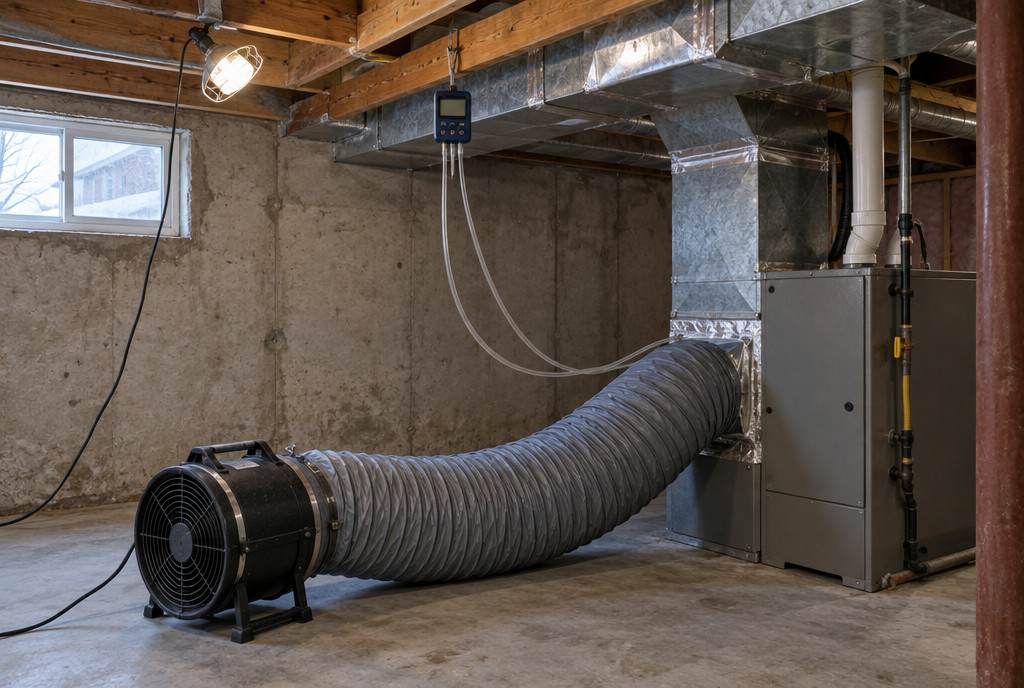
A duct leakage test seals all the registers, pressurizes the duct system to 25 pascals, and measures how much air it takes to hold that pressure. The result, in CFM25, is compared to the home’s conditioned floor area.
Typical cost
Not published
What the number means
The IECC limit is expressed per 100 sq ft of conditioned floor area, tested at 25 pascals (0.1 inch water gauge) at rough-in or after construction, with all registers sealed. ANSI/RESNET/ICC 380 also covers duct airtightness testing.
Example
A 2,000 sq ft home has 20 units of 100 sq ft. At the 2021 IECC limit of 4.0 CFM25 per 100 sq ft, its ducts may leak up to 4.0 × 20 = 80 CFM25 in total.
Sources: DOE BASC, duct leakage tests ↗, RESNET standards ↗ · verified October 12, 2026
The code limits for new homes
| When it’s tested | Maximum |
|---|---|
| After construction, or at rough-in with the air handler installed | 4.0 CFM25 |
| At rough-in without the air handler | 3.0 CFM25 |
| Ducts and air handler entirely inside the thermal envelope (new in 2021) | 8.0 CFM25 |
- The 4.0 limit was unchanged from the 2012 through the 2021 IECC.
- The 2024 IECC moves the limits into a new Table R403.3.6, allowing more leakage for systems with three or more ducted returns, for smaller homes, and for ducts in conditioned space without an air handler at rough-in (6 CFM per 100 sq ft, up from 3). Leakage to outside may be used only on the performance and ERI paths.
- Which edition applies depends on local adoption. DOE issued its 2024 IECC determination on December 20, 2024; state certifications are due December 30, 2026.
Sources: DOE 2021 IECC webinar slides ↗, DOE 2021 determination analysis ↗, DOE 2024 determination analysis ↗, DOE determinations ↗ · verified October 12, 2026
How to get it done
Ask for a duct leakage test by name when you book an energy assessment. HERS raters test ducts under ANSI/RESNET/ICC 380. If new equipment or ducts are in the plan, pair the test with a Manual J load calculation and Manual D duct design.
What it costs: no official source publishes a price for a duct leakage test, so we don’t quote one.
Source: RESNET standards ↗ · verified October 12, 2026
If the ducts leak
- Have the leaks sealed, then retest so you know the number went down.
- If you’re replacing equipment at the same time, make sure the duct work is part of the Manual D design rather than an afterthought.
Common questions
How much leakage does the code allow for my house size?
The 2021 IECC limit is 4.0 CFM25 per 100 sq ft of conditioned floor area, so a 2,000 sq ft home may leak up to 80 CFM25 in total. The limits are written for new construction, and the 2024 IECC adjusts them for some systems and home sizes.
Sources: DOE Building America Solution Center ↗, DOE Building Energy Codes Program ↗ · verified October 12, 2026
Are ducts inside the house exempt from testing?
Not since the 2021 IECC. Ducts and air handlers located entirely inside the thermal envelope must now test at 8.0 CFM25 per 100 sq ft or less, twice the standard rate.
Sources: DOE Building Energy Codes Program ↗, DOE/PNNL ↗ · verified October 12, 2026
What’s the difference between total leakage and leakage to outside?
The IECC test measures total leakage with every register sealed: air escaping anywhere from the duct system. Leakage to outside counts only the air lost outside the home. In the 2024 IECC, leakage to outside may be used only on the performance and ERI paths.
Sources: DOE BECP ↗, DOE/PNNL ↗ · verified October 12, 2026
What does a duct leakage test cost?
No official source publishes a price, so we don’t quote one.
Sources
Every source below was opened and checked on October 12, 2026. A date in a source’s name is the “last updated” date shown on that page.
- DOE Building America Solution Center (PNNL): Duct Leakage Tests ↗
- RESNET: RESNET-ANSI American National Standards (301, 380, 310 editions and compliance dates) ↗
- DOE Building Energy Codes Program: 2021 IECC Residential Webinar slides (Feb 2021) ↗
- DOE BECP: 2021 IECC Residential Webinar transcript (Feb 2021) ↗
- DOE/PNNL: 2021 IECC Final Determination energy savings analysis (TSD, Jul 2021) ↗
- DOE/PNNL: 2024 IECC Determination TSD (Dec 2024) ↗
- DOE BECP: 2024 IECC webinar presentation (Sep 19, 2024) ↗
- DOE BECP: Determinations (2024 IECC determination Dec 20, 2024; state certifications due Dec 30, 2026) ↗
- RESNET: Find a HERS Rater ↗
Rooms that never get warm or cool?
Tell us your ZIP code and what you’re noticing. A person reads every message and replies with certified auditors and HERS raters who test ducts in your area.