Home health test guide · verified October 12, 2026
Well water: nobody tests it but you
About 15 percent of Americans, more than 43 million people, get their water from private wells. The federal Safe Drinking Water Act doesn’t cover those wells, and neither do most states, so making sure the water is safe is up to the owner.
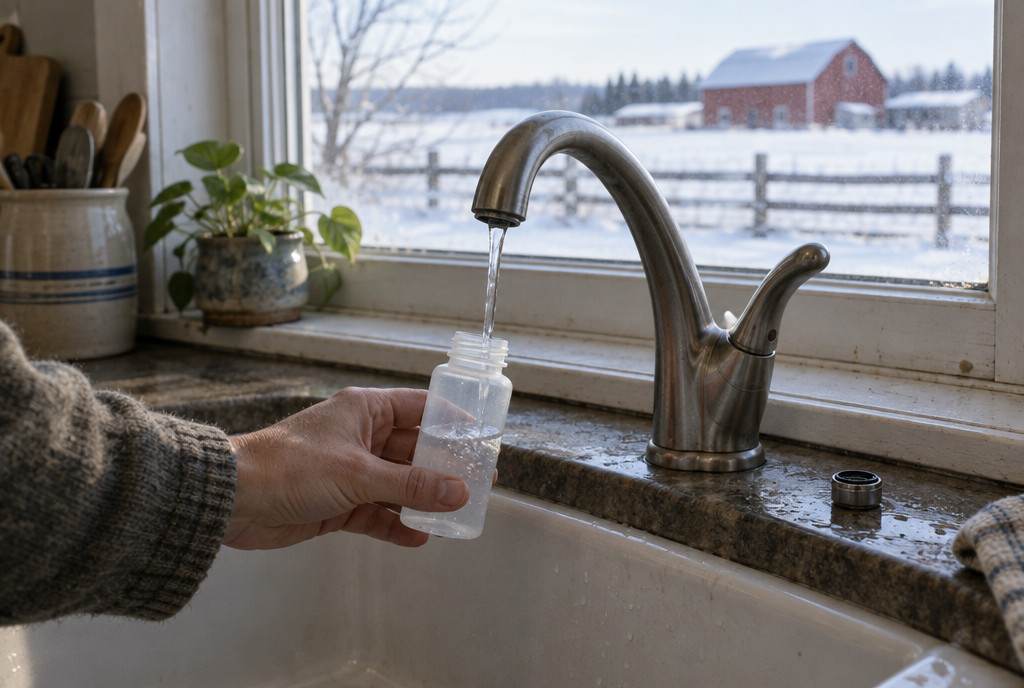
Why private wells need testing
In a USGS study of 2,100 domestic wells, about one in five had at least one contaminant above a human-health benchmark, mostly naturally occurring metals, radionuclides and nitrate. Bacteria turned up in about a third of the roughly 400 wells tested for microbes.
Sources: EPA private wells (updated Aug 25, 2026) ↗, USGS domestic wells ↗ · verified October 12, 2026
The yearly test
-
Every year: four basics
Total coliform bacteria, nitrates, total dissolved solids and pH.
-
More often for some households
If young children, older adults, or someone pregnant or nursing lives in the home.
-
Right away after a change
After flooding, land disturbance, or nearby construction or industrial activity; after repairing or replacing any part of the well system; or if the water’s taste, odor or color changes.
-
Ask what’s common locally
Ask your local health department what is common in local groundwater. Known groundwater problems in the area are another reason to test right away.
Source: EPA, protect your home’s water (updated Feb 26, 2026) ↗ · verified October 12, 2026
When to test for more
| If you have | Test for |
|---|---|
| Recurring stomach illness | Coliform bacteria |
| Lead plumbing or signs of corrosion | pH, lead and copper |
| Radon in your indoor air, or a radon-rich area | Radon |
| Intensive farming nearby | Nitrate, nitrite, pesticides and coliform |
| Mining nearby | Metals and pH |
| Gas drilling nearby | Chloride, sodium, barium and strontium |
| Landfills, gas stations or dry cleaners nearby, or a fuel odor | Volatile organic compounds (VOCs) |
Source: EPA, potential well water contaminants (updated Jul 6, 2026) ↗ · verified October 12, 2026
Arsenic, uranium and PFAS
Arsenic
USGS estimates about 2.1 million people use wells high in arsenic, meaning over 10 µg/L, the limit for public water systems. About 7 percent of drinking-water aquifer wells sampled nationally exceeded it, and about 16 percent in the Southwest. Arsenic is more common in the West, the glacial aquifer system and several eastern and southern aquifers.
Source: USGS, arsenic and drinking water ↗ · verified October 12, 2026
Uranium and other radionuclides
EPA lists uranium among the radionuclides that can occur in wells; radionuclides can harm the kidneys and raise cancer risk. EPA’s pages give no testing interval for arsenic, uranium or PFAS, so ask your local health department whether they’re a concern in your area.
Source: EPA, potential well water contaminants ↗ · verified October 12, 2026
PFAS
EPA’s PFAS limits don’t apply to private wells. For reference, the 2024 public-water limits are 4.0 ppt for PFOA and PFOS and 10 ppt for PFHxS, PFNA and GenX, plus a hazard index for mixtures. EPA said on May 14, 2025 it would keep the PFOA and PFOS limits, and on May 18, 2026 proposed two rules: one lets systems request two more years (to 2031) to comply, and one would rescind the limits for PFHxS, PFNA, GenX and the hazard index. Whether either has been finalized since wasn’t verified.
Source: EPA PFAS drinking water rule (updated May 18, 2026) ↗ · verified October 12, 2026
Finding a certified lab
Use only a lab certified for drinking-water testing. EPA links each state’s lab certification program, and local health departments may test private wells for free. EPA itself does not test home water on request. We don’t quote private lab prices: none came from an official source.
Sources: EPA lab certification contacts (updated Aug 11, 2026) ↗, EPA state programs PDF ↗ · verified October 12, 2026
If a result comes back high
- Ask your local health department what the result means for your household and what to do next.
- After any repair or replacement in the well system, test again; EPA lists that as a time to test.
- If radon shows up in your water or your air, read the radon guide too.
Source: EPA, protect your home’s water ↗ · verified October 12, 2026
Common questions
How often should I test my well?
EPA says every year for total coliform bacteria, nitrates, total dissolved solids and pH, and more often if young children, older adults, or someone pregnant or nursing lives there. Test right away after flooding, land disturbance or nearby construction, after any repair to the well system, or if the water’s taste, odor or color changes.
Source: EPA ↗ · verified October 12, 2026
Will EPA test my water?
No. EPA does not test home water on request. Use a lab certified for drinking-water testing; EPA links each state’s lab certification program. Local health departments may test private wells for free.
Source: EPA ↗ · verified October 12, 2026
Do the federal PFAS limits apply to my well?
No. Private wells fall outside the Safe Drinking Water Act, so EPA’s PFAS limits don’t apply to them. For reference, the 2024 public-water limits are 4.0 parts per trillion for PFOA and PFOS and 10 ppt for PFHxS, PFNA and GenX, plus a mixture hazard index. In May 2026 EPA proposed letting systems request two more years to comply (to 2031) and rescinding the limits for PFHxS, PFNA, GenX and the hazard index; whether either has been finalized wasn’t verified.
Source: EPA ↗ · verified October 12, 2026
Should I test my well for radon?
EPA lists radon in your indoor air, or living in a radon-rich area, as a reason to test well water for radon. Testing the air is a separate test; see the radon guide.
Source: EPA ↗ · verified October 12, 2026
How common are problems in private wells?
In a USGS study of 2,100 domestic wells, about one in five had at least one contaminant above a human-health benchmark, mostly naturally occurring metals, radionuclides and nitrate. Bacteria turned up in about a third of the roughly 400 wells tested for microbes.
Source: USGS ↗ · verified October 12, 2026
Sources
Every source below was opened and checked on October 12, 2026. A date in a source’s name is the “last updated” date shown on that page.
- EPA: Private Drinking Water Wells (updated Aug 25, 2026) ↗
- EPA: Protect Your Home's Water (updated Feb 26, 2026) ↗
- EPA: Potential Well Water Contaminants and Their Impacts (updated Jul 6, 2026) ↗
- EPA: Contact Information for Certification Programs and Certified Laboratories for Drinking Water (updated Aug 11, 2026) ↗
- EPA: State certification programs for drinking water labs (PDF) ↗
- USGS: Domestic (Private) Supply Wells ↗
- USGS: Arsenic and Drinking Water ↗
- EPA: Per- and Polyfluoroalkyl Substances (PFAS) NPDWR (updated May 18, 2026) ↗
Buying or renovating a home on a well?
Tell us your ZIP code and what you’re planning. A person reads every message and replies with where to find certified drinking-water labs and the auditors who serve your area.