Home health test guide · verified October 12, 2026
Carbon monoxide: an alarm on every level, and a check before you seal
CPSC recommends a carbon monoxide alarm on every level of your home and outside sleeping areas, ideally interconnected so that when one sounds, they all do. Most of the states we checked also require alarms in at least some homes, usually those with a fuel-burning appliance, a fireplace or an attached garage.
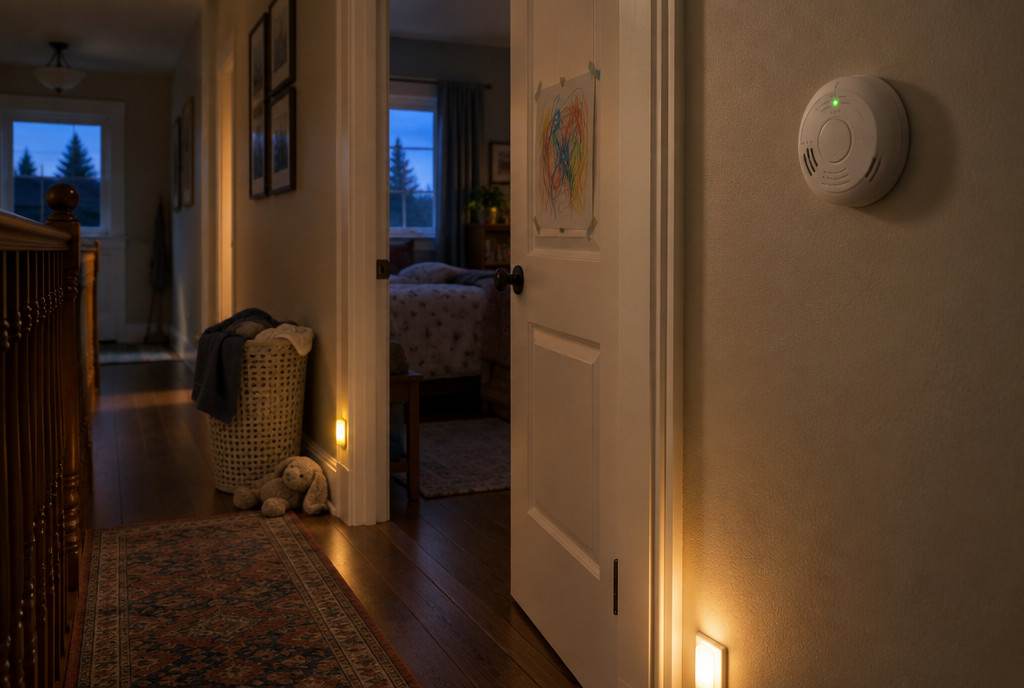
What a CO alarm is built to do
The standard for home CO alarms is UL 2034, and CPSC points consumers to it. Its current edition, Edition 5, was published June 3, 2024 and last revised August 7, 2024. Alarms must sound before CO reaches levels that impair a person’s ability to react, and must resist false alarms from long-term low-level or brief CO, such as air pollution or properly working appliances.
Two limits to know: the test button checks the circuitry, not the accuracy of the sensor, and alarms wear out. Replace yours at the age given in the product literature; CPSC doesn’t set a fixed number of years.
Sources: UL 2034 (Edition 5) ↗, CPSC CO questions and answers ↗ · verified October 12, 2026
Where to put alarms
-
Every level, and outside sleeping areas
Ideally interconnected, so that when one alarm sounds, all of them sound.
-
Keep them clear
Away from heating vents and anywhere furniture or drapes could block them.
-
Not in the kitchen or over an appliance
CPSC doesn’t recommend kitchens or spots above fuel-burning appliances.
-
Pick a power source with a backup
Battery-operated alarms, or plug-in or hard-wired alarms with battery backup.
Source: CPSC CO questions and answers ↗ · verified October 12, 2026
What an energy auditor measures
Auditors working to BPI’s standard check the air for carbon monoxide before they test anything, and act on what they find:
9 to 35 ppm
Advise
The auditor advises checking the sources of CO and ventilating.
36 to 69 ppm
Ventilate and shut off sources
Open the house up and turn off the appliances producing CO.
70 ppm or more
Stop and evacuate
Work stops, everyone leaves, and emergency services are called from outside.
Source: ANSI/BPI-1200-S-2017 ↗ · verified October 12, 2026
The appliance-by-appliance check, measuring spillage and CO under worst-case conditions, is a separate test. See the combustion safety guide.
State CO alarm laws
A “statewide law” here means a state law requires CO alarms in at least some homes: all homes, homes being sold, rentals or new construction. Florida, Georgia and Michigan rules apply mainly to new construction, and Texas’s statute covers only child-care facilities. Some laws require alarms listed to UL 2034 or UL 2075, including North Carolina’s rental law and Michigan’s.
| State | Statewide law? | What the rule says | Source |
|---|---|---|---|
| Arizona | Not confirmed | No statute in NCSL's compilation; not confirmed either way. More detailNo Arizona statute appears in NCSL's compilation (updated Sep 29, 2025), and none was found elsewhere. Local codes may require CO alarms in new construction. Absence not independently confirmed. | NCSL ↗ |
| California | Yes | H&S 17926 covers existing dwellings with CO sources. More detailHealth & Safety Code 17926: owners must install a State Fire Marshal-listed CO device in each existing dwelling unit with a fossil-fuel heater or appliance, fireplace or attached garage, by July 1, 2011 for single-family homes, Jan 1, 2013 for other dwellings and Jan 1, 2017 for hotels and motels. Sellers disclose CO devices on the transfer disclosure form (Civ. Code 1102, per ELI). | Cal. Health & Safety Code 17926 ↗ |
| Colorado | Yes | C.R.S. 38-45 covers sale or transfer of homes with fuel-burning appliances, fireplaces or attached garages, plus new construction (per NCSL). More detailC.R.S. 38-45-101 to -106 (per NCSL): existing single-family homes and multifamily units offered for sale or transfer (on or after a specified date) that have a fuel-burning heater or appliance, fireplace or attached garage must have an operational CO alarm within a specified distance of each sleeping room; a similar rule applies to new residential construction. The statute text was not opened; leg.colorado.gov blocked automated access. | NCSL ↗ |
| District of Columbia | Yes | Owners of new and existing dwellings must install CO detectors (D.C. Code 6-751.02). More detailD.C. Code 6-751.02: the owner of every new and existing occupied dwelling unit must install smoke detectors and carbon monoxide detectors in accordance with the DC Construction Codes. | D.C. Code 6-751.02 ↗ |
| Florida | Yes | F.S. 553.885 covers buildings and additions built on or after July 1, 2008. More detailF.S. 553.885: every building or addition built on or after July 1, 2008 with a fossil-fuel heater or appliance, fireplace, attached garage or other CO source needs an approved CO alarm within 10 feet of each room used for sleeping (hard-wired or battery, or combination smoke/CO). Does not apply to existing homes unless an addition is built. | Florida Statutes 553.885 ↗ |
| Georgia | Yes | State minimum standard code requires CO detectors in new 1-2 family homes and townhomes (new construction only, per NCSL). More detailGeorgia State Minimum Standard One and Two Family Dwelling Code (R313.4.1, R315.2.1, adopted under O.C.G.A. 8-2-20): CO detectors in general sleeping areas of all new one- and two-family homes and townhomes of three stories or less. New construction only. | NCSL ↗ |
| Illinois | Yes | 430 ILCS 135 requires an alarm within 15 ft of sleeping rooms (per NCSL). More detailCarbon Monoxide Alarm Detector Act (430 ILCS 135/10): every dwelling unit must have at least one approved, operating CO alarm within 15 feet of every room used for sleeping; multi-unit structures also need at least one. | NCSL ↗ |
| Maryland | Yes | Public Safety 12-1101 to -1106 covers new fossil-fuel homes (permits from Jan 1, 2008), hotels (2017) and rental units (Apr 1, 2018). More detailPublic Safety 12-1101 to -1106: applies to new dwellings using fossil fuel with building permits issued on or after Jan 1, 2008, and to hotels, rooming houses and rental dwelling units. A CO alarm goes in a central location outside each sleeping area; rental units since April 1, 2018 need alarms outside each sleeping area and on each level including the basement; hotels since April 1, 2017. Per NCSL, sellers of single-family homes must disclose fossil-fuel heating and alarm installation. | Md. Code, Public Safety 12-1104 ↗ |
| Massachusetts | Yes | M.G.L. c.148 s.26F1/2 requires alarms in homes with fossil-fuel equipment or enclosed parking, with a fire department inspection at sale. More detailM.G.L. c.148 s.26F1/2: every residential building with fossil-fuel equipment (furnace, boiler, water heater, fireplace) or enclosed parking must have working, approved CO alarms. Landlords install them and must have them working at the start of each rental. The fire department inspects for compliance on sale or transfer. | Mass. Gen. Laws ch. 148, sec. 26F1/2 ↗ |
| Michigan | Yes | MCL 125.1504f applies through the state code to new construction, permitted renovations and bedroom additions. More detailMCL 125.1504f (effective Mar 23, 2009): the state construction code may require at least one CO device in new single- and multifamily dwellings, renovations needing a permit, and bedroom additions. Devices go near bedrooms, next to an attached garage and next to fuel-burning appliances, and must be listed to ANSI/UL 2034 or UL 2075. The requirement applies through the adopted residential code; it is not a retrofit mandate for existing homes. | Michigan MCL 125.1504f ↗ |
| Minnesota | Yes | Minn. Stat. 299F.51 requires an alarm within 10 ft of each sleeping room in every dwelling. More detailMinn. Stat. 299F.51: every single-family dwelling and every multifamily dwelling unit must have an approved, working CO alarm within 10 feet of each room lawfully used for sleeping. Multifamily owners install and replace alarms between tenancies; occupants maintain them; disabling an alarm is prohibited. | Minn. Stat. 299F.51 ↗ |
| Missouri | Not confirmed | No statute in NCSL's compilation; not confirmed either way. More detailNo Missouri statute appears in NCSL's compilation (updated Sep 29, 2025), and none was found elsewhere. Local ordinances or adopted building codes may apply. Absence not independently confirmed. | NCSL ↗ |
| New Jersey | Yes | Required at initial occupancy or change of occupancy of 1-2 family homes (N.J.S.A. 52:27D-133.3). More detailN.J.S.A. 52:27D-133.3 to -133.5: CO detectors in one- and two-family homes at initial occupancy or change of occupancy (sale or new tenancy); separate statutes cover hotels, multiple dwellings and rooming houses unless no CO hazard exists. Fire Code rules (N.J.A.C. 5:70-4.9(d), 4.19) require CO detection in existing buildings with a fuel-burning appliance or attached garage. | NCSL ↗ |
| New York | Yes | Exec. Law 378(5-a) covers 1-2 family homes, condos/co-ops and multiple dwellings with CO sources or attached garages. More detailExecutive Law 378(5-a): every one- or two-family dwelling, condo or co-op dwelling unit, and multiple dwelling must have an operable CO detector where the unit has CO-emitting appliances, devices or systems, or an attached garage. The statute sets no construction-date cutoff. | N.Y. Executive Law 378 ↗ |
| North Carolina | Yes | G.S. 42-42 requires landlords to provide one alarm per level in units with fossil-fuel sources or attached garages. More detailG.S. 42-42(a)(7): landlords must provide at least one operable CO alarm per rental unit per level in units with a fossil-fuel heater, appliance or fireplace, or an attached garage. Alarms must be listed to ANSI/UL 2034 or 2075, working at the start of each tenancy, and repaired or replaced within 15 days of written notice. Per NCSL, G.S. 143-138 also authorizes State Building Code rules requiring CO detectors in dwelling units with fossil-fuel sources or attached garages. | N.C. Gen. Stat. 42-42 ↗ |
| Oregon | Yes | ORS 105.838 requires alarms at sale or transfer, and ORS 90.317 sets landlord duties. More detailORS 105.836-.842: one- and two-family dwellings and multifamily housing with a CO source (fuel-burning heater, fireplace, appliance or cooking source, or an attached garage) can't be sold or transferred unless working CO alarms cover all sleeping areas; buyers may sue for the greater of actual damages or $250 per unit. ORS 90.317: landlords must provide CO alarms in such units and give written testing instructions; CO alarms are a habitability requirement. | Oregon ORS chapter 105 ↗ |
| Pennsylvania | Yes | Act 121 of 2013 covers seller disclosure and multifamily rentals. More detailAct 121 of 2013 (Carbon Monoxide Alarm Standards Act, effective Dec 18, 2013): on sale of a residential building the seller must disclose CO detector information on the property disclosure statement. Each apartment in a multifamily dwelling with a fossil-fuel heater or appliance, fireplace or attached garage must have an approved, centrally located CO alarm near the bedrooms (owner installs; tenant maintains). Municipalities may adopt stricter rules. | Pennsylvania Carbon Monoxide Alarm Standards Act, Act 121 of 2013 ↗ |
| Texas | Not for homes | Statewide statute covers only child-care facilities (per NCSL); municipal residential code is the 2012 IRC (Loc. Gov't Code 214.212), whose CO section was not verified. More detailNo statewide residential CO-alarm statute found. NCSL lists only Hum. Res. Code 42.060, which requires CO detectors in qualifying day-care centers, group day-care homes and family homes. Municipalities apply the IRC as it existed May 1, 2012 as their residential code (Loc. Gov't Code 214.212); its CO-alarm section was not verified here. | NCSL ↗ |
| Virginia | Yes | Rental standard under the Statewide Fire Prevention Code (per NCSL). More detailPer NCSL: Va. Code 27-94 et seq. and 36-97 et seq. set a statewide standard for installing and maintaining smoke and CO alarms in rental properties under the Statewide Fire Prevention Code. The landlord's annual certification (Va. Code 55.1-1220) covers smoke alarms. The fire-code CO provisions were not opened. | NCSL ↗ |
| Washington | Yes | RCW 19.27.530 covers all residential buildings since Jan 1, 2013, except owner-occupied homes occupied before July 26, 2009, which must be equipped at sale. More detailRCW 19.27.530: CO alarms required in newly built residential occupancies (code by Jan 1, 2011) and all other residential buildings by Jan 1, 2013. Owner-occupied single-family homes legally occupied before July 26, 2009 are exempt, but when one is sold the seller must install CO alarms before the buyer occupies it. | RCW 19.27.530 ↗ |
State rules verified October 12, 2026 against the source linked in each row. Rules marked “per NCSL” come from NCSL’s compilation and were not checked against the statute text.
Source: NCSL CO detector requirements (updated Sep 29, 2025) ↗ · verified October 12, 2026
If an alarm sounds
- Get everyone out to fresh air and call emergency services from outside. It’s the same response BPI’s standard requires of auditors when CO in the air reaches 70 ppm.
- Have a qualified technician find the source before the appliances run again.
- If your home has natural-draft gas, oil or propane appliances and you’re planning air sealing, ask for a combustion safety test as part of the work.
Source: ANSI/BPI-1200-S-2017 ↗ · verified October 12, 2026
Common questions
How many CO alarms do I need?
CPSC recommends a CO alarm on every level of the home and outside sleeping areas, ideally interconnected so that when one sounds, they all sound. Some state laws are more specific: Illinois requires an alarm within 15 feet of every room used for sleeping, Minnesota within 10 feet of each sleeping room, and Florida within 10 feet of each sleeping room in buildings built on or after July 1, 2008 that have a fuel-burning appliance, fireplace, attached garage or other CO source.
Sources: CPSC ↗, Minn. Stat. 299F.51 ↗, Florida Statutes 553.885 ↗ · verified October 12, 2026
Can I put a CO alarm in the kitchen or next to the furnace?
CPSC does not recommend placing CO alarms in kitchens or above fuel-burning appliances. Keep them away from heating vents and anywhere furniture or drapes could block them.
Source: CPSC ↗ · verified October 12, 2026
How often should I replace a CO alarm?
At the replacement age given in the product literature. CPSC doesn’t give a fixed number of years. Pressing the test button checks the alarm’s circuitry, not whether the sensor is still accurate.
Source: CPSC ↗ · verified October 12, 2026
My home is all-electric. Do I need a CO alarm?
CPSC’s recommendation of an alarm on every level isn’t limited to homes with fuel-burning appliances. Most state laws we checked apply to homes with a fuel-burning appliance, a fireplace or an attached garage, but some are broader: Minnesota covers every single-family dwelling, and DC requires CO detectors in every new and existing occupied dwelling.
Sources: CPSC ↗, Minn. Stat. 299F.51 ↗, D.C. Code 6-751.02 ↗ · verified October 12, 2026
Do I need CO alarms to sell my home?
In some states, yes. Oregon homes with a CO source can’t be sold or transferred without working alarms covering sleeping areas; in Washington, sellers of older owner-occupied homes must install alarms before the buyer moves in; Massachusetts fire departments inspect for compliance at sale; New Jersey requires detectors in one- and two-family homes at a change of occupancy. Pennsylvania sellers disclose CO detector information on the property disclosure statement. Check the table on this page for your state.
Sources: Oregon ORS chapter 105 ↗, RCW 19.27.530 ↗, Mass. Gen. Laws ch. 148, sec. 26F1/2 ↗, Pennsylvania Carbon Monoxide Alarm Standards Act, Act 121 of 2013 ↗ · verified October 12, 2026
Sources
Every source below was opened and checked on October 12, 2026. A date in a source’s name is the “last updated” date shown on that page.
- CPSC: Carbon Monoxide Questions and Answers ↗
- UL Standards & Engagement: UL 2034 Single and Multiple Station Carbon Monoxide Alarms (Edition 5) ↗
- ANSI/BPI-1200-S-2017 Standard Practice for Basic Analysis of Buildings ↗
- NCSL: Carbon Monoxide Detector Requirements, Laws and Regulations (updated Sep 29, 2025) ↗
Planning air sealing in a home with gas, oil or propane?
Tell us your ZIP code and what you’re planning. A person reads every message and replies with certified auditors who can run the combustion safety test alongside the work.