Energy test guide · verified October 12, 2026
Attic insulation: what you have, and what ENERGY STAR recommends
ENERGY STAR’s retrofit table sets out how much insulation an existing wood-framed home should have, by climate zone. For an attic with none today, that’s R30 in zone 1 and R60 in zones 4 through 8, a little less if there’s already 3 to 4 inches. Check what’s up there first, and if it’s vermiculite, stop and read EPA’s advice.
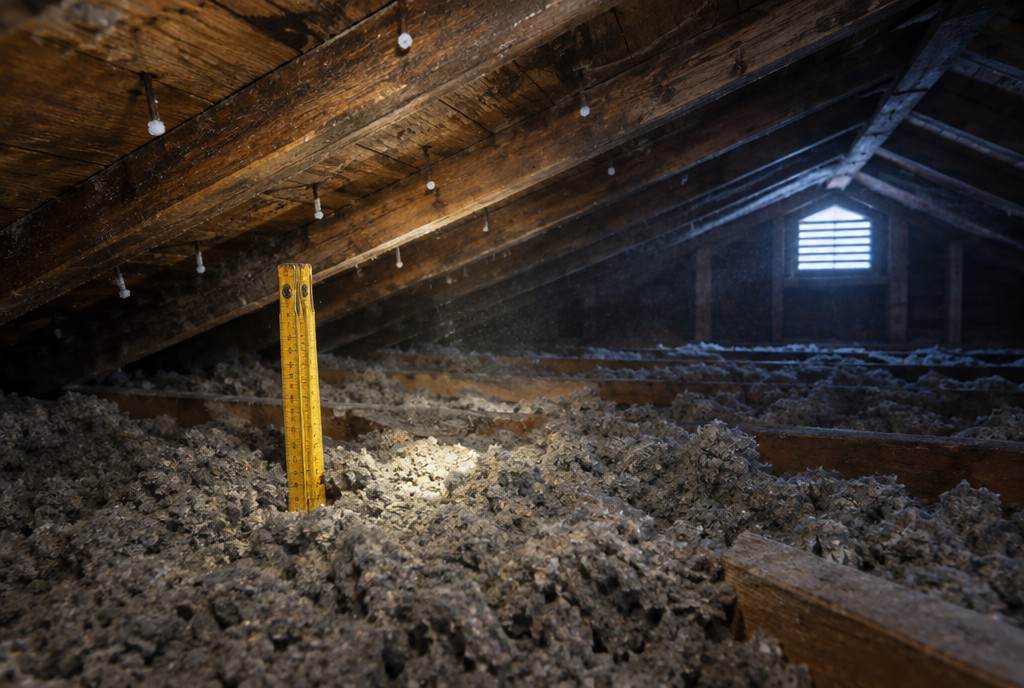
Before you go up there: vermiculite
If your attic has vermiculite insulation, EPA says to assume it may contain asbestos, leave it undisturbed, limit trips into the attic and not try to remove it yourself. See the asbestos and vermiculite guide.
Source: EPA, vermiculite insulation ↗ · verified October 12, 2026
ENERGY STAR’s recommended R-values
For retrofitting existing wood-framed homes, based on 2021 IECC Table R402.1.3. ENERGY STAR groups the zones as 1, 2, 3, 4A/4B, 4C/5/6 and 7/8; the rows below expand those groups. Wall advice applies whenever exterior siding is removed.
| Zone | Attic, none now | Attic, 3–4 in. now | Floor | Walls, when re-siding |
|---|---|---|---|---|
| Zone 1 | R30 | R25 | R13 | When siding is removed on an uninsulated wood-frame wall: blow insulation into the empty cavities (ENERGY STAR lists no added sheathing for zones 1-2) |
| Zone 2 | R49 | R38 | R13 | When re-siding an uninsulated wall: blow insulation into the cavities (no added sheathing listed) |
| Zone 3 | R49 | R38 | R19 | When re-siding an uninsulated wall: blow in cavity insulation plus R5 insulative sheathing; basement/crawlspace walls R5 sheathing or R13 batt |
| Zone 4 | R60 | R49 | R19 (4A and 4B); R30 (4C) | When re-siding: blow in cavity insulation plus R5-R10 insulative sheathing (R10 if the 2x4 wall is already insulated); basement/crawlspace walls R10 sheathing or R13 batt in 4A/4B, R15 sheathing or R19 batt in 4C |
| Zone 5 | R60 | R49 | R30 | When re-siding: blow in cavity insulation plus R5-R10 sheathing (R10 if already insulated); basement/crawlspace walls R15 sheathing or R19 batt |
| Zone 6 | R60 | R49 | R30 | When re-siding: blow in cavity insulation plus R5-R10 sheathing (R10 if already insulated); basement/crawlspace walls R15 sheathing or R19 batt |
| Zone 7 | R60 | R49 | R38 | When re-siding: blow in cavity insulation plus R5-R10 sheathing (R10 if already insulated); basement/crawlspace walls R15 sheathing or R19 batt |
| Zone 8 | R60 | R49 | R38 | When re-siding: blow in cavity insulation plus R5-R10 sheathing (R10 if already insulated); basement/crawlspace walls R15 sheathing or R19 batt |
Source: ENERGY STAR recommended R-values (no last-updated date shown) ↗ · verified October 12, 2026
Find your climate zone
Zones are assigned by county. Each metro below is listed under the 2021 IECC zone of its principal county; suburbs in another county can fall in a different zone. The letter after the number is the moisture regime in DOE/PNNL’s county guide.
Zone 1AR30 attic if uninsulated
Zone 2AR49 attic if uninsulated
Zone 2BR49 attic if uninsulated
Zone 3BR49 attic if uninsulated
Zone 3CR49 attic if uninsulated
Zone 4AR60 attic if uninsulated
Zone 5BR60 attic if uninsulated
Zone 6AR60 attic if uninsulated
Sources: DOE/PNNL climate zones by county (PNNL-33270) ↗, ENERGY STAR R-values ↗ · verified October 12, 2026
How to check, or get it checked
-
Look before you step
From the hatch, see what kind of insulation is there. If it’s vermiculite, stop (see above).
-
Measure the depth
ENERGY STAR’s table splits on whether there’s already 3 to 4 inches of insulation, so a ruler tells you which column applies.
-
Find your zone and target
Match your county’s climate zone to the table above.
-
Have the hidden parts checked
Walls and sloped ceilings are harder to see into. An infrared scan can flag missing insulation; ASTM C1060 says a visual check confirms it.
What it costs: no official source publishes a price for an attic inspection or insulation, so we don’t quote one.
Sources: ENERGY STAR R-values ↗, ASTM C1060 ↗ · verified October 12, 2026
If you’re short of the target
- Plan to bring the attic up to the ENERGY STAR level for your zone.
- If a blower door or infrared scan found leaks at the attic floor, have them sealed before new insulation covers them.
- Air sealing a home with natural-draft gas, oil or propane appliances? DOE calls for combustion appliance zone testing during the work; see the combustion safety guide.
Sources: ENERGY STAR R-values ↗, DOE BASC, CAZ testing ↗ · verified October 12, 2026
Common questions
How much attic insulation do I need?
For an attic with no insulation now, ENERGY STAR’s retrofit table recommends R30 in zone 1, R49 in zones 2 and 3, and R60 in zones 4 to 8. If there’s already 3 to 4 inches, the targets are R25, R38 and R49.
Source: ENERGY STAR ↗ · verified October 12, 2026
What climate zone am I in?
Climate zones are assigned by county. The list on this page gives the IECC 2021 zone for the principal county of 26 large metros, from DOE/PNNL’s county guide; other counties in the same metro can differ. ENERGY STAR’s table runs from zone 1 to zone 8, with higher R-values in the higher-numbered zones.
Source: DOE/PNNL ↗ · verified October 12, 2026
Should I insulate the walls too?
ENERGY STAR’s wall advice applies whenever exterior siding is removed: blow insulation into the empty cavities of an uninsulated wood-frame wall, and in zones 3 through 8 add insulative sheathing as well (R5 in zone 3; R5 to R10 in zones 4 to 8, R10 if the 2x4 wall is already insulated).
Source: ENERGY STAR ↗ · verified October 12, 2026
There’s vermiculite in my attic. Can I add insulation on top?
EPA’s advice is to assume vermiculite may contain asbestos, leave it undisturbed, limit trips into the attic and hire a professional asbestos contractor for any renovation that would disturb it. Talk to one before planning insulation work.
Source: EPA ↗ · verified October 12, 2026
What does an attic insulation check cost?
No official source publishes a price for an attic inspection or for adding insulation, so we don’t quote one.
Sources
Every source below was opened and checked on October 12, 2026. A date in a source’s name is the “last updated” date shown on that page.
- ENERGY STAR: Recommended Home Insulation R-Values ↗
- DOE/PNNL: Guide to Determining Climate Zones by County (PNNL-33270, IECC 2021 zones) ↗
- EPA: Protect Your Family from Asbestos-Contaminated Vermiculite Insulation (updated Apr 17, 2026) ↗
- ASTM C1060-23 Thermographic Inspection of Insulation Installations in Envelope Cavities of Frame Buildings ↗
- DOE Building America Solution Center (PNNL): Combustion Appliance Zone (CAZ) Testing ↗
- DOE Energy Saver: Professional Home Energy Assessments ↗
Planning to top up the attic?
Tell us your ZIP code and the kind of home you have. A person reads every message and replies with certified auditors and the programs that may help pay for insulation in your area.