Specialty test guide · verified October 2, 2026
Well water: the free test rural Ontario keeps forgetting
If your water comes from a private well, nobody is testing it but you. Ontario makes the important half effortless — Public Health Ontario analyzes private well samples for E. coli and total coliforms free of charge — and the discipline is simply doing it regularly, plus a paid chemistry panel every few years for what bacteria tests can't see.
Bacterial test
Free (PHO)
Sample window
Drop off within 24 h
Rhythm
Test often — seasonal
Chemistry panel
$100–$300, private lab
The testing routine
-
Pick up the free kit
Sterile sample bottles come from your nearest Public Health Ontario laboratory, your local health unit, or a designated pickup location — no charge, no appointment.
-
Collect the sample properly
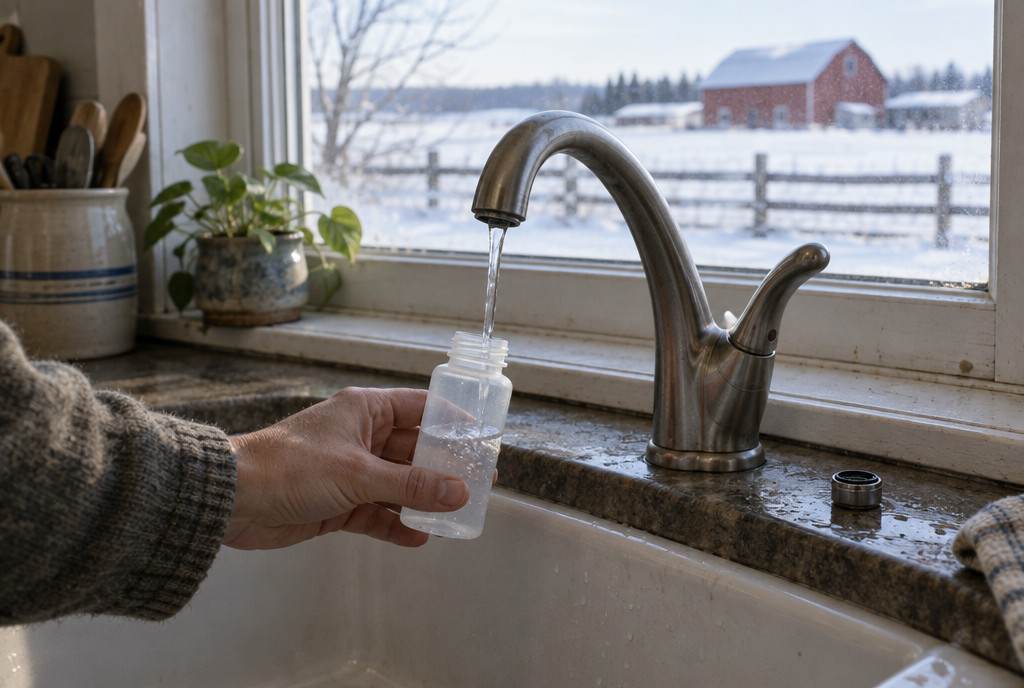
Follow the kit card exactly: a clean tap without an aerator screen if possible, run the cold water a few minutes first, don't rinse the bottle or touch its rim, fill to the line, cap immediately.
-
Get it to a drop-off within 24 hours, kept cool
Public Health Ontario has to test the sample within 48 hours of collection, so aim to drop it off within 24. Keep it in the dark at 2–8 °C, in a cooler with ice packs that don't touch the bottle: frozen samples are refused, and anything that arrives above 25 °C isn't tested. PHO labs take routine samples weekdays 8:30 a.m. to 4:30 p.m., except statutory holidays (and the day before one that falls on a weekday); many health units run local drop-off points with their own hours.
-
Read the result — the target is zero
Safe well water shows no total coliforms and no E. coli. Any detection means investigate: wellhead condition, casing, surface drainage, septic distance. Resample after any fix, and after every spring melt if your well has history.
-
Every few years, pay for the chemistry
An accredited private lab panel for nitrates, arsenic, uranium, sodium, and metals — the free test says nothing about these. Baseline it when you buy or drill, repeat every few years or when taste, colour, or smell changes.
-
Keep every report
A dated file of clean results documents your water the way an EnerGuide label documents your energy — it answers a buyer's hardest rural question before it's asked.
The rural audit connection
Rural retrofits touch the well more than you'd think: the pump is part of your electrical baseload (it shows up in the planner's bill analysis), trenching and grading work near the wellhead can change surface drainage, and a heat pump conversion that frees you from fuel deliveries pairs naturally with getting the water file in order. If you told the planner you're on a well, this test is already in your audit request.
Common questions
How often should I test?
Public Health Ontario's guidance is to test often, because well water quality changes — many Ontario health units suggest a seasonal rhythm along the lines of spring, summer, and fall, and Ontario's well guidance singles out spring snowmelt and heavy-rain periods as the moments contamination sneaks in. Shallow and older dug wells need more frequent checks than deep drilled wells with sound casings. Since the bacterial test is free, frequency costs you only the drive to a drop-off.
My result came back positive for coliforms. Now what?
Stop drinking it untreated (boil or use bottled), resample to rule out collection error, and look for the cause: a damaged or unsealed well cap, casing cracks, surface water pooling at the wellhead, or a nearby septic issue. Shock chlorination plus repairs often clears it — then retest until you have consecutive clean results. Your local health unit will walk you through it; that's literally their job.
Do I need the paid chemistry tests too?
Periodically, yes. The free test covers bacteria only — it says nothing about nitrates (a real concern near farmland), arsenic or uranium (bedrock geology), sodium, fluoride, or metals. Ontario's guidance is to run those through a private accredited lab: a baseline panel when you move in or drill, again every few years, and any time taste, colour, or smell changes. Budget $100–$300 depending on the panel.
Buying a rural home — what should I ask for?
Test before closing (make it a condition), and ask the sellers for their testing history — a documented record of clean results is worth real money, and its absence is worth a question. Include a chemistry panel, not just the free bacterial test, plus a well record: depth, age, casing, and the flow test. Our planner folds the well test into your audit request automatically for rural homes.
Sources
- Public Health Ontario — Well water testing (free service, what's tested, kits & drop-offs) (verified October 2, 2026)
- Public Health Ontario — Drinking water testing for private citizens (48-hour testing rule, 2–8 °C storage, lab hours) (verified October 2, 2026)
- Ontario — Testing and treating private water wells (chemistry via private labs, snowmelt risk, disinfection) (verified October 2, 2026)
Rural home, full picture
Tell us where you are — we'll match you with an advisor who covers the whole rural checklist: envelope, heating, radon, and the well.
Email us what you’re planning, your postal code and the type of building (a house, a duplex or triplex, or a larger multi-unit building) — we’ll reply with registered service organizations for your area and which rebates apply.
Email dave@clickshift.ca