Get your free plan → Six short steps for a home in the San Antonio area: what to fix first, the tests to ask for and the programs open to you. No email.

Texas · #24 metro by population

Home energy audits in San Antonio

Where to get a home energy audit in the San Antonio area, what it costs, which rebates are open now and where Texas stands on the federal Home Energy Rebates. Every program links to its official page and was checked on October 12, 2026.

Metro area: San Antonio-New Braunfels, TX Metropolitan Statistical Area (CBSA 41700; OMB July 2023 delineation: Atascosa, Bandera, Bexar, Comal, Guadalupe, Kendall, Medina and Wilson counties).

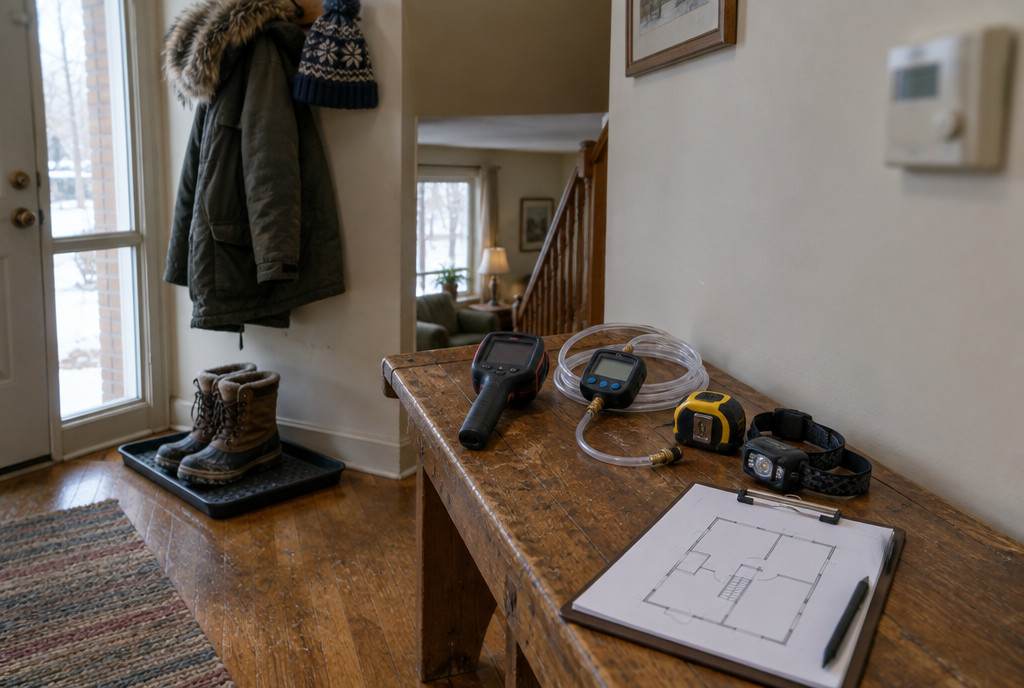
An energy advisor’s kit on a front-hall bench: infrared camera, pressure gauge with tubing, tape measure, headlamp and a floor sketch
Start here Free CPS Energy No-Cost Home Energy Assessment (in-home)
Rebates and incentives open now 7 of 8 1 not open yet or without a posted status
Federal Home Energy Rebates Not open yet What that means here

San Antonio at a glance

Climate zone 2A

IECC 2021 climate zone for Bexar County, TX. PNNL ↗

What it means: Hot and humid climate. Cooling and humidity drive your bills; attic ducts, AC health and outages drive comfort.

Heating and cooling 1,438 HDD · 3,148 CDD

Heating and cooling degree days, base 65°F, 1991–2020 normals at SAN ANTONIO INTL AP, TX US (USW00012921). NOAA ↗

What it means: Cooling far outweighs heating here: summer bills, humidity and attic heat matter more than winter drafts.

Homes 1985 median year built

52.2% of occupied homes are owner-occupied. San Antonio city, Texas, 2020–2024 ACS 5-year. Census ↗

What it means: Homes from the 1980s and 1990s usually have insulation, but ducts, attic air leaks and aging heating and cooling equipment are common audit findings.

Radon EPA zone 3

low potential: predicted average below 2 pCi/L (Bexar County, TX). EPA says not to use the zone to decide whether to test: high levels turn up in all three zones, so test every home. Radon testing guide · EPA ↗

What energy costs here

State Electricity¢ per kWh · July 2026 Natural gas$ per therm · 2025 average Propane$ per gallon · week of Oct 5, 2026
Texas 15.9¢ $1.87 $19.42 per thousand cu ft $3.10

What this means for your bills: Electricity in Texas is cheaper than the US average (15.9¢ against 18.3¢ per kWh), which keeps air conditioning and heat pumps cheaper to run.

  • Electricity: EIA’s average residential price, July 2026 (preliminary; released September 24, 2026). The U.S. average was 18.3¢ per kWh. EIA ↗
  • Natural gas: EIA’s 2025 average residential price per thousand cubic feet, which EIA says includes taxes and delivery, divided by 10.36 therms per thousand cubic feet (EIA’s 2025 average heat content of 1,036 Btu per cubic foot). A full-year average is used because summer months run far higher. EIA ↗
  • Heating oil and propane: EIA’s weekly residential prices, excluding taxes, for the week of October 5, 2026. EIA surveys them only in some states. EIA ↗

Hot and humid Florida, Texas and the Gulf Coast

What homes in San Antonio need

Cooling and humidity drive your bills; attic ducts, AC health and outages drive comfort.

Cooling and humidity drive your bills, and in slab homes the ducts often run through a hot attic. Comfort depends on an AC that is sized right, dries the air and keeps running, plus a house that can ride out outages, storms and the occasional hard freeze. A good audit starts with the ducts, the attic and the AC.

In San Antonio: San Antonio averages about 18 days a year at 100°F or more, plus real freezes. CPS Energy's Casa Verde program offers income-qualified weatherization, including attic insulation, duct sealing, solar screens and AC tune-ups.

What drives bills and comfort here

  • Cooling dominates: about 2,800 to 4,700 cooling degree days a year, and 91 to 124 days at 90°F or more.
  • Humid air: July dew points average 68–74°F, so your AC has to remove moisture as well as heat.
  • Most homes sit on slabs, so ducts and the air handler often run through the hottest space in the house, the attic.
  • Most homes heat with electricity, and long power outages are more common here than nationally.

Local risks to plan for

  • February 2021: the airport stayed below freezing for 4.5 days, and outages left many homes cold.
  • Hail: losses here are high; check roofs and outdoor AC units after storms.
  • Extreme heat: about 122 days a year reach 90°F or more.

What to check first, and why

  1. Fix attic ducts and the air handler

    In slab homes this is often the biggest avoidable loss. Return ducts that pull in hot, humid attic air are a classic problem. Check leakage and insulation, and consider bringing ducts inside.

    Ask your auditor: Ask for a duct leakage test that measures leakage to outside, plus an attic check of duct insulation.

    Duct leakage testAttic inspection

  2. Control humidity, not just temperature

    Keep indoor relative humidity below 60%. An oversized AC short-cycles and leaves moisture behind, and AC breakdowns are the top reason homes here get too hot.

    Ask your auditor: Ask the auditor to log indoor humidity and compare your AC's size to a Manual J load calculation.

    Manual J load calculationMold and humidity check

  3. Cut attic heat: insulation and a radiant barrier

    ENERGY STAR suggests R30 (zone 1) to R49 (zone 2) for an uninsulated attic. A radiant barrier cuts attic heat flow by about 40%, typically 8–12% of cooling costs.

    Ask your auditor: Ask whether a radiant barrier fits your roof, and to seal attic air leaks before adding insulation.

    Attic inspectionInfrared (thermal) scan

  4. Block solar heat at the windows

    Single-pane and aluminum-frame windows are still common in this region. Low-SHGC glass, exterior solar screens and shading cut the heat coming in.

    Ask your auditor: Ask which windows take the most sun, and whether screens or shading would help before replacing windows.

    Infrared (thermal) scan

  5. Plan for outages, storms and freezes

    Long outages are more common here than nationally, from hurricanes, storms and the occasional hard freeze. A tight, well-insulated house holds its temperature longer.

    Ask your auditor: Ask how long your house would hold temperature in an outage, and where pipes could freeze in a hard freeze.

    Blower door test

  6. Check the pool pump, water heater and radon

    About one in six houses in this region has a pool, and its pump is a large, controllable load. Radon turns up in all three EPA zones, so test.

    Ask your auditor: Ask for pool pump and water heater advice, and test for radon; EPA says every home should be tested.

    Radon testEnergy bill analysis

Tests that matter most here

  • Duct leakage test Finds leaks in attic ducts and the air handler, measured as leakage to outside. Best timing: Any time. Do the attic inspection in the morning, before the attic heats up.
  • Blower door test Measures whole-house air leakage. With the house depressurized, an infrared scan shows leaks even at small temperature differences. Best timing: Hot afternoons with the AC on. To image insulation, run the AC a few degrees cooler for about 4 hours first.
  • Mold and humidity check Logging indoor temperature and humidity for several days shows whether your AC removes moisture. Aim for below 60% relative humidity. Best timing: Humid spring or fall days, when the AC runs less and humidity tends to climb.
  • Manual J load calculation A Manual J load calculation checks your AC's size against your house. Some utilities require one for rebates. Best timing: Before replacing your AC or heat pump.
  • Radon test EPA says to test every home, whatever its radon zone. Best timing: With windows and doors closed, before and after air sealing.

Upgrades that usually pay off here

  1. Seal and insulate ducts, or bring them inside. Options include a sealed attic or burying ducts in insulation. In humid climates, buried ducts must first be encapsulated in closed-cell foam to prevent condensation. A sealed attic needs a way to remove moisture.
  2. Right-sized variable-speed AC or heat pump. Sized with Manual J and Manual S, it runs longer, gentler cycles that pull more moisture from the air. Add a dehumidifier only if humidity stays above 60% afterward.
  3. Attic insulation plus a radiant barrier. Attic heat drives your cooling load and heats any ducts up there. A radiant barrier cuts attic heat flow about 40%. Install foil at the roof deck or rafters, not on the attic floor, where dust ruins it.
  4. Solar control at the windows. Low-SHGC glass, exterior solar screens and shading cut solar heat gain. Some utility programs, such as CPS Energy's Casa Verde, fund solar screens.
  5. Heat pump water heater in the garage. It cools and dehumidifies the space around it. It needs a space that stays between 40°F and 90°F.

Heating and cooling equipment

  • Southeast rules: a new split AC must be at least 14.3 SEER2 (13.8 for the largest sizes), based on installation date. EER2 shows efficiency on the hottest afternoons.
  • Heating loads are small, so a heat pump or AC with strip heat covers most winters. Where hard freezes come, check the heat pump's output at 17°F and size the backup heat for a multi-day cold snap.
  • Size with Manual J and Manual S, not a rule of thumb. Oversized systems short-cycle and leave the house humid.
  • Avoid exhaust-only ventilation: it depressurizes the house and pulls in humid outdoor air. Balanced ventilation, such as an ERV, avoids that.

Health and comfort

  • Mold and dust mites thrive in humid air. Keep indoor relative humidity below 60%, ideally 30–50%.
  • Long outages in summer heat are a health risk. Keep portable generators outside, away from windows and doors, because their exhaust contains carbon monoxide.
  • In flood-prone areas, ask the auditor about where your equipment sits and any signs of water intrusion.

Common mistakes in this climate

  • Plastic or vinyl wallpaper on exterior walls. On the inside of exterior walls, plastic or vinyl wallpaper traps moisture that humid outdoor air drives into the wall.
  • Oversized AC or rule-of-thumb sizing. Short cycles leave humidity behind. Insist on a Manual J load calculation.
  • Burying attic ducts without encapsulating them. In humid climates, ducts buried in insulation without closed-cell foam can sweat and drip.
  • Sealing the attic without moisture removal. A sealed attic brings ducts inside the envelope, but it needs a way to remove moisture.

When to book: Book in spring, before peak heat, so fixes are done by summer. Hot afternoons suit infrared, and humid spring or fall days show whether your AC dries the air.

Sources for this climate guide · checked October 26, 2026

Common problems in San Antonio homes

What each one usually means in this climate, the tests that confirm it and the fixes, cheapest first.

Utilities in the San Antonio area

Utility efficiency programs follow the company that delivers your power or gas, so check your bill before you book anything.

Electric

  • CPS Energy City of San Antonio-owned utility (since 1942), which CPS describes as 'the nation's largest municipally owned energy utility providing both natural gas and electric service.' It serves 'more than 996,000 electric and 399,000 natural gas customers in San Antonio and portions of seven adjoining counties' (main body of its About page; the page's meta description gives older figures). CPS sells and delivers power itself and runs its own efficiency plan (STEP). Source ↗

Natural gas

  • CPS Energy (natural gas) Same city-owned utility provides natural gas in San Antonio and parts of adjoining counties. Source ↗

CPS Energy is municipally owned and sells and delivers electricity to its own customers. Under the Public Utility Commission of Texas (PUCT) rules, municipal utilities decide for themselves whether to join Texas retail competition, so the PUCT Power to Choose marketplace and the wires-company efficiency model used in Dallas and Houston do not describe CPS territory. CPS has its own efficiency program, the Sustainable Tomorrow Energy Plan (STEP): a $350 million, 5-year plan authorized by San Antonio City Council Ordinance 2022-06-16-0435 on June 16, 2022. Rebates are paid by CPS (usually as a bill credit or check to the account holder) rather than routed through a wires company. The current rebate forms cover 'program dates: February 1, 2026–January 31, 2027' (labeled PY5). CPS's fiscal year runs Feb 1 to Jan 31. All current STEP residential rebates are for electric measures; no CPS natural-gas appliance rebates were found on its rebate pages. Outlying parts of the 8-county MSA are served by other municipal utilities or electric cooperatives, which aren’t covered in this guide.

How to get a home energy audit in San Antonio

4 programs we track, open ones first. Prices are as each program publishes them. If you want a full diagnostic audit outside these programs, look for a certified auditor: how to find one and what audits cost.

CPS Energy No-Cost Home Energy Assessment (in-home)

CPS Energy (STEP), delivered by a CPS Energy Home Energy Advisor through program implementer CLEAResult

Open Open. Listed 'In stock' at $0 with an active booking flow on 2026-10-12.
Free

Cost, as published $0, described as 'A $150 value'.

Official page ↗ · verified October 12, 2026

Who qualifies
Current CPS Energy residential customers (account holders). An adult 18+ must be present. 'Apartment complexes do not qualify.'
What you get
A 1–2 hour visit identifying energy waste and comfort fixes. Free energy-saving products such as LED bulbs and smart power strips (up to a $125 value). A personalized report with recommendations. Rebates for qualifying improvements through a participating contractor, 'up to $435 for homes with central AC and non-electric heating.' CPS's FY2026 Q4 STEP report says the visit may include installing advanced power strips, faucet aerators, low-flow showerheads, LED lighting and smart thermostats.
How to book
Online at cpsenergy.clearesult.com (verify eligibility, request an appointment, schedule, then 'place order' at $0), or call 210-353-2728.

CPS Energy Virtual Home Energy Assessment

CPS Energy (STEP) via CLEAResult

Open Open (booking flow live 2026-10-12; the page shows both 'In stock' and 'Out Of Stock' labels, so confirm at checkout).
Free Virtual

Official page ↗ · verified October 12, 2026

Who qualifies
Current CPS Energy residential customers; an adult 18+ must video chat with the advisor. Apartment complexes do not qualify.
What you get
Smartphone video walk-through with a CPS Energy advisor after a 15–30 minute pre-assessment call. Free energy-saving products (LEDs, smart power strips, up to $125) are mailed afterward. Personalized report; the same contractor rebate eligibility as the in-home version.
How to book
Online at cpsenergy.clearesult.com/virtual-home-energy-assessment or 210-353-2728.

Casa Verde Weatherization (assessment by a registered Trade Ally)

CPS Energy (STEP)

Unconfirmed The application link is live, but the page states no open/closed or waitlist status.
No cost stated Income-qualified

Cost, as published No participant cost stated. CPS Energy 'will rebate the cost of all eligible upgrades.'

Official page ↗ · verified October 12, 2026

Who qualifies
Income-qualifying homeowners and renters. 2026 gross monthly income limits: 1 person < $2,660; 2 < $3,607; 3 < $4,554; 4 < $5,550; 5 < $6,447; 6 < $7,394; 7 < $8,340; 8 < $9,287; +$947 each additional person. Also qualifies: energy burden of 10%+ of annual income, or receipt of income-based assistance.
What you get
A home assessment by a registered Trade Ally, then upgrades: attic, wall and floor insulation; air infiltration reduction; duct sealing/repair; WiFi smart thermostats; central A/C tune-ups; LED bulbs; low-flow showerheads and aerators; solar screens; window A/C replacement.
How to book
Online application ('Begin application') or paper form; choose a registered Trade Ally. Help line 210-353-CASA (2272).

AACOG Weatherization Assistance Program (Bexar and 10 other Alamo-region counties)

Alamo Area Council of Governments (the local Weatherization Assistance Program provider for Bexar County)

Unconfirmed The page states no waitlist or closure. A 2026 application form is posted, and AACOG lists a Weatherization Program Lunch & Learn on Oct 30, 2026.
Free Income-qualified

Cost, as published 'at no cost to eligible residents'

Official page ↗ · verified October 12, 2026

Who qualifies
Income-eligible households under federal guidelines (no dollar figure on the page); U.S. citizens or eligible resident aliens. The home must be structurally sound (no roof damage or faulty wiring); the Weatherization Assistance Program (WAP) 'does not cover major home repairs.'
What you get
Draft sealing, insulation, duct sealing or heating/cooling replacement, and indoor air quality assessment.
How to book
Complete the 2026 Weatherization Assistance Program (WAP) application PDF, call (210) 362-5282, or email wap@aacog.gov.

Rebates and incentives now

8 offers we track for the San Antonio metro; 7 are open as of October 12, 2026. Many require the program’s own contractor or an audit first, so read the terms before you buy.

Insulation and air sealing 1 open of 1

CPS Energy Attic Insulation Rebate (STEP)

CPS Energy (STEP)

Open Open, program dates Feb 1, 2026 – Jan 31, 2027; file within 30 days of completion.

Official page ↗ · verified October 12, 2026

Amount $0.35/sq ft contractor-installed; $0.25/sq ft self-installed.

Who qualifies CPS residential account holders. Insulation must sit between air-conditioned living space and an unconditioned attic. With more than 24 in. attic clearance: final level at least R-38, existing no greater than R-14. With less clearance: final R-19+, existing no greater than R-11. Garages and other non-living areas don't qualify. Dated itemized receipt required.

Heat pumps 1 open of 1

CPS Energy HVAC Rebates: central A/C, heat pumps, mini-splits (STEP)

CPS Energy (STEP), administered by CLEAResult

Open · limits apply Open for program dates Feb 1, 2026 – Jan 31, 2027 (PY5), first-come, first-served, 'subject to change or cancellation without notice'. Apply within 30 days of installation. Paid as a bill credit (2–3 weeks) or check (8–12 weeks).

Official page ↗ · verified October 12, 2026

Amount Per cooling ton. Early Replacement (working system under 25 yrs for central A/C, under 20 yrs for heat pumps): 13.8–15.1 SEER2 $115; 15.2–16.1 $130; 16.2–17.0 $175; 17.1–19.9 $250; 20.0+ $310. Replace on Burnout: $90; $120; $150; $225; $275 for the same tiers. Rebate cannot exceed project cost.

Who qualifies Residential CPS Energy account holders (single-family up to fourplex; tenants need owner permission). Not available for new homes. One-for-one retrofit installed by a Texas-licensed HVAC contractor. Minimums: A/C 14.3 SEER2/11.7 EER2 (<45,000 BTUh); heat pumps 14.3 SEER2/11.7 EER2/7.5 HSPF2. A permit number is required inside San Antonio city limits.

Appliances and equipment 2 open of 2

CPS Energy Window A/C Rebate (STEP)

CPS Energy (STEP)

Open Open, program dates Feb 1, 2026 – Jan 31, 2027; apply within 30 days.

Official page ↗ · verified October 12, 2026

Amount $50 or $75 per ENERGY STAR room unit depending on size and CEER (e.g., louvered 20,000–27,999 BTU/hr at CEER 12.7: $75).

Who qualifies CPS residential account holders; ENERGY STAR certified unit meeting CEER minimums.

CPS Energy Variable-Speed Pool Pump Rebate (STEP)

CPS Energy (STEP)

Open Open, program dates Feb 1, 2026 – Jan 31, 2027.

Official page ↗ · verified October 12, 2026

Amount '$50/hp, up to $150' (rounded to nearest half hp; not to exceed project cost).

Who qualifies New ENERGY STAR variable-speed pump with 1-year+ warranty, one-for-one replacement. New pools, motor-only swaps and rebuilds excluded.

Income-qualified offers 1 open of 1

City of San Antonio Under 1 Roof: Cool Roofs for High-Heat Areas

City of San Antonio Neighborhood and Housing Services Department

Partly open Restricted. NHSD 'is only accepting Cool Roof appointments from San Antonio homeowners living in an Urban Heat Island Neighborhood'. Processing can take up to 3 months. Not for emergency roof replacement.

Official page ↗ · verified October 12, 2026

Amount '0% interest, forgivable loans' up to $19,000 for energy-efficient cool-roof shingle replacement, with a 5-year restrictive covenant. The loan is forgiven over time while the owner stays; the balance plus interest is due if the owner moves, rents or sells early.

Who qualifies Owner-occupants of single-family homes in a Cool Roofs covered area (Urban Heat Island priority map). Household income at or below 80% AMI (limits updated June 1, 2026). Also requires a homestead exemption, current taxes and mortgage, clear title (liens under $5,000 allowed) and homeowner's insurance. No reverse mortgages.

Other incentives 2 open of 3

CPS Energy Cool Roof Rebate (STEP)

CPS Energy (STEP)

Open Open, program dates Feb 1, 2026 – Jan 31, 2027; file within 30 days.

Official page ↗ · verified October 12, 2026

Amount Per sq ft: low slope, solar reflectance 0.50–<0.70 $0.08, 0.70+ $0.20. High slope, 0.15–<0.50 $0.08, 0.50+ $0.20.

Who qualifies CRRC-listed products; at least 75% of the roof surface replaced; home must have functioning electric A/C and no significant shading.

CPS Energy WiFi Thermostat Rewards (demand response)

CPS Energy (STEP)

Open Open for enrollment ('subject to change without prior notice').

Official page ↗ · verified October 12, 2026

Amount '$85 one-time rebate for each thermostat you enroll' plus 'a $30 bill credit per business or household account' after each summer season while enrolled.

Who qualifies Customers who install and enroll a CPS-approved WiFi thermostat (Google Nest except Gen 1–2, Honeywell Home, ecobee, Sensi, Amazon, etc.) and allow brief adjustments during peak demand. CPS-installed thermostats don't qualify.

CPS Energy High-Performance A/C Tune-up

CPS Energy (STEP)

Unconfirmed Registration form live; ask whether it is open (requires an outdoor temperature of at least 55°F).

Official page ↗ · verified October 12, 2026

Amount 'no-cost High-Performance A/C Tune-up' for qualifiers. The customer pays for a filter if needed, and any recommended repairs are extra and optional.

Who qualifies Residential customers in single-family homes in CPS territory with a working central A/C or heat pump at least one year old. No program tune-up in the past five years. Mini-splits and window units are excluded.

Statewide rebate programs and federal options: rebates and programs.

Heat pumps in San Antonio → What a heat pump costs to run here for cooling and heating, each heat pump rebate with the equipment rule that decides which models qualify, and the certified systems and brands that suit the climate.

Federal Home Energy Rebates in Texas

The two federal rebate programs, HOMES (whole-home efficiency) and the high-efficiency electric home rebates (HEAR, renamed HEEHR in 2026), are run by each state, so availability depends on the state. DOE rewrote the rules effective May 29, 2026 (Program Notice 26-2 ↗): no more federal rebates for switching from gas, oil or propane to electric equipment, and insulation and air sealing come before heating and cooling upgrades unless a home already meets a state-set level.

Status for the San Antonio metro
Not open yet Texas hasn't launched either federal Home Energy Rebate program: HEEHR for electric appliances or HOMES for whole-home upgrades. Official page ↗ verified October 12, 2026

Program: Texas HOMES and HEAR Rebate programs (Home Efficiency Rebates, HOMES; Home Electrification and Appliance Rebates, HEAR)

Run by: Texas Comptroller of Public Accounts, State Energy Conservation Office (SECO). Implementer: APTIM Federal Services, LLC, hired April 2026.

$690 million DOE allocation. HOMES will be open to all incomes; HEAR is limited to households below 150% of AMI. Amounts are not yet set, and HOMES levels are under DOE review. Projects completed before launch are unlikely to qualify. The FAQ says the implementer will work with local partners statewide; no municipal-utility carve-out was described.

StateHEAR / HEEHR (electric appliances)HOMES (whole-home efficiency)
Texas Texas rebate guide
Not open yet not launched (planning and design phase) Official page ↗ verified October 12, 2026

How the programs work: Home Energy Rebates explained · every state’s status.

Help for lower-income households

Weatherization Assistance Program, Bexar County and Alamo region

Alamo Area Council of Governments (AACOG)

Free Weatherization Assistance Program (WAP) for income-eligible residents of Bexar, Atascosa, Bandera, Comal, Guadalupe, Kendall, Medina, Wilson and other Alamo-region counties: sealing, insulation, duct/HVAC work, indoor air quality assessment. (210) 362-5282, wap@aacog.gov. AACOG also runs the Amy Young Barrier Removal grant, Warm Hearts Warm Homes space heaters for people 60+, and Homes for Texas Heroes repairs and weatherization for low-income veterans.

Official page ↗ · verified October 12, 2026

CPS Energy Casa Verde Weatherization

CPS Energy (STEP)

Rebate-funded whole-home weatherization (insulation, air and duct sealing, smart thermostat, A/C tune-up, solar screens and more) for income-qualified homeowners and renters. 2026 limit for one person is under $2,660/month gross. STEP's goal is to weatherize 16,000 homes over 5 years. Phone 210-353-2272.

Official page ↗ · verified October 12, 2026

City of San Antonio Under 1 Roof (cool roofs)

City of San Antonio NHSD

Forgivable 0% loan up to $19,000 for a cool-roof replacement for owner-occupants at or below 80% AMI in Urban Heat Island neighborhoods. NHSD's repair menu also lists Green & Healthy Homes (lead, asthma and fire hazards in pre-1978 homes with young children, at or below 80% AMI), a Minor Repair Loan and a Major Rehab Forgivable Loan.

Official page ↗ · verified October 12, 2026

Bill assistance (CEAP) and community services in Bexar County

Bexar County Department of Community Resources (CEAP); City of San Antonio Department of Human Services (CSBG), per the Texas Department of Housing and Community Affairs (TDHCA)

The Texas Department of Housing and Community Affairs’ (TDHCA) list of local providers routes Comprehensive Energy Assistance Program (utility bill help) for Bexar County to the county's Department of Community Resources. The Weatherization Assistance Program (WAP) goes to AACOG.

Official page ↗ · verified October 12, 2026

Local energy rules

None of the 1 rule we found reaches ordinary homes.

No local mandate found

No energy audit, disclosure-at-sale or private-building benchmarking requirement in San Antonio

Who it applies to Not applicable to homeowners.

We know of no City of San Antonio requirement for home energy audits, disclosure at sale or private-building benchmarking. ACEEE's State & Local Policy Database (non-government; sections last updated Sept 2023) says the city benchmarks its own buildings 'Although a benchmarking policy is not in place,' and reports San Antonio adopted the 2021 IECC effective February 2023 (a new-construction code, not a requirement on existing homes).

Official page ↗ · verified October 12, 2026

Notes worth knowing

  • CPS Energy pays rebates directly to its customers (bill credit or check) and offers a free in-home or virtual energy assessment open to all residential customers, not only low-income ones.
  • CPS Energy 'does not currently offer rebates for residential solar installations'.
  • Its residential solar page still points homeowners to the federal Residential Clean Energy Credit, which the IRS says is not allowed for expenditures after Dec 31, 2025, so that CPS page is out of date.
  • CPS 'Hosted solar' is 'Fully Subscribed'; Community Solar is 'Now Accepting Enrollments'.
  • STEP is a 5-year, $350M plan authorized June 16, 2022.
  • Its current program dates run to Jan 31, 2027, and no successor plan was found on CPS's site.
  • AACOG Weatherization Assistance Program (WAP) waitlist; what follows STEP after its 5-year term.
  • Ask the program whether it is taking applications now.

San Antonio: common questions

How do I get a home energy audit in San Antonio?

Start with CPS Energy No-Cost Home Energy Assessment (in-home). Run by: CPS Energy (STEP), delivered by a CPS Energy Home Energy Advisor through program implementer CLEAResult. Cost: $0, described as 'A $150 value'. Who qualifies: Current CPS Energy residential customers (account holders). An adult 18+ must be present. 'Apartment complexes do not qualify.' How to book: Online at cpsenergy.clearesult.com (verify eligibility, request an appointment, schedule, then 'place order' at $0), or call 210-353-2728. We track 4 audit programs for the San Antonio metro, checked October 12, 2026; all of them are on this page.

Are the federal Home Energy Rebates available in San Antonio?

Texas hasn't launched either federal Home Energy Rebate program: HEEHR for electric appliances or HOMES for whole-home upgrades. Checked October 12, 2026. Nationally, DOE rewrote the rules effective May 29, 2026: federal appliance rebates no longer pay for switching from gas, oil or propane to electric equipment, and homes must get insulation and air sealing before heating and cooling upgrades unless they already meet a state-set level.

Is there help for lower-income households in San Antonio?

Yes. Programs for income-qualified households in the San Antonio metro include Weatherization Assistance Program, Bexar County and Alamo region, CPS Energy Casa Verde Weatherization, City of San Antonio Under 1 Roof (cool roofs) and Bill assistance (CEAP) and community services in Bexar County. Each one’s rules and contacts are listed on this page, with a link to its official page.

Which local energy rules affect homeowners in San Antonio?

None of the local energy rules we track applies to ordinary existing homes. No energy audit, disclosure-at-sale or private-building benchmarking requirement in San Antonio.

Can I claim a federal tax credit for an energy audit in San Antonio?

Not for an audit done in 2026. The federal credit of up to $150 for a home energy audit was part of the Energy Efficient Home Improvement Credit (25C), and the IRS says it can’t be claimed for audits paid for or done after December 31, 2025. Public Law 119-21 ended 25C and the Residential Clean Energy Credit (25D) for 2026 work. An audit done in 2025 is claimed on the 2025 return (Form 5695).

Sources and checks

Every source below was opened and checked on October 12, 2026.

Planning upgrades in San Antonio?

Tell us your ZIP code, the kind of home you have and what you’re planning. A person reads every message and replies with the certified auditors and utility programs that serve your area.

A person replies by email. We don’t sell your details or share them with contractors. See our privacy note.