Energy test guide · verified October 2, 2026

The blower door: one hour that reorders your whole plan

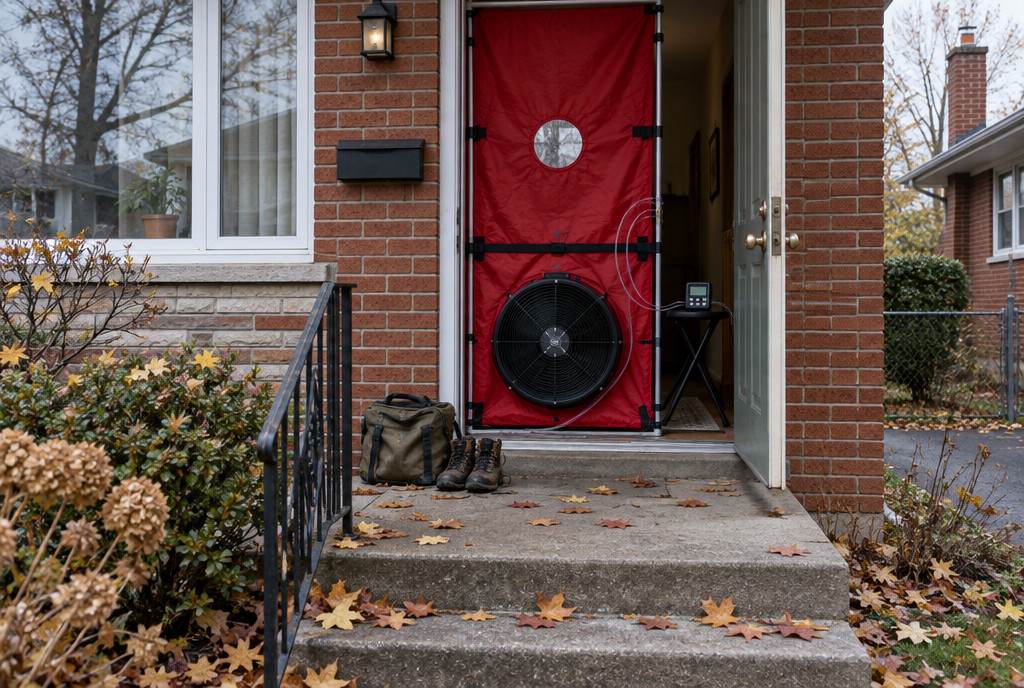
A calibrated fan seals into an exterior door and gently depressurizes your house, measuring exactly how much air leaks through the envelope — and, more usefully, letting you walk the house and feel where. It's the single measurement that separates a real audit from a sales walkthrough, and it's included in every EnerGuide assessment.

A red blower-door panel with a large fan fitted into the front doorway of a brick bungalow, a pressure gauge on a stool inside

Cost

Included in EnerGuide

Time on site

~1 hour

Result

Air changes/hr @ 50 Pa

Fixes start at

$50 DIY sealing

What's involved, start to finish

  1. The setup

    Your advisor mounts a fabric panel with a calibrated fan into an exterior door frame. Windows and doors get closed, fireplace ashes covered, combustion appliances set safely, dampers shut. You can stay home — it's tidy and quiet.

  2. Depressurize to 50 pascals

    The fan pulls air out until the house sits at a standard test pressure — roughly the effect of a stiff wind hitting every side of the house at once. Because the pressure is standardized (the national CGSB test method), your number is comparable to any other home's, and to your own house after upgrades.

  3. Read the number

    The result is air changes per hour at 50 Pa (ACH50): how many times per hour your home's entire air volume leaks out and gets replaced under test pressure. Your EnerGuide report benchmarks it against homes of your era — pre-war houses commonly test several times leakier than new code-built homes.

  4. The leak walk — the most valuable 20 minutes

    While the fan runs, air races in through every gap, and you can find leaks by hand: the attic hatch, rim joists in the basement, pot lights, plumbing stacks, trim, electrical penetrations. Take notes and photos — this is your air-sealing shopping list, ranked by what you can feel.

  5. Retest after the work

    A post-retrofit blower door proves what changed — it's built into the Home Renovation Savings assessment path (pre and post evaluations), and it's the honest scoreboard for any air-sealing money you spend.

How to get it done

You can't rent this result — it takes the calibrated fan and the trained operator, and it comes standard with every EnerGuide assessment. Book the assessment, and tell the advisor you want to do the leak walk with them rather than just receiving the number.

If it finds a problem: your remediation options

A leaky result isn't bad news — it's the cheapest big opportunity in home energy. The options, from smallest to largest:

$50–$300

The DIY sealing weekend

Caulk, low-expansion foam, and weatherstripping applied to the exact leaks you felt during the walk: attic hatch gasket, rim joist gaps, trim, plumbing and wiring penetrations. Dollar for dollar, the best return in home energy.

$500–$2,500

Professional air sealing

Attic-side sealing of top plates, pot lights, stacks and chases — the leaks you can't reach — done properly before any insulation top-up buries them.

Project pricing

Deep envelope measures

Rim-joist spray foam, and airtightness details folded into siding, window, or renovation projects you're doing anyway — the cheap moment to fix the hard leaks.

Two guardrails: after any serious tightening, get the combustion spillage check repeated (a tighter house changes how appliances vent), and retest radon — sealing shifts your pressure balance. A tight house then earns proper ventilation: that's the HRV conversation.

Cost figures are Ontario planning bands as of October 2, 2026 — quotes vary with the house; use them to budget, not to negotiate.

Common questions

What's a good number?

It's era-relative. New homes built to current code land dramatically tighter than pre-war housing, and your EnerGuide report benchmarks your result against comparable homes rather than an absolute pass/fail. The more useful framing: every point of improvement is heat you stop buying, and the leak walk tells you exactly where to earn it.

Is the test safe for my house?

Yes — it's a standard, gentle procedure. Ashes get covered so nothing puffs out of the fireplace, combustion appliances are handled per protocol, and the pressure involved is what a windy day already does to your house. It runs in occupied homes all day, every day.

I already know my house is drafty. Can I skip it?

Knowing it's drafty isn't knowing where, how much, or whether you improved. The measurement is your rebate baseline (the assessment path requires pre and post evaluations), the leak walk is your work plan, and the retest is your proof. Skipping it means sealing blind.

Book the assessment, get the number

Every registered advisor we match runs the blower door as part of the EnerGuide assessment — tell us where you are and we'll connect you.

Email us what you’re planning, your postal code and the type of building (a house, a duplex or triplex, or a larger multi-unit building) — we’ll reply with registered service organizations for your area and which rebates apply.

Email dave@clickshift.ca

This inbox is answered by a person. Participating advisors pay us a referral fee — you pay nothing, and it never affects the directory.