Get your free plan → Six short steps for a home in the Boston area: what to fix first, the tests to ask for and the programs open to you. No email.

Massachusetts · New Hampshire · #11 metro by population

Home energy audits in Boston

Where to get a home energy audit in the Boston area, what it costs, which rebates are open now and where Massachusetts and New Hampshire stand on the federal Home Energy Rebates. Every program links to its official page and was checked on October 12, 2026.

Metro area: Boston-Cambridge-Newton, MA-NH Metropolitan Statistical Area.

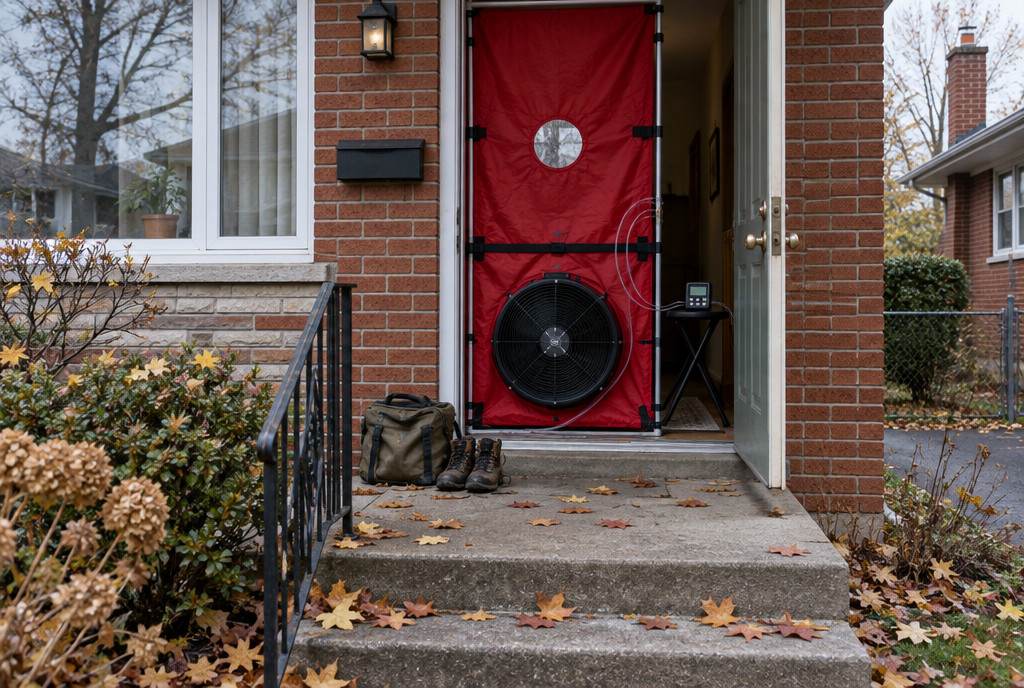
A red blower-door panel with a large fan fitted into the front doorway of a brick bungalow, a pressure gauge on a stool inside
Start here Free Mass Save Home Energy Assessment (virtual or in-person)
Rebates and incentives open now 7 of 8 1 not open yet or without a posted status
Federal Home Energy Rebates Unconfirmed What that means here

Boston at a glance

Climate zone 5A

IECC 2021 climate zone for Suffolk County, MA. PNNL ↗

What it means: Cold and humid climate. Heating drives your bills, and older homes lose heat through attics, walls and basements.

Heating and cooling 5,545 HDD · 802 CDD

Heating and cooling degree days, base 65°F, 1991–2020 normals at BOSTON LOGAN INTL AP, MA US (USW00014739). NOAA ↗

What it means: Long, cold winters drive the bills here: air sealing, insulation and heating efficiency pay back fastest.

Homes 1947 median year built

35.7% of occupied homes are owner-occupied. Boston city, Massachusetts, 2020–2024 ACS 5-year. Census ↗

What it means: Most homes here are old enough that walls may be uninsulated and wiring, lead paint or vermiculite need checking before insulation work; an audit sorts out what to do first.

Radon EPA zone 3

low potential: predicted average below 2 pCi/L (Suffolk County, MA). EPA says not to use the zone to decide whether to test: high levels turn up in all three zones, so test every home. Radon testing guide · EPA ↗

What energy costs here

State Electricity¢ per kWh · July 2026 Natural gas$ per therm · 2025 average Heating oil$ per gallon · week of Oct 5, 2026 Propane$ per gallon · week of Oct 5, 2026
Massachusetts 30.5¢ $2.42 $25.06 per thousand cu ft $6.12 $3.59
New Hampshire 26.6¢ $1.80 $18.61 per thousand cu ft $5.98 $3.95

What this means for your bills: Electricity in Massachusetts costs more than the US average (30.5¢ against 18.3¢ per kWh), so every kWh an upgrade saves is worth more here, and it's worth checking a heat pump's running cost against gas before you switch.

  • Electricity: EIA’s average residential price, July 2026 (preliminary; released September 24, 2026). The U.S. average was 18.3¢ per kWh. EIA ↗
  • Natural gas: EIA’s 2025 average residential price per thousand cubic feet, which EIA says includes taxes and delivery, divided by 10.36 therms per thousand cubic feet (EIA’s 2025 average heat content of 1,036 Btu per cubic foot). A full-year average is used because summer months run far higher. EIA ↗
  • Heating oil and propane: EIA’s weekly residential prices, excluding taxes, for the week of October 5, 2026. EIA surveys them only in some states. EIA ↗

Cold and humid Northeast and Great Lakes

What homes in Boston need

Heating drives your bills, and older homes lose heat through attics, walls and basements.

Heating is the main bill here, and many homes are decades old, with heat escaping through attics, walls and basements. Older houses may need knob-and-tube wiring, vermiculite or lead paint handled before insulation goes in. Air sealing, attic insulation and a combustion safety test are the core of a good audit.

In Boston: Half the homes in Suffolk County (Boston) were built in 1949 or earlier, and about 4 in 10 Boston-area homes heat with boilers, so ductless heat pumps often fit. Mass Save offers no-cost energy assessments, 75–100% off approved insulation and a 0% HEAT Loan.

What drives bills and comfort here

  • Heating dominates: about 5,500 to 6,100 heating degree days a year, against 800 to 1,000 cooling degree days.
  • Old housing: about 7 to 8 in 10 homes in the core counties were built before 1980, many before 1940.
  • Heating systems differ: boilers heat about 4 in 10 Boston-area homes, while furnaces dominate around Chicago and Detroit.
  • Electricity prices vary: about 19 cents/kWh in Illinois, 23 in Michigan and 30 in Massachusetts (August 2026), which shapes heat pump savings.

Local risks to plan for

  • Coastal flooding and nor'easters: FEMA rates coastal-flood and hurricane risk relatively high.
  • Winter: about 49 inches of snow a year at Logan, and 92 nights at or below freezing.
  • Radon: Suffolk is Zone 3, but neighboring Middlesex County is Zone 1.
  • Summer heat: about 14 days a year reach 90°F or more.

What to check first, and why

  1. Seal the attic and wall tops first

    Air leaks into the attic waste heat and cause ice dams. Seal them, then insulate. ENERGY STAR suggests an R-value of R60 for an uninsulated attic in this zone.

    Ask your auditor: Ask for a blower door test with infrared imaging, and a written list of attic bypasses to seal.

    Blower door testInfrared (thermal) scanAttic inspection

  2. Clear old-house hazards before insulating

    Live knob-and-tube wiring and vermiculite or asbestos must be dealt with before insulation goes in. Paid work that disturbs paint in pre-1978 homes must follow EPA lead-safe rules.

    Ask your auditor: Ask the auditor to check for knob-and-tube wiring, vermiculite and old paint before writing the insulation scope.

    Asbestos and vermiculite checkLead paint test

  3. Test fuel-burning appliances for safe venting

    Air sealing can make open-flue appliances spill exhaust when fans run. A combustion safety test catches backdrafting, and EPA guidance calls for CO testing and alarms.

    Ask your auditor: Ask for a combustion safety test before and after air sealing, and keep CO alarms working.

    Combustion safety testCarbon monoxide check

  4. Fix basement water, then seal rim joists

    Most houses here have basements. Rim joists leak air, and any water problem should be fixed before insulation goes on basement walls.

    Ask your auditor: Ask the auditor to check for water entry and to include rim-joist sealing in the plan.

    Infrared (thermal) scanMold and humidity check

  5. Test for radon, whatever your county's zone

    Zones change sharply around these cities. Suffolk and Wayne are Zone 3 and Cook is Zone 2, but Middlesex County, next to Boston, is Zone 1. EPA says test every home.

    Ask your auditor: Test before work starts and again after air sealing.

    Radon test

  6. Check attic ducts added for central AC

    If central AC was added to a radiator-heated house, its ducts may run through the attic. Typical duct systems lose 20–30% of their air through leaks.

    Ask your auditor: Ask for a duct leakage test, and have any attic ducts sealed and insulated.

    Duct leakage test

Tests that matter most here

  • Blower door test Measures total air leakage and guides sealing. Pair it with infrared to find bypasses and rim-joist leaks. Best timing: Winter, on a calm day.
  • Infrared (thermal) scan Finds missing wall insulation, attic bypasses and rim-joist leaks. Best timing: Winter, when it's at least 18°F colder outside for about 4 hours. Avoid walls that just had sun.
  • Combustion safety test Needed whenever air sealing affects natural-draft boilers, furnaces or water heaters. Best timing: Before and after air sealing, in the heating season.
  • Radon test Radon zones vary from county to county here, so test every home. Best timing: Heating season, with the house closed up. Retest after air sealing.
  • Asbestos and vermiculite check Vermiculite and asbestos must be handled before insulating, and accredited professionals should take any samples. Best timing: During the audit walk-through, before the insulation scope is written.

Upgrades that usually pay off here

  1. Air sealing plus attic insulation. Usually the lowest-cost, highest-impact upgrade in older, heating-dominated homes. ENERGY STAR says sealing and insulating can save up to 10% on annual energy bills.
  2. Dense-pack insulation for empty walls. If your older home's walls have no insulation, dense-pack can fill them. Any knob-and-tube wiring has to be cleared first.
  3. Rim joist and basement wall insulation. Rim joists are a big, often-missed air leak in basement homes. Seal them, and insulate basement walls once any water problems are fixed.
  4. Cold-climate heat pumps. Ductless units suit radiator homes, and ducted ones work where ducts exist. They can displace oil, propane or electric resistance heat. In Massachusetts, Mass Save lists up to $8,500 in 2026 equipment rebates. Choose ENERGY STAR cold-climate or NEEP-listed models.
  5. Sealed-combustion heating or a heat pump water heater. When it's time to replace, sealed-combustion equipment cuts spillage risk in a tighter house. A heat pump water heater suits a basement that stays between 40°F and 90°F.

Heating and cooling equipment

  • A cold-climate heat pump is strongly advised around Chicago (6.5 nights a year at or below 0°F) and Detroit (3.6), and recommended in Boston (0.6).
  • Size to the Manual J heating load. A dual-fuel setup, with your furnace as backup, is one way to cover the coldest days.
  • Federal minimums: 13.4 SEER2 for a split AC, and 14.3 SEER2 with 7.5 HSPF2 for a split heat pump. ENERGY STAR's cold-climate tier for ducted models is 8.1 HSPF2.
  • Radiator and steam homes usually have no ducts. Ductless mini-splits avoid new attic ductwork; if you add ducts, keep them inside the insulated part of the house.

Health and comfort

  • Radon zones change sharply between city and suburban counties, so test every home.
  • Homes built before 1978 are more likely to have lead paint, and most homes here were built before 1980. Hire a lead-safe certified firm for paid work that disturbs paint.
  • Wildfire smoke reached the Midwest and Northeast in 2023. MERV 13 filters and portable air cleaners help on smoky days.
  • Keep relative humidity below 60%. Summer basements often need a dehumidifier, and winter window condensation means the air is too humid.

Common mistakes in this climate

  • Insulating over live knob-and-tube wiring. Old wiring, vermiculite and asbestos need to be handled first. Have suspect material sampled by accredited professionals.
  • Air sealing without combustion and ventilation checks. Open-flue appliances risk backdrafting in a tighter house. At 5 ACH50 or tighter, the code calls for whole-house mechanical ventilation.
  • Plastic sheeting over fiberglass on basement walls. Interior poly against below-grade walls with fiberglass batts can trap moisture.
  • Sizing a heat pump on the cooling load. Heating is the bigger load here. Size to the Manual J heating load, not a rule of thumb.

When to book: Book in the heating season: cold weather gives the clearest infrared images, and closed-house conditions suit radon tests. Allow time to clear wiring or vermiculite before insulation.

Sources for this climate guide · checked October 26, 2026

Common problems in Boston homes

What each one usually means in this climate, the tests that confirm it and the fixes, cheapest first.

Utilities in the Boston area

Utility efficiency programs follow the company that delivers your power or gas, so check your bill before you book anything.

Electric

  • Eversource Energy City of Boston, plus Cambridge, Somerville, Brookline, Newton, Waltham, Framingham, Lexington, Arlington, Watertown, Dedham, Milton, Chelsea, Needham, Woburn, Burlington, Natick and Plymouth, per the MA DPU electric service map Source ↗
  • National Grid Electric in Quincy, Malden, Medford, Lynn, Lowell, Everett, Revere, Salem, Brockton, Weymouth, Haverhill, Methuen and Andover, per the MA DPU map Source ↗
  • Municipal Light Plants (e.g., Wellesley, Belmont, Braintree, Peabody) These towns are served by municipal utilities, which are not part of Mass Save. Mass Save's own page says so. Source ↗

Natural gas

  • National Grid (Boston Gas) Most inner-core suburbs, including Brookline, Newton, Quincy, Malden, Medford, Waltham, Lynn, Lexington, Arlington, Watertown, Milton, Everett, Chelsea, Revere, Weymouth and Braintree. The DPU gas map shows the City of Boston itself as 'Multiple Providers'. Source ↗
  • Eversource Energy (NSTAR Gas and EGMA) NSTAR Gas: Cambridge, Framingham, Dedham, Needham, Plymouth. EGMA: Brockton, Methuen, Andover. Boston and Somerville are listed as 'Multiple Providers'. Source ↗

Massachusetts has retail electric choice (state EnergySwitch site) and municipal aggregation. Boston Community Choice Electricity (BCCE) buys supply in bulk for over 200,000 enrolled Boston households and businesses. Its three plans have rates valid through December 2027, and from February 2021 to December 2025 it saved households an average of $150 a year versus Eversource Basic Service. Residents can opt out anytime without fees. Delivery, and therefore Mass Save eligibility, stays with the utility. boston.gov ↗ mass.gov ↗

How to get a home energy audit in Boston

2 programs we track, open ones first. Prices are as each program publishes them. If you want a full diagnostic audit outside these programs, look for a certified auditor: how to find one and what audits cost.

Mass Save Home Energy Assessment (virtual or in-person)

Sponsors of Mass Save (in Boston, Eversource and National Grid), delivered by lead vendors or participating Home Performance Contractors

Open Open. Offers are 'subject to change or cancellation'. This is part of the 2025–2027 Three-Year Plan; the 2028–2030 plan is in public listening sessions in November 2026.
Free

Official page ↗ · verified October 12, 2026

Who qualifies
Residents of 1–4 unit homes served by a Mass Save sponsor. Renters and landlords are also eligible, and 5+ unit buildings go through a multifamily assessment. Municipal-utility customers are not covered.
What you get
An Energy Specialist reviews the home and recommends upgrades, and you get a Decarbonization Report listing the rebates you qualify for. Typical results are 75–100% off approved insulation, no-cost targeted air sealing, equipment rebates based on assessment findings, and access to the 0% HEAT Loan.
How to book
Call 866-527-SAVE (7283), schedule online after entering zip code and heating fuel at masssave.com, or choose a participating Home Performance Contractor. Customers can also skip the assessment and use a Direct Weatherization contractor.

Mass Save Income Eligible Home Energy Assessment (Community Action Programs)

Sponsors of Mass Save through local Community Action Program agencies. ABCD serves Boston, Brookline, Newton and the Mystic Valley communities.

Open
Free Income-qualified

Official page ↗ · verified October 12, 2026

Who qualifies
Income-eligible households in 1–4 unit homes. The 2026–2027 Income Eligible limit shown by Mass Save is ≤ $103,049 for a household of 4, and limits may vary by zip code.
What you get
Assessment plus no-cost insulation and air sealing, replacement of inefficient appliances (refrigerators, freezers, dehumidifiers, window ACs, washers), thermostats, LEDs, water-saving devices and eligible window replacement
How to book
Call 866-537-7267 or contact your local Community Action Program

Rebates and incentives now

8 offers we track for the Boston metro; 7 are open as of October 12, 2026. Many require the program’s own contractor or an audit first, so read the terms before you buy.

Insulation and air sealing 1 open of 1

Mass Save insulation and air sealing (standard, Designated Equity Community, Enhanced)

Sponsors of Mass Save

Open

Official page ↗ · verified October 12, 2026

Amount Standard: 75–100% off approved insulation and no-cost targeted air sealing. Designated Equity Communities: 100% off insulation and air sealing with no income verification. Enhanced (income-verified, 1–4 units): 100% off recommended insulation.

Who qualifies Mass Save customers in 1–4 unit homes, with recommendations from a Home Energy Assessment. The Enhanced tier for a household of 4 is $103,050–$137,399 (2026–2027 season; zip-specific limits may differ).

Heat pumps 1 open of 2

Mass Save air-source heat pump rebates (2026)

Sponsors of Mass Save (Eversource and National Grid in the Boston area)

Open Open for 2026 installs. From October 1, 2026, applications must include the serial number and a nameplate photo of each outdoor unit.

Official page ↗ · verified October 19, 2026

Amount Whole-home: $2,650 per ton, up to $8,500. Partial-home: $1,125 per ton, up to $8,500, plus a $500 weatherization bonus and a $500 sizing bonus where eligible. Basic: $250 per ton, up to $2,500. Income-based enhanced: 'Up to $16,000 or up to no cost through Turnkey Services'. Mass Save has announced lower rates for 2027 installs: whole-home $2,350 per ton and partial-home $1,000 per ton, each up to $7,500.

Who qualifies Residential customers replacing oil, propane or electric resistance heat (electric-account sponsors) or natural gas heat (gas-account sponsors). Equipment must be ENERGY STAR Cold Climate, installed by a Heat Pump Installer Network contractor between January 1 and December 31, 2026. Paperwork is due by February 28, 2027. Whole-home requires sufficient weatherization, and partial-home requires integrated controls. The sizing bonus requires equipment sized to 90–120% of the home's heating load at the outdoor design temperature, using an ACCA Manual J calculation. Enhanced tier requires prior oil, propane or electric resistance heat.

New England Heat Pump Accelerator point-of-sale incentives

State-led regional initiative funded by a federal grant (not Mass Save)

Unconfirmed Ask the program whether it is taking applications now.

Official page ↗ · verified October 12, 2026

Amount Not published

Who qualifies Mass Save says instant incentives 'may also be available through distributors and contractors at the point of sale'. Confirm current amounts with the program before you buy.

Income-qualified offers 2 open of 2

Mass Save Enhanced turnkey services (moderate income)

Sponsors of Mass Save

Open

Official page ↗ · verified October 12, 2026

Amount No-cost weatherization, air-source heat pumps 'for up to no cost' (if heating with electricity, oil or propane), and up to 100% of electrical panel upgrades and pre-weatherization barrier removal

Who qualifies 1–4 unit homes. The Mass Save table for 2026–2027 shows the Enhanced band at $103,050–$137,399 for a household of 4, while the page text says 'a family of four with a household income of $132,000 or less may qualify'. Projects are subject to cost-effectiveness screening.

Seniors Save: heating system repair or replacement

City of Boston (Boston Home Center)

Open Open (page updated 8/27/26)

Official page ↗ · verified October 12, 2026

Amount Up to $12,000 in grants plus in-house contractor support, with 0% deferred loans for remaining costs

Who qualifies Boston homeowners aged 60+ who own and occupy a 1–4 family home, with household income ≤80% AMI (120% in Allston or Brighton), and who are current on property taxes, mortgage and water bills. Not a reimbursement program: already-replaced systems are ineligible.

Financing 3 open of 3

Mass Save HEAT Loan (0% financing)

Sponsors of Mass Save with participating lenders

Open

Official page ↗ · verified October 12, 2026

Amount 0% interest, up to $25,000 total over a customer's lifetime (the maximum effective January 1, 2025)

Who qualifies Mass Save customers financing weatherization, pre-weatherization barriers, ENERGY STAR windows (only alongside completed weatherization), ConnectedSolutions batteries, heat pumps and heat pump water heaters. A Home Energy Assessment is required for certain measures, and lender approval is required.

Boston Home Center Home Repair and Improvement Loan

City of Boston (Mayor's Office of Housing / Boston Home Center)

Open Open (page updated 9/23/26)

Official page ↗ · verified October 12, 2026

Amount Deferred, interest-free loans up to $50,000 with no monthly payments, due on sale, transfer or refinance. One-third is forgiven after 10 years of owner-occupancy. Covers repairs plus 'energy efficiency, weatherization, and decarbonization improvements'.

Who qualifies Boston owner-occupants of 1–4 family homes or condos in associations of 6 units or fewer, with household income ≤135% AMI. Incomes from 120% to 135% AMI require a 50/50 cost share. Financial assets must be under $100,000, though seniors 60+ are exempt from the asset limit.

DOER MLP Z-Loan (municipal-utility towns only)

Massachusetts Department of Energy Resources

Open Launched (press release September 3, 2026); apply at myz-loan.com

Official page ↗ · verified October 12, 2026

Amount Interest-free loans up to $25,000 per homeowner, repaid over up to five years ($9.7 million program)

Who qualifies Homeowners served by a municipal light plant who are not eligible for Mass Save (in this metro, e.g., Wellesley, Belmont, Braintree, Peabody electric customers). A qualifying home energy assessment through Energy New England or NextZero is required first.

Statewide rebate programs and federal options: rebates and programs.

Heat pumps in Boston → What a heat pump costs to run here for cooling and heating, each heat pump rebate with the equipment rule that decides which models qualify, and the certified systems and brands that suit the climate.

Federal Home Energy Rebates in Massachusetts and New Hampshire

The two federal rebate programs, HOMES (whole-home efficiency) and the high-efficiency electric home rebates (HEAR, renamed HEEHR in 2026), are run by each state, so availability depends on the state. DOE rewrote the rules effective May 29, 2026 (Program Notice 26-2 ↗): no more federal rebates for switching from gas, oil or propane to electric equipment, and insulation and air sealing come before heating and cooling upgrades unless a home already meets a state-set level.

Status for the Boston metro
Unconfirmed Massachusetts hasn’t posted a status for the federal Home Energy Rebates on a state page we can link to, so ask the state energy office before you count on them. verified October 12, 2026

Run by: Massachusetts Department of Energy Resources (DOER) would be the state energy office.

None of the DOER, mass.gov or Mass Save pages (energy programs for individuals, Building Decarbonization and Energy Efficiency, Energy Efficiency Programs, The Mass Save Program page updated June 10, 2026) mentions IRA Home Efficiency Rebates or HEAR/HEEHR. The only federally funded heat pump incentive referenced is the New England Heat Pump Accelerator, which is a separate federal grant. Whatever Massachusetts does is subject to DOE Program Notice 26-2 (effective May 29, 2026): no federal rebates for fuel switching, insulation and air sealing first, and launched programs must conform within three months.

StateHEAR / HEEHR (electric appliances)HOMES (whole-home efficiency)
Massachusetts Massachusetts rebate guide
Unconfirmed No status posted by the state. The Building Performance Association’s June 2026 map lists Massachusetts as “Applied & Funds Awarded (not launched)”. verified October 12, 2026
New Hampshire New Hampshire rebate guide
Unconfirmed No status posted by the state. The Building Performance Association’s June 2026 map lists New Hampshire as “Applied & Funds Awarded (not launched)”. verified October 12, 2026

How the programs work: Home Energy Rebates explained · every state’s status.

Help for lower-income households

Weatherization Assistance Program, HEARTWAP heating repair and Fuel Assistance (Boston)

Action for Boston Community Development (ABCD), serving Boston, Brookline, Newton, Malden, Medford, Everett, Melrose, Stoneham, Winchester and Woburn

The Weatherization Assistance Program (WAP) provides attic and wall insulation, weather stripping and air sealing at no cost. HEARTWAP repairs or replaces heating systems, provides no-heat emergency response, and does tune-ups. ABCD administers HEAP fuel assistance, which also unlocks discounted utility rates. Conservation services with Eversource cover LEDs, water measures and replacement of inefficient appliances. All are for income-eligible residents.

Official page ↗ · verified October 12, 2026

Mass Save Income Eligible program

Sponsors of Mass Save through Community Action Program agencies

No-cost assessment, weatherization, appliance replacement and heating help. The 2026–2027 table shows households of 4 at ≤ $103,049. The income-eligible page still shows a 2025–2026 table. Call 866-537-7267.

Official page ↗ · verified October 12, 2026

Mass Save Enhanced (moderate income) turnkey offers

Sponsors of Mass Save

For households above the income-eligible limit up to $137,399 for 4 (2026–2027): 100% off recommended insulation, heat pumps up to no cost if heating with electricity, oil or propane, and panel and barrier-removal help. Income verification at 888-714-3990.

Official page ↗ · verified October 12, 2026

Boston Home Center: Seniors Save and Home Repair and Improvement Loan

City of Boston

Heating-system grants up to $12,000 for seniors (≤80% AMI), and deferred 0% loans up to $50,000 for owner-occupants (≤135% AMI) that can fund weatherization and decarbonization. Call 617-635-4663.

Official page ↗ · verified October 12, 2026

Local energy rules

1 of the 3 rules we found reaches ordinary homeowners in some way; it’s listed first.

New building or permitted work

Massachusetts building energy codes (base, stretch, specialized opt-in)

Who it applies to New construction and permitted work, so it matters to homeowners who build or significantly renovate.

There are three tiers: Base Code (IECC 2021 with MA amendments, 780 CMR), opt-in Stretch Code (225 CMR 22/23), and opt-in Specialized Code (Stretch plus Appendix RC/CC).

Official page ↗ · verified October 12, 2026

Not for ordinary homes

Boston BERDO (Building Emissions Reduction and Disclosure Ordinance)

Who it applies to Residential buildings with 15 or more units, non-residential buildings of 20,000 sq ft or more, and tax parcels whose buildings sum to 20,000 sq ft or 15 units. Owners of single-family homes and small multifamily buildings are not covered. Condo owners in 15+ unit buildings are affected through their association.

Annual energy and water reporting to the City, third-party verification, and emissions standards starting in 2025 or 2030 depending on size, declining to net zero by 2050. 2026 deadlines: October 15 for annual reporting with approved extensions, and October 31 to buy MA Class I RECs through the City's REC Connector.

Official page ↗ · verified October 12, 2026

Not for ordinary homes

Massachusetts Large Building Energy Reporting (LBER)

Who it applies to 'All buildings in the Commonwealth over 20,000 square feet'. Not ordinary homeowners.

Annual reporting under DOER's LBER program. DOER warns that third-party vendors have been sending misleading letters.

Official page ↗ · verified October 12, 2026

Notes worth knowing

  • Mass Save's 2026 heat pump rebates are paid per ton ($2,650/ton whole-home, capped at $8,500).
  • The income-based enhanced tier is up to $16,000.
  • Installs must be in calendar 2026 with paperwork by February 28, 2027, and serial-number photos are required from October 1, 2026.
  • Mass Save has announced lower rates for 2027 installs: $2,350/ton whole-home and $1,000/ton partial-home, each capped at $7,500.
  • The 2025–2027 plan is in effect, and DOER/EEAC listening sessions for the 2028–2030 plan are scheduled for November 10 and 12, 2026, so expect changes for 2028.
  • The state Weatherization Assistance Program (WAP) administrator (ABCD confirms local delivery).
  • The New Hampshire part of the MSA (Rockingham and Strafford counties) isn’t covered in this guide.

Boston: common questions

How do I get a home energy audit in Boston?

Start with Mass Save Home Energy Assessment (virtual or in-person). Run by: Sponsors of Mass Save (in Boston, Eversource and National Grid), delivered by lead vendors or participating Home Performance Contractors. Cost: No cost. Who qualifies: Residents of 1–4 unit homes served by a Mass Save sponsor. Renters and landlords are also eligible, and 5+ unit buildings go through a multifamily assessment. Municipal-utility customers are not covered. How to book: Call 866-527-SAVE (7283), schedule online after entering zip code and heating fuel at masssave.com, or choose a participating Home Performance Contractor. Customers can also skip the assessment and use a Direct Weatherization contractor. We track 2 audit programs for the Boston metro, checked October 12, 2026; all of them are on this page.

Are the federal Home Energy Rebates available in Boston?

Massachusetts hasn’t posted a status for the federal Home Energy Rebates on a state page we can link to, so ask the state energy office before you count on them. Checked October 12, 2026. Nationally, DOE rewrote the rules effective May 29, 2026: federal appliance rebates no longer pay for switching from gas, oil or propane to electric equipment, and homes must get insulation and air sealing before heating and cooling upgrades unless they already meet a state-set level.

Is there help for lower-income households in Boston?

Yes. Programs for income-qualified households in the Boston metro include Weatherization Assistance Program, HEARTWAP heating repair and Fuel Assistance (Boston), Mass Save Income Eligible program, Mass Save Enhanced (moderate income) turnkey offers and Boston Home Center: Seniors Save and Home Repair and Improvement Loan. Each one’s rules and contacts are listed on this page, with a link to its official page.

Which local energy rules affect homeowners in Boston?

None of the local energy rules we track applies to ordinary existing homes. Massachusetts building energy codes (base, stretch, specialized opt-in) applies only to new buildings or permitted work. 2 other rules apply only to larger buildings.

Can I claim a federal tax credit for an energy audit in Boston?

Not for an audit done in 2026. The federal credit of up to $150 for a home energy audit was part of the Energy Efficient Home Improvement Credit (25C), and the IRS says it can’t be claimed for audits paid for or done after December 31, 2025. Public Law 119-21 ended 25C and the Residential Clean Energy Credit (25D) for 2026 work. An audit done in 2025 is claimed on the 2025 return (Form 5695).

Sources and checks

Every source below was opened and checked on October 12, 2026.

Planning upgrades in Boston?

Tell us your ZIP code, the kind of home you have and what you’re planning. A person reads every message and replies with the certified auditors and utility programs that serve your area.

A person replies by email. We don’t sell your details or share them with contractors. See our privacy note.