Get your free plan → Six short steps for a home in the Greater Houston area: what to fix first, the tests to ask for and the programs open to you. No email.

Texas · #5 metro by population

Home energy audits in Greater Houston

Where to get a home energy audit in the Greater Houston area, what it costs, which rebates are open now and where Texas stands on the federal Home Energy Rebates. Every program links to its official page and was checked on October 12, 2026.

Metro area: Houston-Pasadena-The Woodlands, TX Metropolitan Statistical Area (CBSA 26420; OMB July 2023 delineation: Austin, Brazoria, Chambers, Fort Bend, Galveston, Harris, Liberty, Montgomery, San Jacinto and Waller counties).

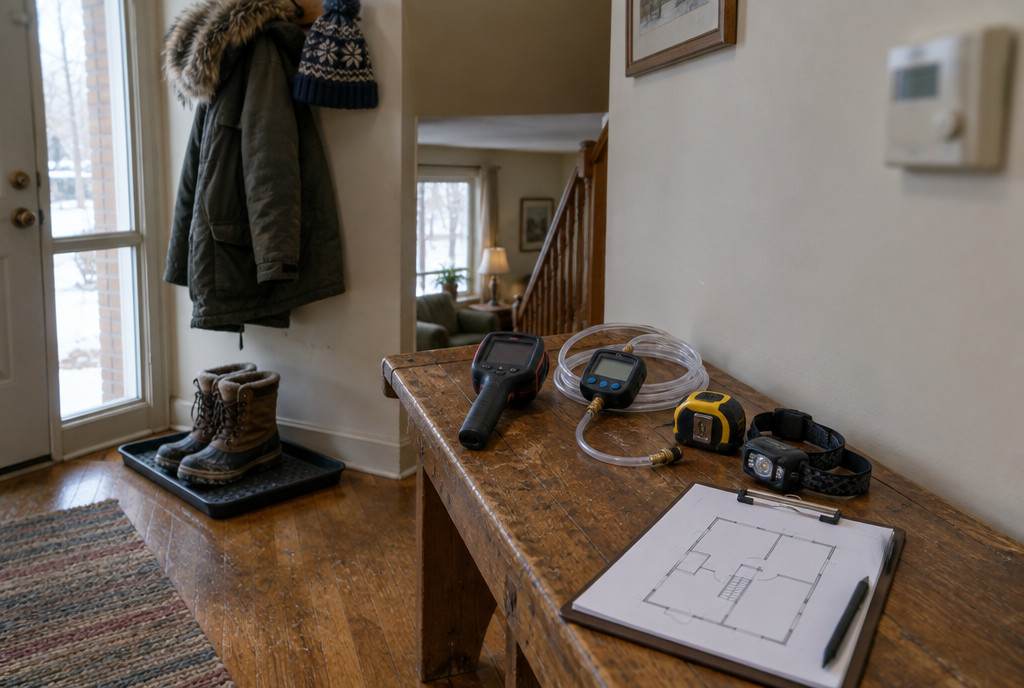
An energy advisor’s kit on a front-hall bench: infrared camera, pressure gauge with tubing, tape measure, headlamp and a floor sketch
Start here Free CenterPoint Energy Agencies in Action (free home energy audit + weatherization) · Income-qualified
Rebates and incentives open now 1 of 7 6 not open yet or without a posted status
Federal Home Energy Rebates Not open yet What that means here

Greater Houston at a glance

Climate zone 2A

IECC 2021 climate zone for Harris County, TX. PNNL ↗

What it means: Hot and humid climate. Cooling and humidity drive your bills; attic ducts, AC health and outages drive comfort.

Heating and cooling 1,266 HDD · 3,288 CDD

Heating and cooling degree days, base 65°F, 1991–2020 normals at HOUSTON INTERCONT AP, TX US (USW00012960). NOAA ↗

What it means: Cooling far outweighs heating here: summer bills, humidity and attic heat matter more than winter drafts.

Homes 1982 median year built

42.1% of occupied homes are owner-occupied. Houston city, Texas, 2020–2024 ACS 5-year. Census ↗

What it means: Homes from the 1980s and 1990s usually have insulation, but ducts, attic air leaks and aging heating and cooling equipment are common audit findings.

Radon EPA zone 3

low potential: predicted average below 2 pCi/L (Harris County, TX). EPA says not to use the zone to decide whether to test: high levels turn up in all three zones, so test every home. Radon testing guide · EPA ↗

What energy costs here

State Electricity¢ per kWh · July 2026 Natural gas$ per therm · 2025 average Propane$ per gallon · week of Oct 5, 2026
Texas 15.9¢ $1.87 $19.42 per thousand cu ft $3.10

What this means for your bills: Electricity in Texas is cheaper than the US average (15.9¢ against 18.3¢ per kWh), which keeps air conditioning and heat pumps cheaper to run.

  • Electricity: EIA’s average residential price, July 2026 (preliminary; released September 24, 2026). The U.S. average was 18.3¢ per kWh. EIA ↗
  • Natural gas: EIA’s 2025 average residential price per thousand cubic feet, which EIA says includes taxes and delivery, divided by 10.36 therms per thousand cubic feet (EIA’s 2025 average heat content of 1,036 Btu per cubic foot). A full-year average is used because summer months run far higher. EIA ↗
  • Heating oil and propane: EIA’s weekly residential prices, excluding taxes, for the week of October 5, 2026. EIA surveys them only in some states. EIA ↗

Hot and humid Florida, Texas and the Gulf Coast

What homes in Greater Houston need

Cooling and humidity drive your bills; attic ducts, AC health and outages drive comfort.

Cooling and humidity drive your bills, and in slab homes the ducts often run through a hot attic. Comfort depends on an AC that is sized right, dries the air and keeps running, plus a house that can ride out outages, storms and the occasional hard freeze. A good audit starts with the ducts, the attic and the AC.

In Greater Houston: Houston combines Gulf humidity (July dew points near 73°F) with hurricanes and flooding. Hurricane Beryl in July 2024 cut power to nearly 3 million Texans, and heat during the outages contributed to deaths, so resilience belongs in your audit.

What drives bills and comfort here

  • Cooling dominates: about 2,800 to 4,700 cooling degree days a year, and 91 to 124 days at 90°F or more.
  • Humid air: July dew points average 68–74°F, so your AC has to remove moisture as well as heat.
  • Most homes sit on slabs, so ducts and the air handler often run through the hottest space in the house, the attic.
  • Most homes heat with electricity, and long power outages are more common here than nationally.

Local risks to plan for

  • Flooding: inland flood losses here are high; ask where your equipment sits.
  • Hurricanes: plan for high winds and long outages.
  • Extreme heat: about 111 days a year reach 90°F, and 7 reach 100°F.
  • Freezes: about 10 nights a year at or below 32°F.

What to check first, and why

  1. Fix attic ducts and the air handler

    In slab homes this is often the biggest avoidable loss. Return ducts that pull in hot, humid attic air are a classic problem. Check leakage and insulation, and consider bringing ducts inside.

    Ask your auditor: Ask for a duct leakage test that measures leakage to outside, plus an attic check of duct insulation.

    Duct leakage testAttic inspection

  2. Control humidity, not just temperature

    Keep indoor relative humidity below 60%. An oversized AC short-cycles and leaves moisture behind, and AC breakdowns are the top reason homes here get too hot.

    Ask your auditor: Ask the auditor to log indoor humidity and compare your AC's size to a Manual J load calculation.

    Manual J load calculationMold and humidity check

  3. Cut attic heat: insulation and a radiant barrier

    ENERGY STAR suggests R30 (zone 1) to R49 (zone 2) for an uninsulated attic. A radiant barrier cuts attic heat flow by about 40%, typically 8–12% of cooling costs.

    Ask your auditor: Ask whether a radiant barrier fits your roof, and to seal attic air leaks before adding insulation.

    Attic inspectionInfrared (thermal) scan

  4. Block solar heat at the windows

    Single-pane and aluminum-frame windows are still common in this region. Low-SHGC glass, exterior solar screens and shading cut the heat coming in.

    Ask your auditor: Ask which windows take the most sun, and whether screens or shading would help before replacing windows.

    Infrared (thermal) scan

  5. Plan for outages, storms and freezes

    Long outages are more common here than nationally, from hurricanes, storms and the occasional hard freeze. A tight, well-insulated house holds its temperature longer.

    Ask your auditor: Ask how long your house would hold temperature in an outage, and where pipes could freeze in a hard freeze.

    Blower door test

  6. Check the pool pump, water heater and radon

    About one in six houses in this region has a pool, and its pump is a large, controllable load. Radon turns up in all three EPA zones, so test.

    Ask your auditor: Ask for pool pump and water heater advice, and test for radon; EPA says every home should be tested.

    Radon testEnergy bill analysis

Tests that matter most here

  • Duct leakage test Finds leaks in attic ducts and the air handler, measured as leakage to outside. Best timing: Any time. Do the attic inspection in the morning, before the attic heats up.
  • Blower door test Measures whole-house air leakage. With the house depressurized, an infrared scan shows leaks even at small temperature differences. Best timing: Hot afternoons with the AC on. To image insulation, run the AC a few degrees cooler for about 4 hours first.
  • Mold and humidity check Logging indoor temperature and humidity for several days shows whether your AC removes moisture. Aim for below 60% relative humidity. Best timing: Humid spring or fall days, when the AC runs less and humidity tends to climb.
  • Manual J load calculation A Manual J load calculation checks your AC's size against your house. Some utilities require one for rebates. Best timing: Before replacing your AC or heat pump.
  • Radon test EPA says to test every home, whatever its radon zone. Best timing: With windows and doors closed, before and after air sealing.

Upgrades that usually pay off here

  1. Seal and insulate ducts, or bring them inside. Options include a sealed attic or burying ducts in insulation. In humid climates, buried ducts must first be encapsulated in closed-cell foam to prevent condensation. A sealed attic needs a way to remove moisture.
  2. Right-sized variable-speed AC or heat pump. Sized with Manual J and Manual S, it runs longer, gentler cycles that pull more moisture from the air. Add a dehumidifier only if humidity stays above 60% afterward.
  3. Attic insulation plus a radiant barrier. Attic heat drives your cooling load and heats any ducts up there. A radiant barrier cuts attic heat flow about 40%. Install foil at the roof deck or rafters, not on the attic floor, where dust ruins it.
  4. Solar control at the windows. Low-SHGC glass, exterior solar screens and shading cut solar heat gain. Some utility programs, such as CPS Energy's Casa Verde, fund solar screens.
  5. Heat pump water heater in the garage. It cools and dehumidifies the space around it. It needs a space that stays between 40°F and 90°F.

Heating and cooling equipment

  • Southeast rules: a new split AC must be at least 14.3 SEER2 (13.8 for the largest sizes), based on installation date. EER2 shows efficiency on the hottest afternoons.
  • Heating loads are small, so a heat pump or AC with strip heat covers most winters. Where hard freezes come, check the heat pump's output at 17°F and size the backup heat for a multi-day cold snap.
  • Size with Manual J and Manual S, not a rule of thumb. Oversized systems short-cycle and leave the house humid.
  • Avoid exhaust-only ventilation: it depressurizes the house and pulls in humid outdoor air. Balanced ventilation, such as an ERV, avoids that.

Health and comfort

  • Mold and dust mites thrive in humid air. Keep indoor relative humidity below 60%, ideally 30–50%.
  • Long outages in summer heat are a health risk. Keep portable generators outside, away from windows and doors, because their exhaust contains carbon monoxide.
  • In flood-prone areas, ask the auditor about where your equipment sits and any signs of water intrusion.

Common mistakes in this climate

  • Plastic or vinyl wallpaper on exterior walls. On the inside of exterior walls, plastic or vinyl wallpaper traps moisture that humid outdoor air drives into the wall.
  • Oversized AC or rule-of-thumb sizing. Short cycles leave humidity behind. Insist on a Manual J load calculation.
  • Burying attic ducts without encapsulating them. In humid climates, ducts buried in insulation without closed-cell foam can sweat and drip.
  • Sealing the attic without moisture removal. A sealed attic brings ducts inside the envelope, but it needs a way to remove moisture.

When to book: Book in spring, before peak heat, so fixes are done by summer. Hot afternoons suit infrared, and humid spring or fall days show whether your AC dries the air.

Sources for this climate guide · checked October 26, 2026

Common problems in Greater Houston homes

What each one usually means in this climate, the tests that confirm it and the fixes, cheapest first.

Utilities in the Greater Houston area

Utility efficiency programs follow the company that delivers your power or gas, so check your bill before you book anything.

Electric

  • CenterPoint Energy Houston Electric Regulated transmission and distribution utility (wires company) for the Greater Houston area. Its delivery charges are billed through competitive retailers. It runs the PUCT-required residential efficiency programs in its Houston Electric service territory, paying incentives through participating contractors and agencies. Source ↗
  • Retail electric providers (REPs), chosen by the customer Households in CenterPoint's area buy electricity from a competitive retailer; offers are compared on Power to Choose, the Public Utility Commission of Texas’ (PUCT) official electric choice site. CenterPoint's 2025 Energy Efficiency Plan describes a REP program in which participating REPs market CenterPoint's CoolSaver A/C tune-ups and the 'Efficiency Connection' online marketplace to their customers. Source ↗
  • Texas-New Mexico Power (TNMP) Another wires utility with a Texas Gulf Coast service area. TNMP runs its own Residential and Hard-to-Reach Standard Offer Programs with a 2026 program manual. Check your bill or the utility’s website to confirm it serves your address. Source ↗

Natural gas

  • CenterPoint Energy (natural gas, Texas divisions) Natural gas distribution in its Houston, Beaumont/East Texas, Texas Coast and South Texas divisions. Rates are regulated by the Railroad Commission of Texas. Source ↗

Retail electric choice applies across CenterPoint Houston Electric's territory. CenterPoint delivers power and runs the efficiency programs; REPs sell the electricity. CenterPoint's incentives go to participating contractors and service providers, who apply them to the homeowner's invoice. Its solar page states 'This is not a direct-to-customer program', and its insulation page says 'The rebate is given to the contractor who may extend savings to you on your bill.' No CenterPoint residential natural-gas rebate program for Texas customers was found on CenterPoint's current site (sitemap reviewed 2026-10-12); its gas appliance rebate pages are for Minnesota and Indiana customers. Parts of the 10-county MSA are served by other utilities (TNMP, and in outer counties possibly non-choice utilities or co-ops); those aren’t covered in this guide.

How to get a home energy audit in Greater Houston

2 programs we track, open ones first. Prices are as each program publishes them. If you want a full diagnostic audit outside these programs, look for a certified auditor: how to find one and what audits cost.

CenterPoint Energy Agencies in Action (free home energy audit + weatherization)

CenterPoint Energy Houston Electric (Targeted Low-Income Market Transformation Program), delivered by local agencies and energy service companies

Open Open: the page carries an active application form. No 2026 funding-exhausted notice appeared on 2026-10-12.
Free Income-qualified

Cost, as published Free: 'All energy audits and approved installations are 100% free for qualified residents.'

Official page ↗ · verified October 12, 2026

Who qualifies
Residential customers in CenterPoint's Houston Electric service territory, living in a home at least 16 years old, who meet the income-eligibility guidelines. The page also lists receiving benefits such as SNAP, Medicare or Supplemental Security Income. Renters can take part with landlord permission. Homes with foundation, plumbing or significant sheetrock damage must fix those first. CenterPoint's 2025 plan describes eligibility as household income under 200% of federal poverty guidelines.
What you get
A trained professional does an in-home energy audit (air leaks, insulation levels, safety issues). An approved provider then installs the recommended upgrades at no cost: air sealing, HVAC tune-ups or upgrades, water heater pipe insulation, LED lighting, solar screens for south- and west-facing windows, low-flow showerheads, and ceiling or wall insulation. CenterPoint's 2025 plan says the audit uses DOE's NEAT tool and caps spending at $8,250 per home.
How to book
Apply via the application form on CenterPoint's Agencies in Action page, or contact a participating agency directly: Chinese Community Center, Love Network of Baytown, Peoples United Summit, Premier Center, Rebuilding Together Houston, Sustainable Services, Tejano Center, VN Teamwork.

BakerRipley Weatherization Assistance Program (Harris County)

BakerRipley (the local Weatherization Assistance Program provider for Harris County), funded by DOE and HHS

Unconfirmed Applications requested through the page; the page states no waitlist or closure. Separately, BakerRipley's Utility Assistance program shows 'Applications are currently closed.'
Free Income-qualified

Cost, as published Free: 'our services are FREE for qualifying households.'

Official page ↗ · verified October 12, 2026

Who qualifies
Harris County residents meeting HHS income guidelines. Applicants need 30 days of income proof for all members 18+, ID for every household member, federal-benefit eligibility documents (e.g., U.S. passport, birth certificate, naturalization or permanent resident card), and current electric and gas bills.
What you get
Sealing around doors, windows and HVAC ducts; replacement of select appliances with ENERGY STAR models; LED bulbs; low-flow showerheads and faucets; attic and wall insulation; solar screens. Under the Texas Department of Housing and Community Affairs’ (TDHCA) statewide Weatherization Assistance Program (WAP) design, work follows an energy audit.
How to book
Use BakerRipley's 'Request an Application' link, or contact the United Way of Greater Houston 211 Texas / United Way HELPLINE.

Rebates and incentives now

7 offers we track for the Greater Houston metro; 1 is open as of October 12, 2026. Many require the program’s own contractor or an audit first, so read the terms before you buy.

Insulation and air sealing 0 open of 1

CenterPoint Ceiling and Attic Insulation Incentives

CenterPoint Energy Houston Electric, through approved insulation contractors

Unconfirmed Not stated; no funding notice on the page.

Official page ↗ · verified October 12, 2026

Amount Not stated. 'The rebate is given to the contractor who may extend savings to you on your bill.'

Who qualifies Existing homes in the Greater Houston area with insufficient insulation. Newly constructed homes are not eligible.

Heat pumps 0 open of 2

CenterPoint HVAC System Replacement Incentives

CenterPoint Energy Houston Electric, through participating HVAC contractors

Unconfirmed Not stated. The page shows no funding or closure notice.

Official page ↗ · verified October 12, 2026

Amount 'CenterPoint offers incentives that start at $200 and may increase, depending on your installation.' Applied directly to the installation invoice.

Who qualifies Homes in CenterPoint's Houston Electric territory installing central A/C, heat pumps or mini-splits rated 15.2 SEER2 or higher (Texas minimum is 14.0 SEER2), installed by a participating contractor.

CenterPoint Heat Pump Water Heater Incentive

CenterPoint Energy Houston Electric, through approved plumbing professionals

Unconfirmed Not stated; contact CenterPoint for a list of approved plumbers.

Official page ↗ · verified October 12, 2026

Amount Not stated: 'Incentives can vary depending on selected equipment.'

Who qualifies Customers in CenterPoint's Houston electric territory (excluding apartments) who replace an existing residential electric storage water heater with a new ENERGY STAR certified heat pump water heater.

Appliances and equipment 0 open of 1

CenterPoint Variable Speed Pool Pump program

CenterPoint Energy, through participating independent contractors

Unconfirmed Not stated.

Official page ↗ · verified October 12, 2026

Amount Not stated; the page refers customers to CenterPoint for the list of participating contractors.

Who qualifies Pool owners; the page does not spell out eligibility.

Income-qualified offers 1 open of 1

City of Houston Home Repair programs (HCD)

City of Houston Housing and Community Development Department

Partly open Mostly closed or paused. The general Home Repair Program has exhausted its funding and new applicant files are not being reviewed. Single-Family Home Repair is closed. Winter Storm Uri (DR21) applications are 'temporarily paused.' DR24 (derecho/Beryl) Phase 1 is closing, with no new applications 'until further notice.' Programs are suspended inside the Fifth Ward/Kashmere Gardens UPRR sampling zone.

Official page ↗ · verified October 12, 2026

Amount Repairs can include roofing, HVAC, windows and doors. DR24 tiers: emergency/minor under $50,000; moderate/substantial rehab $50,000.01–$80,000; gut rehab $80,000.01–$200,000; reconstruction $80,000.01–$250,000.

Who qualifies City of Houston homeowner-occupants at or below 80% AMI, with taxes current and the home outside the floodway. Priority for seniors 62+, families with children and people with disabilities.

Other incentives 0 open of 2

CenterPoint ComfortCheck A/C Tune-Up Program

CenterPoint Energy Houston Electric (independent certified technicians)

Unconfirmed Enrollment link ('Enroll Today') live on 2026-10-12; no dates or funding status stated.

Official page ↗ · verified October 12, 2026

Amount Not stated on the current page. CenterPoint's 2025 Energy Efficiency Plan says the program 'pays incentives to the A/C contractor to reduce the customer's upfront cost of system diagnosis and correction.'

Who qualifies Residential customers in the Houston Electric service area (excluding apartments) with a central A/C or heat pump at least one year old and working, and no A/C tune-up through the program in the past five years.

CenterPoint Residential Solar Program

CenterPoint Energy Houston Electric, through participating solar service providers (PUCT-approved efficiency funding)

Unconfirmed Not stated; no funding notice on the page.

Official page ↗ · verified October 12, 2026

Amount $135/kW of rated DC system size, capped at 15 kW. Applied as a credit on the installation invoice.

Who qualifies Existing single-family homes in the Houston Electric territory. New construction and homes with existing PV are not eligible. An interconnection agreement with CenterPoint is required.

Statewide rebate programs and federal options: rebates and programs.

Heat pumps in Greater Houston → What a heat pump costs to run here for cooling and heating, each heat pump rebate with the equipment rule that decides which models qualify, and the certified systems and brands that suit the climate.

Federal Home Energy Rebates in Texas

The two federal rebate programs, HOMES (whole-home efficiency) and the high-efficiency electric home rebates (HEAR, renamed HEEHR in 2026), are run by each state, so availability depends on the state. DOE rewrote the rules effective May 29, 2026 (Program Notice 26-2 ↗): no more federal rebates for switching from gas, oil or propane to electric equipment, and insulation and air sealing come before heating and cooling upgrades unless a home already meets a state-set level.

Status for the Greater Houston metro
Not open yet Texas hasn't launched either federal Home Energy Rebate program: HEEHR for electric appliances or HOMES for whole-home upgrades. Official page ↗ verified October 12, 2026

Program: Texas HOMES and HEAR Rebate programs (Home Efficiency Rebates, HOMES; Home Electrification and Appliance Rebates, HEAR)

Run by: Texas Comptroller of Public Accounts, State Energy Conservation Office (SECO). Implementer: APTIM Federal Services, LLC, hired April 2026.

$690 million DOE allocation. HOMES will be open to all incomes; HEAR is limited to households below 150% of AMI (low <80%, moderate 80–150%). Amounts are not set, and HOMES levels are under DOE review. Projects finished before launch are unlikely to qualify. Funds must be spent by Sept 30, 2031.

StateHEAR / HEEHR (electric appliances)HOMES (whole-home efficiency)
Texas Texas rebate guide
Not open yet not launched (planning and design phase) Official page ↗ verified October 12, 2026

How the programs work: Home Energy Rebates explained · every state’s status.

Help for lower-income households

Weatherization Assistance Program, Harris County

BakerRipley

Free DOE/HHS-funded weatherization for income-eligible Harris County residents: sealing, insulation, solar screens, ENERGY STAR appliance replacement, LEDs, low-flow fixtures. Apply via BakerRipley's application request or 211/United Way HELPLINE. BakerRipley is also the Texas Department of Housing and Community Affairs’ (TDHCA) CEAP (bill assistance) provider for Harris, Brazoria and Galveston counties.

Official page ↗ · verified October 12, 2026

CenterPoint Agencies in Action

CenterPoint Energy Houston Electric with local agencies

Free audit plus free weatherization upgrades (up to $8,250 per home per CenterPoint's 2025 plan) for income-eligible customers in homes 16+ years old in the Houston Electric territory.

Official page ↗ · verified October 12, 2026

CenterPoint Hard-to-Reach Standard Offer Program

CenterPoint Energy Houston Electric, through registered project sponsors (contractors)

Contractor-delivered incentives for HVAC replacement, duct sealing, weatherization, ceiling insulation, water-saving measures and ENERGY STAR windows for customers with household income below 200% of federal poverty guidelines. Described in CenterPoint's 2025 Energy Efficiency Plan and Report (PUCT Project 57468), which says no additional programs were planned for 2026. Current-year status was not published on a customer page.

Official page ↗ · verified October 12, 2026

WAP providers for the rest of the Houston MSA

Local agencies funded by the Texas Department of Housing and Community Affairs (TDHCA)

Fort Bend and Austin counties: Combined Community Action, Inc. Montgomery and Waller: Brazos Valley Community Action Programs. Brazoria: Crossroads Community Action. Galveston, Liberty, Chambers and San Jacinto: Greater East Texas Community Action Program (GETCAP).

Official page ↗ · verified October 12, 2026

City of Houston Home Repair

City of Houston Housing and Community Development Department

Repairs for homeowners at or below 80% AMI (roof, HVAC, windows/doors and more). Funding is currently exhausted or applications paused for nearly all tracks. Questions: 832-394-6200 or homerepair@houstontx.gov.

Official page ↗ · verified October 12, 2026

Local energy rules

None of the 1 rule we found reaches ordinary homes.

No local mandate found

No energy audit, disclosure-at-sale or benchmarking mandate for private buildings in Houston

Who it applies to Not applicable to homeowners.

We know of no City of Houston requirement for home energy audits, disclosure at sale or private-building benchmarking. ACEEE's State & Local Policy Database (non-government source, sections last updated Sept 2023 to Feb 2024) reports only a voluntary commercial benchmarking program run with Better Buildings. It also notes a 2022 Municipal Building Decarbonization and Benchmarking Policy that 'applies to municipal and city-operated buildings.' Ordinary homeowners have no audit or disclosure obligation.

Official page ↗ · verified October 12, 2026

Notes worth knowing

  • Texas HOMES/HEAR rebates have not launched.
  • The A/C tune-up is now branded 'ComfortCheck'; CenterPoint's 2025 plan calls it CoolSaver.
  • CenterPoint's High Efficiency Homes program pays builders for new ENERGY STAR or above-code homes, which matters to buyers of new homes, not to existing homeowners.
  • Any Texas natural-gas efficiency rebates from CenterPoint; exactly which Houston-area cities TNMP serves; the Weatherization Assistance Program (WAP) waitlist length at BakerRipley.
  • Check your bill or the utility’s website to confirm it serves your address.

Greater Houston: common questions

How do I get a home energy audit in Greater Houston?

Start with CenterPoint Energy Agencies in Action (free home energy audit + weatherization). Run by: CenterPoint Energy Houston Electric (Targeted Low-Income Market Transformation Program), delivered by local agencies and energy service companies. It’s for income-qualified households. Cost: Free: 'All energy audits and approved installations are 100% free for qualified residents.' Who qualifies: Residential customers in CenterPoint's Houston Electric service territory, living in a home at least 16 years old, who meet the income-eligibility guidelines. The page also lists receiving benefits such as SNAP, Medicare or Supplemental Security Income. Renters can take part with landlord permission. Homes with foundation, plumbing or significant sheetrock damage must fix those first. CenterPoint's 2025 plan describes eligibility as household income under 200% of federal poverty guidelines. How to book: Apply via the application form on CenterPoint's Agencies in Action page, or contact a participating agency directly: Chinese Community Center, Love Network of Baytown, Peoples United Summit, Premier Center, Rebuilding Together Houston, Sustainable Services, Tejano Center, VN Teamwork. We track 2 audit programs for the Greater Houston metro, checked October 12, 2026; all of them are on this page.

Are the federal Home Energy Rebates available in Greater Houston?

Texas hasn't launched either federal Home Energy Rebate program: HEEHR for electric appliances or HOMES for whole-home upgrades. Checked October 12, 2026. Nationally, DOE rewrote the rules effective May 29, 2026: federal appliance rebates no longer pay for switching from gas, oil or propane to electric equipment, and homes must get insulation and air sealing before heating and cooling upgrades unless they already meet a state-set level.

Is there help for lower-income households in Greater Houston?

Yes. Programs for income-qualified households in the Greater Houston metro include Weatherization Assistance Program, Harris County, CenterPoint Agencies in Action, CenterPoint Hard-to-Reach Standard Offer Program, WAP providers for the rest of the Houston MSA and City of Houston Home Repair. Each one’s rules and contacts are listed on this page, with a link to its official page.

Which local energy rules affect homeowners in Greater Houston?

None of the local energy rules we track applies to ordinary existing homes. No energy audit, disclosure-at-sale or benchmarking mandate for private buildings in Houston.

Can I claim a federal tax credit for an energy audit in Greater Houston?

Not for an audit done in 2026. The federal credit of up to $150 for a home energy audit was part of the Energy Efficient Home Improvement Credit (25C), and the IRS says it can’t be claimed for audits paid for or done after December 31, 2025. Public Law 119-21 ended 25C and the Residential Clean Energy Credit (25D) for 2026 work. An audit done in 2025 is claimed on the 2025 return (Form 5695).

Sources and checks

Every source below was opened and checked on October 12, 2026.

Planning upgrades in Greater Houston?

Tell us your ZIP code, the kind of home you have and what you’re planning. A person reads every message and replies with the certified auditors and utility programs that serve your area.

A person replies by email. We don’t sell your details or share them with contractors. See our privacy note.