Get your free plan → Six short steps for a home in the Washington, DC area: what to fix first, the tests to ask for and the programs open to you. No email.

District of Columbia · Virginia · Maryland · West Virginia · #7 metro by population

Home energy audits in Washington, DC

Where to get a home energy audit in the Washington, DC area, what it costs, which rebates are open now and where District of Columbia, Virginia, Maryland and West Virginia stand on the federal Home Energy Rebates. Every program links to its official page and was checked on October 12, 2026.

Metro area: Washington-Arlington-Alexandria, DC-VA-MD-WV Metropolitan Statistical Area.

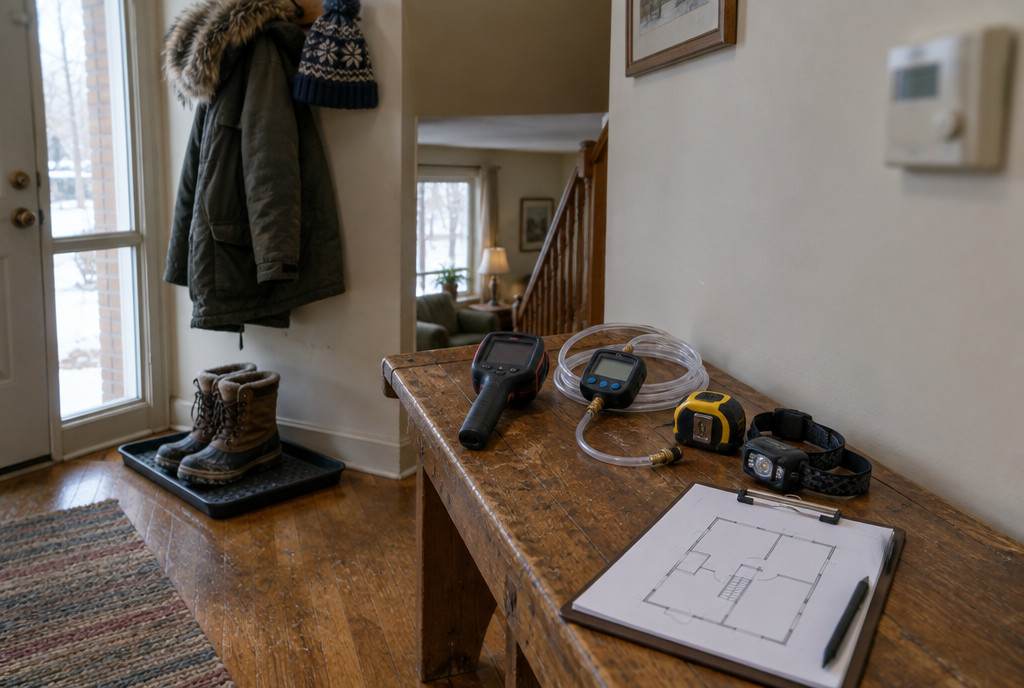
An energy advisor’s kit on a front-hall bench: infrared camera, pressure gauge with tubing, tape measure, headlamp and a floor sketch
Start here Free Online Home Energy Profile (DC, MD, VA gas customers) · Online tool
Rebates and incentives open now 7 of 7 All the offers we track are open.
Federal Home Energy Rebates Open What that means here

Washington, DC at a glance

Climate zone 4A

IECC 2021 climate zone for District of Columbia, DC. PNNL ↗

What it means: Mixed-humid climate. You pay to heat and to cool, and muggy summers make basements and AC health matter.

Heating and cooling 3,769 HDD · 1,738 CDD

Heating and cooling degree days, base 65°F, 1991–2020 normals at WASHINGTON REAGAN AP, VA US (USW00013743). NOAA ↗

What it means: Both seasons count here: real winters and humid summers, so fixes should help heating and cooling.

Homes 1958 median year built

41.5% of occupied homes are owner-occupied. Washington city, District of Columbia, 2020–2024 ACS 5-year. Census ↗

What it means: Most homes here are old enough that walls may be uninsulated and wiring, lead paint or vermiculite need checking before insulation work; an audit sorts out what to do first.

Radon EPA zone 3

low potential: predicted average below 2 pCi/L (District of Columbia, DC). EPA says not to use the zone to decide whether to test: high levels turn up in all three zones, so test every home. Radon testing guide · EPA ↗

What energy costs here

State Electricity¢ per kWh · July 2026 Natural gas$ per therm · 2025 average Heating oil$ per gallon · week of Oct 5, 2026 Propane$ per gallon · week of Oct 5, 2026
District of Columbia 25.2¢ $1.61 $16.68 per thousand cu ft Not reported Not reported
Virginia 17.6¢ $1.62 $16.79 per thousand cu ft $5.95 $3.68
Maryland 21.4¢ $1.56* $16.14 per thousand cu ft $6.11 $3.80
West Virginia 15.8¢ $1.33 $13.80 per thousand cu ft Not reported Not reported

What this means for your bills: Electricity in District of Columbia costs more than the US average (25.2¢ against 18.3¢ per kWh), so every kWh an upgrade saves is worth more here, and it's worth checking a heat pump's running cost against gas before you switch.

  • Electricity: EIA’s average residential price, July 2026 (preliminary; released September 24, 2026). The U.S. average was 18.3¢ per kWh. EIA ↗
  • Natural gas: EIA’s 2025 average residential price per thousand cubic feet, which EIA says includes taxes and delivery, divided by 10.36 therms per thousand cubic feet (EIA’s 2025 average heat content of 1,036 Btu per cubic foot). A full-year average is used because summer months run far higher. EIA ↗ *Maryland: 2024 average; EIA published no 2025 average.
  • Heating oil and propane: EIA’s weekly residential prices, excluding taxes, for the week of October 5, 2026. EIA surveys them only in some states. EIA ↗

Mixed-humid Mid-Atlantic and St. Louis

What homes in Washington, DC need

You pay to heat and to cool, and muggy summers make basements and AC health matter.

You pay to heat in winter and to cool and dry the air in muggy summers. Many homes are old, with basements that can get damp and lead paint to plan around. A good audit covers air sealing and attic insulation, basement moisture, safe venting of fuel-burning equipment and AC health.

In Washington, DC: DC homes split almost evenly between gas and electric heat, and new central ACs here follow the Southeast standard of 14.3 SEER2 for most split systems. DC is radon Zone 3, but Montgomery County, MD, and Fairfax County, VA, are Zone 1.

What drives bills and comfort here

  • Two real seasons: about 3,800 to 4,500 heating degree days and 1,300 to 1,700 cooling degree days a year.
  • Muggy summers: July dew points average 63–67°F, so your AC has to remove moisture as well as heat.
  • Old housing: in the core cities, the median home was built between 1938 (St. Louis) and 1958 (Washington, DC).
  • Power is pricey along the Northeast corridor, about 21 to 29 cents/kWh in August 2026, against 16 cents in Missouri.

Local risks to plan for

  • Wildfire smoke: in June 2023, the region had some of its smokiest air in 25 years.
  • Extreme heat: about 40 days a year reach 90°F or more.
  • Heat waves: a serious health risk in homes without working AC.
  • Muggy summers: July dew points average about 66°F.

What to check first, and why

  1. Seal and insulate for both seasons

    Air sealing and attic insulation cut both heating and cooling bills. ENERGY STAR suggests an R-value of R60 for an uninsulated attic in this zone.

    Ask your auditor: Ask for a blower door test with infrared imaging, and a sealing plan for the attic and top-floor ceilings.

    Blower door testInfrared (thermal) scanAttic inspection

  2. Fix basement water, then seal and dehumidify

    Most houses here have basements. Fix water entry first, then seal rim joists and keep summer relative humidity below 60%.

    Ask your auditor: Ask the auditor to measure basement humidity and look for water staining before anything is insulated.

    Mold and humidity checkInfrared (thermal) scan

  3. Check boilers, furnaces and water heaters vent safely

    Open-flue boilers, furnaces and water heaters risk backdrafting once a house is tightened. EPA guidance includes CO testing and alarms.

    Ask your auditor: Ask for a combustion safety test before and after air sealing, including any oil or steam system.

    Combustion safety testCarbon monoxide check

  4. Plan for lead, asbestos and old wiring

    Most homes in these core cities were built before 1980. Paid work that disturbs paint in pre-1978 homes must follow EPA lead-safe rules, and vermiculite or knob-and-tube needs handling before insulation.

    Ask your auditor: Ask whether the work will disturb paint, and have suspect materials checked before the scope is final.

    Lead paint testAsbestos and vermiculite check

  5. Test for radon, especially in the suburbs

    DC, Philadelphia and New York City are radon Zone 3, but suburban counties such as Montgomery (MD), Fairfax (VA), Bucks and Baltimore County are Zone 1.

    Ask your auditor: Test before work and again after air sealing, even if your city's zone is low.

    Radon test

  6. Keep the AC healthy and the ducts tight

    AC breakdowns are the most common reason homes here get too hot. Typical duct systems lose 20–30% of their air through leaks, and an oversized AC leaves humidity high.

    Ask your auditor: Ask for a duct leakage test and a check of your AC's size against a Manual J load calculation.

    Duct leakage testManual J load calculation

Tests that matter most here

  • Blower door test Measures air leakage and guides sealing; pair it with infrared to find attic bypasses. Best timing: Winter is best. Hot afternoons with the AC running can also work.
  • Infrared (thermal) scan Finds missing insulation and hidden air leaks. Best timing: Winter, or a hot afternoon with the AC on. Scan from inside and skip walls that just had sun.
  • Combustion safety test Checks boilers, furnaces and water heaters for spillage and carbon monoxide in a tightened house. Best timing: Before and after air sealing.
  • Mold and humidity check A basement moisture check, with humidity readings and a look for water stains, shows whether it's safe to insulate. Aim for below 60% relative humidity. Best timing: Mid-summer, when dew points peak.
  • Radon test Suburban counties around DC, Baltimore and Philadelphia are Zone 1. Best timing: With the house closed up, before and after air sealing.

Upgrades that usually pay off here

  1. Air sealing plus attic insulation. It cuts both heating and cooling loads, and ENERGY STAR says sealing and insulating can save up to 10% on annual energy bills.
  2. Basement water fixes, rim sealing, dehumidification. Controls summer basement humidity and mold, and closes a common air leak at the rim joists.
  3. Duct sealing, or moving ducts inside. Where ducts run through an unconditioned attic, they can lose 10–45% of the heating and cooling energy they carry. Sealing, insulating or moving them inside cuts that loss.
  4. Heat pumps, ducted or ductless. These cities average 0–1 nights a year at or below 0°F, so a standard variable-speed heat pump can carry most hours. Ductless units suit radiator homes. A cold-climate heat pump adds margin for cold snaps.
  5. Heat pump water heater in the basement. It cools and dehumidifies the space around it, which helps in a muggy basement.

Heating and cooling equipment

  • Federal AC rules differ here: Baltimore and DC follow Southeast rules (14.3 SEER2 for most split ACs), while New York, Philadelphia and St. Louis follow North rules (13.4 SEER2).
  • Split heat pumps must meet at least 14.3 SEER2 and 7.5 HSPF2. ENERGY STAR models start at 15.2 SEER2 and 7.8 HSPF2.
  • A cold-climate heat pump is optional, since winters rarely reach 0°F. Still check capacity at 17°F and 5°F for the coldest days.
  • Size with Manual J. An oversized AC short-cycles and leaves your house cool but clammy.

Health and comfort

  • Wildfire smoke: in June 2023, New York City's fine-particle AQI topped 175, a record, and DC had some of its smokiest air in 25 years. Use MERV 13 filters and recirculate.
  • Heat waves are a serious health risk in these cities, especially in homes without working AC.
  • Keep basement relative humidity below 60% to limit mold; a dehumidifier helps in summer.
  • Older homes may hold lead paint and asbestos, and suburban homes may have high radon. Test before work starts.

Common mistakes in this climate

  • Plastic vapor barriers on above-grade walls. The code doesn't require interior vapor retarders in this zone, and low-perm layers can trap summer moisture driven inward.
  • Disturbing lead paint without lead-safe practices. Paid work that disturbs paint in pre-1978 homes must follow EPA's Renovation, Repair and Painting rule.
  • An oversized AC. It cools fast but shuts off before removing moisture, so rooms feel clammy.
  • Insulating a basement that still takes on water. Fix drainage and leaks first, or the insulation can trap moisture and grow mold.

When to book: Winter gives the clearest blower door and infrared results and good closed-house radon testing. Check basement humidity in mid-summer, and have AC problems fixed before heat waves.

Sources for this climate guide · checked October 26, 2026

Common problems in Washington, DC homes

What each one usually means in this climate, the tests that confirm it and the fixes, cheapest first.

Utilities in the Washington, DC area

Utility efficiency programs follow the company that delivers your power or gas, so check your bill before you book anything.

Electric

  • Pepco (Potomac Electric Power Company, an Exelon company) District of Columbia (regulated by the DC PSC, which has a pending Pepco multiyear rate case) and Pepco's Maryland customers in the suburbs, who get EmPOWER Maryland programs. Check your bill or the utility’s website to confirm it serves your address. Source ↗
  • Dominion Energy Virginia Virginia service territory, including Northern Virginia suburbs. Other NoVA areas are served by cooperatives that aren’t covered in this guide. Check your bill or the utility’s website to confirm it serves your address. Source ↗
  • Other Maryland EmPOWER electric utilities (Potomac Edison/FirstEnergy, SMECO) Some Maryland parts of the MSA. The MEA lists SMECO among EmPOWER utilities, and DHCD lists FirstEnergy and SMECO as participating companies. Check your bill or the utility’s website to confirm it serves your address. Source ↗

Natural gas

  • Washington Gas (WGL) Natural gas in DC, Maryland and Virginia. It runs separate efficiency offers by state. Source ↗

DC and Maryland have retail choice. The DC PSC runs 'Choose an Energy Supplier', and the MD PSC runs Electric Choice and Gas Choice supplier portals. Virginia retail choice isn’t covered in this guide. In DC, efficiency programs are run by the DC Sustainable Energy Utility (DCSEU) under contract with DOEE, not by Pepco. In Maryland, they run through utilities under EmPOWER Maryland. dcpsc.org ↗ psc.maryland.gov ↗ doee.dc.gov ↗

How to get a home energy audit in Washington, DC

5 programs we track, open ones first. Prices are as each program publishes them. If you want a full diagnostic audit outside these programs, look for a certified auditor: how to find one and what audits cost.

Free one-on-one home energy coaching (Electrify DC)

Electrify DC, promoted by DC DOEE

Open
Free Coaching

Official page ↗ · verified October 12, 2026

Who qualifies
District homeowners
What you get
One-on-one coaching or events to 'ask specific questions about their home energy audit or energy upgrade'. This is coaching, not an on-site diagnostic audit.
How to book
Sign up at electrifydc.org/get-help/ or register for an Electrify DC event

Quick Home Energy Check-up (Maryland suburbs)

Pepco (EmPOWER Maryland)

Open Open but winding down. 'Pepco is awaiting a decision by the Maryland Public Service Commission about extending our energy efficiency programs into 2027. The last day to request a QHEC appointment for 2026 will be on November 06, 2026.'
Free

Official page ↗ · verified October 12, 2026

Who qualifies
Pepco Maryland residential customers, once every 5 years per address
What you get
About an hour-long walk-through by a certified Energy Analyst (insulation, air leakage, HVAC, windows and doors, lighting, water heating). It may include no-cost installs (LEDs, showerheads, aerators, smart power strips, weatherstripping, possibly a smart thermostat) and a customized report. A virtual option is offered.
How to book
Request online or call 866-353-5798

Home Energy Evaluation (Virginia suburbs)

Dominion Energy Virginia, through participating contractors

Open Open. Ask the program for the assessment price.
Not published

Official page ↗ · verified October 12, 2026

Who qualifies
Dominion Energy Virginia residential customers
What you get
An in-home energy assessment to identify savings. Dominion reports participants saved an average of $538 on upgrades and 1,325 kWh a year. An online questionnaire option ships a no-cost kit of efficiency products.
How to book
Schedule with a participating contractor from Dominion's save-energy page

Online Home Energy Profile (DC, MD, VA gas customers)

Washington Gas

Open
Free Online tool

Official page ↗ · verified October 12, 2026

Who qualifies
Washington Gas residential customers
What you get
An online survey with energy-saving education. Customers may get a free Energy Conservation Kit depending on their answers.
How to book
Online via Washington Gas

Home Performance with ENERGY STAR assessment (Maryland suburbs)

Pepco (EmPOWER Maryland), through Participating Contractors

Open · limits apply Open. The limited-time electrification offer requires contractors to reserve rebates by December 31, 2026, and the 2027 program extension is pending at the MD PSC.
$100 (homes up to 3,000 sq ft)

Cost, as published $100 ('a $400 value') for homes up to 3,000 sq ft with a single combustion appliance zone; larger or multi-zone homes may cost more. No cost for qualifying moderate-income customers.

Official page ↗ · verified October 12, 2026

Who qualifies
Active Pepco Maryland residential electric account holders in a single-family residence (not a condo or apartment), once every 5 years per address
What you get
Comprehensive evaluation (air sealing and insulation, HVAC and more) with a customized report, leading to rebates (see rebates)
How to book
Request an assessment or pick a Participating Contractor on Pepco's site

Rebates and incentives now

7 offers we track for the Washington, DC metro; 7 are open as of October 12, 2026. Many require the program’s own contractor or an audit first, so read the terms before you buy.

Whole-home upgrades 1 open of 1

Home Performance with ENERGY STAR rebates (Maryland suburbs)

Pepco (EmPOWER Maryland)

Open · limits apply Open. Contractors must reserve rebates by December 31, 2026, with work done within 90 days of reservation approval. Continuation into 2027 is pending at the MD PSC.

Official page ↗ · verified October 12, 2026

Amount Up to $10,000 for eligible upgrades, and up to $15,000 for eligible electrification upgrades. A 'New Limited Time Offer' gives larger rebates when the project converts fossil-fueled water heating and/or HVAC to electric.

Who qualifies Pepco Maryland single-family residential customers who complete the assessment

Heat pumps 1 open of 1

DCSEU Residential Electrification Rebates

DC Sustainable Energy Utility (locally funded, not the federal DOE rebates)

Open Open for FY2027: 'Offer is valid on technologies installed after 10/1/2026'. 'Rebates for products installed after 09/30/27 are subject to change.' The page also still says documents must be 'postmarked by 09/30/26', which appears to be a leftover FY2026 line, so confirm with DCSEU.

Official page ↗ · verified October 12, 2026

Amount Shown as electric-to-electric / gas-to-electric. Ducted ASHP or ductless mini-split, ENERGY STAR: $1,000 / $4,000. ENERGY STAR Most Efficient: $1,500 / $5,000. HPWH, NEEA Tier 1–2: $750 / $1,200; Tier 3–4: $1,000 / $1,600. Heat pump dryer $400 / $600. Electric range $400 / $600. Induction range $600 / $800. Heavy-up to 200 A: $2,000. Circuit upgrade or addition: $400 per circuit (up to 3). The page headline is 'up to $5,000 off'.

Who qualifies 'All DC residents, regardless of income', in homes of 4 units or fewer (including individual condo and co-op units). Heavy-up and circuit rebates apply only when replacing gas or oil equipment. Limit one product type per utility account per fiscal year. A DOB permit is required for HVAC and HPWH. Apply within 30 days of installation through the Online Rebate Center.

Appliances and equipment 3 open of 3

Washington Gas Virginia residential rebates

Washington Gas

Open Open. 'Programs remain available in VA.'

Official page ↗ · verified October 12, 2026

Amount Up to $2,000 on select ENERGY STAR boilers and furnaces; up to $400 on water heaters; up to $2.50/sq ft on eligible windows and sun shades; $100 smart thermostat; $100 heating tune-up; $50 gas fireplace tune-up

Who qualifies Washington Gas Virginia residential customers

Dominion Energy Virginia heat pump water heater rebate

Dominion Energy Virginia

Open

Official page ↗ · verified October 12, 2026

Amount Up to $500 on eligible heat pump water heaters (and up to $300 on variable-speed pool pumps). Instant rebates on smart thermostats and Marketplace products.

Who qualifies Dominion Energy Virginia residential customers

Washington Gas EmPOWER Maryland rebates (Maryland suburbs)

Washington Gas

Ending soon Ending. 'The Washington Gas EmPOWER Maryland programs will end on December 31, 2026, as required by Maryland House Bill 1532.' Submit applications by December 1. MEA says HB 1532 (2025) 'removes EmPOWER incentives for natural gas'.

Official page ↗ · verified October 12, 2026

Amount Up to $900 on select ENERGY STAR boilers and furnaces; up to $450 on water heaters; $100 heating tune-up; up to $100 on ENERGY STAR dryers; free conservation kit

Who qualifies Washington Gas Maryland residential customers

Income-qualified offers 1 open of 1

Affordable Home Electrification (AHEP), single-family

DCSEU under contract with DC DOEE, using federal DOE Home Energy Rebates funds

Open Open for sign-ups per DCSEU; no waitlist or closure is stated. The program pays for gas-to-electric switching, while DOE Program Notice 26-2 (effective May 29, 2026) bars federal HEEHR rebates for replacing non-electric appliances and gave launched programs three months to conform. Neither DOEE nor DCSEU mentions this, so the federally funded scope may change.

Official page ↗ · verified October 12, 2026

Amount No cost. Covers a ducted or ductless heat pump, heat pump water heater, induction stove, heat pump dryer and thermostat, replacing gas furnaces, boilers, water heaters, dryers and stoves. Gas lines are capped. Households that fully electrify are prioritized.

Who qualifies District homeowners or tenants in homes of 4 units or fewer, plus income-qualified owners of condo and co-op units. Eligibility is by participation in SNAP, TANF, SSI, Low Income Home Energy Assistance Program (LIHEAP), Solar for All or Weatherization Assistance Program (WAP), or by income up to $132,900 for a household of 4 ($93,050 for 1). DOEE approves every project, and projects can be cancelled before installation.

Financing 1 open of 1

BeSMART Home Loan (Maryland)

Maryland Department of Housing and Community Development

Open Open ('Application status: Open')

Official page ↗ · verified October 12, 2026

Amount 6.99% APR, $5,000 to $30,000, terms up to 10 years, unsecured. Up to 25% can go to related health and safety work.

Who qualifies Maryland homeowners with credit score ≥640 and debt-to-income ≤50%. No financing for work already purchased or completed.

Statewide rebate programs and federal options: rebates and programs.

Heat pumps in Washington, DC → What a heat pump costs to run here for cooling and heating, each heat pump rebate with the equipment rule that decides which models qualify, and the certified systems and brands that suit the climate.

Federal Home Energy Rebates in District of Columbia, Virginia, Maryland and West Virginia

The two federal rebate programs, HOMES (whole-home efficiency) and the high-efficiency electric home rebates (HEAR, renamed HEEHR in 2026), are run by each state, so availability depends on the state. DOE rewrote the rules effective May 29, 2026 (Program Notice 26-2 ↗): no more federal rebates for switching from gas, oil or propane to electric equipment, and insulation and air sealing come before heating and cooling upgrades unless a home already meets a state-set level.

Status for the Washington, DC metro
Open In the District of Columbia, HEEHR rebates for electric appliances are open with limits, and HOMES rebates for whole-home upgrades are open. Official page ↗ verified October 12, 2026

Program: DC: Affordable Home Electrification Program (AHEP) and Affordable Housing Retrofit Accelerator (AHRA). MD: IRA Home Energy Rebate Programs (HOMES and HEEHR). VA: Home Efficiency Rebates and High Efficiency Appliance Rebates.

Run by: DC: Department of Energy and Environment (DOEE), delivered by DCSEU. MD: Maryland Energy Administration. VA: Virginia Department of Energy.

DC is also implementing the local Healthy Homes and Residential Electrification Amendment Act of 2024, which directs DOEE to provide no-cost electrification retrofits to low-income households and qualifying multifamily buildings, built on its federal rebate applications. Virginia's allocation is $188,334,635 ($94,347,205 Home Efficiency; $93,987,430 High Efficiency Appliance). Its FAQ notes that under federal law the appliance rebates 'cannot be used to help pay for replacement of a non-electric appliance'. That reflects DOE Program Notice 26-2 (effective May 29, 2026), which ended fuel-switching rebates and requires insulation and air sealing first, with three months for launched programs like DC's to conform.

StateHEAR / HEEHR (electric appliances)HOMES (whole-home efficiency)
District of Columbia District of Columbia rebate guide
Open · limits apply open within existing programs (no stand-alone federal rebate; only through DCSEU's Affordable Home Electrification Program and Affordable Housing Retrofit Accelerator) Official page ↗ verified October 12, 2026
Open open within existing programs (AHRA/AHEP), per DOEE Official page ↗ verified October 12, 2026
Virginia Virginia rebate guide
Not open yet not launched (application being updated for DOE's May 29, 2026 Program Notices) Official page ↗ verified October 12, 2026
Not open yet not launched Official page ↗ verified October 12, 2026
Maryland Maryland rebate guide
Not open yet not launched (updated application submitted to DOE Sept. 30, 2026) Official page ↗ verified October 12, 2026
West Virginia West Virginia rebate guide
Waitlist pilot phase with select households; waitlist registration open; statewide launch pending Official page ↗ verified October 12, 2026

How the programs work: Home Energy Rebates explained · every state’s status.

Help for lower-income households

Weatherization Assistance Program (DC)

DC Department of Energy and Environment (DOEE), with nonprofits and contractors

Free energy audit and audit-recommended efficiency and water measures. For households below 60% of State Median Income (FY26: $118,926 for 4) or with a TANF or SSI recipient. DOEE says: 'Our Weatherization Assistance Program (WAP) and LRP program openings are delayed this fiscal year due to unexpected external circumstances', and it will contact waitlisted applicants. The Emergency Mechanical Systems (EMS) replacement program is open and contacting its waitlist first-come, first-served. Questions: 202-299-3316.

Official page ↗ · verified October 12, 2026

DCSEU Zero-Cost Upgrades and Affordable Home Electrification

DC Sustainable Energy Utility

Income-qualifying DC residents can get select DCSEU services free or at reduced cost. AHEP provides no-cost heat pumps and electric appliances for households up to $132,900 (4 people). Call (202) 479-2222.

Official page ↗ · verified October 12, 2026

EmPOWER Maryland Limited Income Energy Efficiency Program (LIEEP)

Maryland Department of Housing and Community Development

No-charge insulation, hot-water improvements, lighting, furnace tune and safety repairs, and limited health and safety work. For customers of BGE, Delmarva, FirstEnergy, Pepco, SMECO or Washington Gas. Income limit is $106,800 for a household of 4 (updated 07/14/2026). Application status is Open. Call 1-855-583-8976.

Official page ↗ · verified October 12, 2026

Maryland Weatherization Assistance Program (Montgomery and Prince George's)

MD DHCD through local weatherization agencies. For Prince George's and Montgomery: Housing Initiative Partnership (Hyattsville, 301-699-3870) and Building Change (Beltsville, 410-231-3284).

Application status is Open. Income limit is 60% SMI / 200% FPL ($92,470 for a household of 4). SSI, TANF or MEAP recipients are automatically eligible.

Official page ↗ · verified October 12, 2026

Income and Age Qualifying Energy Savings Program (Virginia)

Dominion Energy Virginia, delivered by local weatherization providers that work with Virginia DHCD

No-cost in-home assessment and installed measures. The FAQ lists LEDs, showerheads, aerators and pipe wrap, and weatherization such as attic insulation and duct sealing where eligible. For households ≤80% of local median income or ≤60% of state median income, whichever is greater, or age 60+ at ≤120% of state median income. Call 888-366-8280, option 2.

Official page ↗ · verified October 12, 2026

Local energy rules

None of the 4 rules we found reach ordinary homes.

Not for ordinary homes

DC energy benchmarking

Who it applies to 'All buildings >10,000 ft²'. Single-family homes are not covered.

Annual energy and water reporting through ENERGY STAR Portfolio Manager by May 1. The next third-party verification is due in 2027 (2026 data), then every six years. First-time reporters in 2026 are buildings newly covered at the 10,000 ft² threshold.

Official page ↗ · verified October 12, 2026

Not for ordinary homes

DC Building Energy Performance Standard (BEPS)

Who it applies to Period 1: private buildings ≥50,000 ft². Period 2: ≥25,000 ft². Period 3: ≥10,000 ft². DC-owned buildings ≥10,000 ft² in all periods. Does not affect ordinary homeowners.

Created by the Clean Energy DC Omnibus Act of 2018. Buildings below the standard enter a compliance cycle with performance or prescriptive pathways.

Official page ↗ · verified October 12, 2026

Not for ordinary homes

Montgomery County (MD) benchmarking and BEPS

Who it applies to Most commercial and multifamily buildings of 25,000 gross sq ft or more. Not homeowners.

Benchmark annually by June 1, with verification every 3 years. Site-EUI performance standards have interim and final evaluation years by group, for example 2028/2033 for non-residential 50k–250k sq ft and 2031/2036 for multifamily 25k–250k sq ft.

Official page ↗ · verified October 12, 2026

Not for ordinary homes

Maryland Building Energy Performance Standards (statewide)

Who it applies to Most buildings 35,000 sq ft and larger (with exclusions). Not homeowners.

Per BGE's summary: benchmarking to MDE by September 2025, direct GHG compliance from 2030, net-zero building emissions by 2040, about 9,000 buildings covered.

Official page ↗ · verified October 12, 2026

Notes worth knowing

  • Maryland's EmPOWER cycle (PSC Case No. 9705) covers 2024–2026, and Pepco says it is 'awaiting a decision by the Maryland Public Service Commission about extending our energy efficiency programs into 2027'.
  • The last Pepco Quick Check-up requests are due November 6, 2026, and Home Performance rebate reservations by December 31, 2026.
  • Separately, Maryland HB 1532 (2025) removes EmPOWER gas incentives, so Washington Gas's Maryland rebates end December 31, 2026.
  • Virginia offers through Washington Gas continue.
  • DC's federally funded electrification program (AHEP) explicitly covers gas-to-electric conversions, which DOE's May 29, 2026 notice no longer allows for federal HEEHR funds; DC sources do not yet address this.
  • DCSEU's locally funded rebates are unaffected because they are not federal money (DOEE).
  • The Dominion assessment price; Virginia county-level utility coverage and any NoVA local rules; West Virginia (Jefferson County); DC's building energy code for new homes.
  • Check the eligibility rules with the program before you apply.

Washington, DC: common questions

How do I get a home energy audit in Washington, DC?

Start with Online Home Energy Profile (DC, MD, VA gas customers). Run by: Washington Gas. It’s an online tool, not a home visit. Cost: Free. Who qualifies: Washington Gas residential customers. How to book: Online via Washington Gas. We track 5 audit programs for the Washington, DC metro, checked October 12, 2026; all of them are on this page.

Are the federal Home Energy Rebates available in Washington, DC?

In the District of Columbia, HEEHR rebates for electric appliances are open with limits, and HOMES rebates for whole-home upgrades are open. Checked October 12, 2026. Nationally, DOE rewrote the rules effective May 29, 2026: federal appliance rebates no longer pay for switching from gas, oil or propane to electric equipment, and homes must get insulation and air sealing before heating and cooling upgrades unless they already meet a state-set level.

Is there help for lower-income households in Washington, DC?

Yes. Programs for income-qualified households in the Washington, DC metro include Weatherization Assistance Program (DC), DCSEU Zero-Cost Upgrades and Affordable Home Electrification, EmPOWER Maryland Limited Income Energy Efficiency Program (LIEEP), Maryland Weatherization Assistance Program (Montgomery and Prince George's) and Income and Age Qualifying Energy Savings Program (Virginia). Each one’s rules and contacts are listed on this page, with a link to its official page.

Which local energy rules affect homeowners in Washington, DC?

None of the local energy rules we track applies to ordinary existing homes. 4 rules apply only to larger buildings.

Can I claim a federal tax credit for an energy audit in Washington, DC?

Not for an audit done in 2026. The federal credit of up to $150 for a home energy audit was part of the Energy Efficient Home Improvement Credit (25C), and the IRS says it can’t be claimed for audits paid for or done after December 31, 2025. Public Law 119-21 ended 25C and the Residential Clean Energy Credit (25D) for 2026 work. An audit done in 2025 is claimed on the 2025 return (Form 5695).

Sources and checks

Every source below was opened and checked on October 12, 2026.

Planning upgrades in Washington, DC?

Tell us your ZIP code, the kind of home you have and what you’re planning. A person reads every message and replies with the certified auditors and utility programs that serve your area.

A person replies by email. We don’t sell your details or share them with contractors. See our privacy note.