Get your free plan → Six short steps for a home in the Phoenix area: what to fix first, the tests to ask for and the programs open to you. No email.

Arizona · #10 metro by population

Home energy audits in Phoenix

Where to get a home energy audit in the Phoenix area, what it costs, which rebates are open now and where Arizona stands on the federal Home Energy Rebates. Every program links to its official page and was checked on October 12, 2026.

Metro area: Phoenix-Mesa-Chandler, AZ Metropolitan Statistical Area (CBSA 38060; OMB July 2023 delineation: Maricopa and Pinal counties).

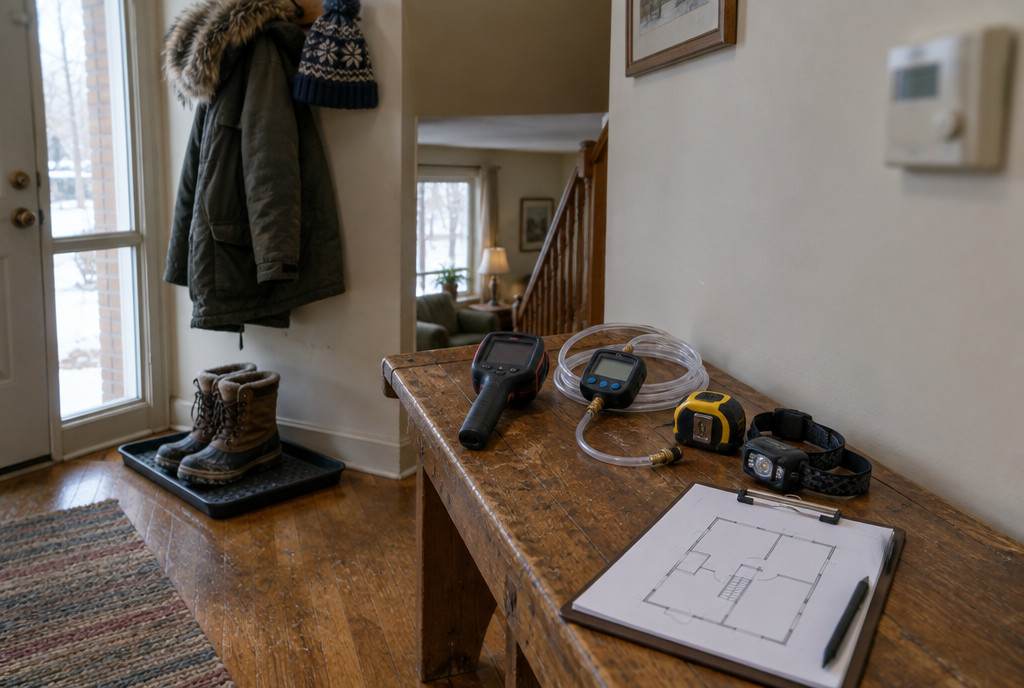
An energy advisor’s kit on a front-hall bench: infrared camera, pressure gauge with tubing, tape measure, headlamp and a floor sketch
Start here Virtual free · in-home $49 SRP Home Energy Assessment (virtual or in-home)
Rebates and incentives open now 10 of 10 All the offers we track are open.
Federal Home Energy Rebates Partly open What that means here

Phoenix at a glance

Climate zone 2B

IECC 2021 climate zone for Maricopa County, AZ. PNNL ↗

What it means: Hot and dry climate. Months of extreme heat make AC your biggest bill and a safety system, too.

Heating and cooling 874 HDD · 4,765 CDD

Heating and cooling degree days, base 65°F, 1991–2020 normals at PHOENIX SKY HARBOR INTL AP, AZ US (USW00023183). NOAA ↗

What it means: Cooling far outweighs heating here: summer bills, humidity and attic heat matter more than winter drafts.

Homes 1985 median year built

57.3% of occupied homes are owner-occupied. Phoenix city, Arizona, 2020–2024 ACS 5-year. Census ↗

What it means: Homes from the 1980s and 1990s usually have insulation, but ducts, attic air leaks and aging heating and cooling equipment are common audit findings.

Radon EPA zone 2

moderate potential: predicted average 2–4 pCi/L (Maricopa County, AZ). EPA says not to use the zone to decide whether to test: high levels turn up in all three zones, so test every home. Radon testing guide · EPA ↗

What energy costs here

State Electricity¢ per kWh · July 2026 Natural gas$ per therm · 2025 average
Arizona 15.4¢ $1.79 $18.58 per thousand cu ft

What this means for your bills: Electricity in Arizona is cheaper than the US average (15.4¢ against 18.3¢ per kWh), which keeps air conditioning and heat pumps cheaper to run.

  • Electricity: EIA’s average residential price, July 2026 (preliminary; released September 24, 2026). The U.S. average was 18.3¢ per kWh. EIA ↗
  • Natural gas: EIA’s 2025 average residential price per thousand cubic feet, which EIA says includes taxes and delivery, divided by 10.36 therms per thousand cubic feet (EIA’s 2025 average heat content of 1,036 Btu per cubic foot). A full-year average is used because summer months run far higher. EIA ↗
  • EIA doesn’t survey heating oil or propane prices in this state; its weekly survey covers the states where those fuels are common for home heating.

Hot and dry Desert Southwest and inland valleys

What homes in Phoenix need

Months of extreme heat make AC your biggest bill and a safety system, too.

Cooling is your biggest bill, and in extreme heat your AC is also a safety system. Ducts and air handlers often sit in the attic, the hottest place in the house, so leaks there waste a lot of cooling. A good audit checks the AC's health and size, tests and seals the ducts, and cuts attic and window heat.

In Phoenix: Phoenix-area homes get electricity from APS or SRP, depending on where you live, and each runs its own programs; SRP, for example, rebates AC, insulation, duct repair and shade screens. Check which utility is on your bill before you book.

What drives bills and comfort here

  • Extreme, long heat: 100°F days come by the dozens each summer (Phoenix averages 111 a year).
  • Dry heat: summer dew points are low, so cooling is mostly about temperature. The monsoon raises humidity in late summer.
  • Most homes sit on slabs, so ducts and air handlers often run through the attic, the hottest space in the house.
  • Electricity prices vary widely in this climate (about 15 cents/kWh in Arizona and about 30 cents in California, August 2026), so the same AC use can cost twice as much, and upgrades pay back faster where power costs more.

Local risks to plan for

  • Extreme heat: about 111 days a year reach 100°F or more.
  • Record heat: in 2023, Phoenix had 31 straight days at or above 110°F.
  • Monsoon storms: flash flooding is a real risk.

What to check first, and why

  1. Keep your AC reliable and right-sized

    A working AC is a safety system here. In Maricopa County's 2024 indoor heat deaths, 88% of homes had an AC, but 70% of those units weren't working.

    Ask your auditor: Ask for an AC performance check and a Manual J comparison before you repair or replace your system.

    Manual J load calculation

  2. Seal and insulate attic ducts

    Ducts in an unconditioned attic can lose 10–45% of the cooling they carry, and typical systems lose 20–30% of their air to leaks.

    Ask your auditor: Ask for a duct leakage test that measures leakage to outside, and a check of the attic air handler.

    Duct leakage testAttic inspection

  3. Cut attic heat gain

    ENERGY STAR suggests an R-value of R49 for an uninsulated attic in zones 2 and 3. A radiant barrier typically saves 8–12% of cooling costs and keeps attic ducts cooler.

    Ask your auditor: Ask whether a radiant barrier at the roof deck makes sense, and to seal attic leaks before insulating.

    Attic inspectionInfrared (thermal) scan

  4. Tame west sun and old windows

    Single-pane glass is still common in this region. Shading, solar screens and low-SHGC glass cut the heat coming in.

    Ask your auditor: Ask which windows take the hottest sun, and whether screens or shading should come before new windows.

    Infrared (thermal) scan

  5. Keep dust and smoke out

    Air leaks let in desert dust and, on smoky days, wildfire smoke. Sealing leaks and using MERV 13 filters keep more of it outside.

    Ask your auditor: Ask for a blower door test to find leakage paths, and whether your system can take a MERV 13 filter.

    Blower door test

  6. Check the pool pump and water heater

    About one in six houses in this region has a pool. Pool pumps and water heating are large loads you can control.

    Ask your auditor: Ask for pool pump run-time and water heater recommendations; your bills can show how big these loads are.

    Energy bill analysis

Tests that matter most here

  • Infrared (thermal) scan With a big indoor-outdoor temperature difference, missing insulation and air leaks show up clearly. Best timing: Summer afternoons with the AC running. Scan from inside; sun-baked outside walls give misleading readings for hours.
  • Duct leakage test Finds leaks in attic ducts and the air handler. Best timing: Early morning, before the attic gets too hot to work in safely.
  • Blower door test Measures total air leakage and finds the paths dust and smoke take into your house. Best timing: Any season.
  • Manual J load calculation A Manual J load calculation checks whether your AC is the right size before you repair or replace it. Best timing: Cooling season, before any replacement.

Upgrades that usually pay off here

  1. Duct sealing, plus insulation or buried ducts. In dry climates, burying ducts in attic insulation works without the condensation worries of humid areas.
  2. Attic insulation plus a roof-deck radiant barrier. A radiant barrier cuts heat flow from the attic into the house by about 40%, typically 8–12% of cooling costs, and keeps attic ducts cooler. Install foil at the roof deck or rafters, never on the attic floor.
  3. High-EER2 AC or heat pump. EER2 measures efficiency at peak heat, which is why Southwest rules set an EER2 minimum. A heat pump also covers your small heating load.
  4. Evaporative or two-stage cooling, where it fits. An evaporative cooler can use about a quarter of the energy of central AC. It works less well as humidity rises, such as during the monsoon. It needs relief vents or open windows, and regular maintenance.
  5. Shade screens and window shading. Solar screens and shading cut heat through older glass. SRP, for example, rebates professionally installed shade screens.

Heating and cooling equipment

  • Southwest rules: most new split ACs need at least 14.3 SEER2 and 11.7 EER2 (9.8 EER2 if rated 15.2 SEER2 or higher). Packaged ACs need at least 10.6 EER2.
  • Heat pumps suit this climate: heating loads are small, and about a third of Phoenix-area homes already heat with one.
  • Direct evaporative coolers drop supply air 15–40°F but add humidity. Indirect and indirect/direct units cool without adding moisture.
  • Size with a Manual J load calculation; oversized units short-cycle.

Health and comfort

  • Heat illness is the main risk when AC fails. Keep your system maintained and have a backup plan for cooling.
  • On smoky or dusty days, use MERV 13 filters, recirculate indoor air and filter any evaporative cooler intake.
  • Drain an idle evaporative cooler's pan so it can't breed mosquitoes or bacteria such as Legionella.
  • Radon turns up in desert homes too. EPA says to test every home.

Common mistakes in this climate

  • Buying an AC on SEER2 alone. EER2 shows efficiency at peak heat, and Southwest rules set a minimum for it.
  • Running an evaporative cooler with the windows shut. Without relief openings it can't work. In humid or smoky spells, adjust use or filter the intake.
  • Laying radiant barrier foil on the attic floor. Dust settles on it and ruins its effect. Install it at the roof deck or rafters.
  • An oversized AC. Bigger isn't better: oversized units short-cycle and run less efficiently.

When to book: Get the AC checked in spring, before triple-digit heat. Summer afternoons give the clearest infrared images, but attic and duct work belongs in the early morning.

Sources for this climate guide · checked October 26, 2026

Common problems in Phoenix homes

What each one usually means in this climate, the tests that confirm it and the fixes, cheapest first.

Utilities in the Phoenix area

Utility efficiency programs follow the company that delivers your power or gas, so check your bill before you book anything.

Electric

  • Arizona Public Service (APS) Investor-owned utility (subsidiary of Pinnacle West Capital Corp.) serving 'approximately 1.4 million customers in Arizona' across a statewide territory. It serves part of the Phoenix metro. Regulated by the Arizona Corporation Commission (ACC). Source ↗
  • SRP (Salt River Project) 'A community-based, not-for-profit' utility that 'serves more than 1.2 million electric customers in central Arizona' and 'provides water and energy throughout the Valley.' It serves much of the Phoenix metro and runs its own rebate programs. Source ↗

Natural gas

  • Southwest Gas Natural gas utility for 'Arizona, Nevada, and portions of California' (more than 2 million customers). The City of Phoenix's weatherization program lists Southwest Gas ('SWG') among its funders. Source ↗

Phoenix-area homes get electricity from either APS or SRP depending on address; both fund the City of Phoenix's weatherization program. Their programs differ sharply, so check which utility is on your bill. Smaller utilities and co-ops in outlying Maricopa and Pinal areas aren’t covered in this guide. SRP still runs a broad residential rebate menu (A/C, insulation, ducts, shade screens, windows, heat pump water heaters), with current terms requiring installation before April 30, 2027. APS's website no longer lists residential HVAC, duct or whole-home rebates. APS's Demand Side Management Adjustment Charge, which recovers 'Commission-approved programs... to meet compliance with Arizona's Energy Efficiency Standard,' now cites only Limited Income Weatherization and smart-thermostat Cool Rewards as examples. That charge was cut to $0.000754/kWh effective January 1, 2026 (ACC Decision No. 81584), a decrease of $0.001639/kWh. Southwest Gas's 2026 Arizona residential rebates are small and do not cover furnaces or water heaters.

How to get a home energy audit in Phoenix

4 programs we track, open ones first. Prices are as each program publishes them. If you want a full diagnostic audit outside these programs, look for a certified auditor: how to find one and what audits cost.

SRP Home Energy Audit discount (BPI-certified contractor)

SRP, through participating BPI-certified contractors

Open Listed as current on 2026-10-12.
Contractor’s price less $100

Cost, as published $100 off an in-person audit, shown on the contractor's invoice. The contractor sets the base price.

Official page ↗ · verified October 12, 2026

Who qualifies
SRP residential electric customers in single-family or apartment/condo homes. Not new construction or mobile homes.
What you get
An in-person audit by a participating BPI-certified contractor.
How to book
Find a participating contractor via SRP's contractor finder.

AllThrive365 Weatherization (Maricopa County outside Phoenix and Mesa)

AllThrive365 (formerly Foundation for Senior Living), funded through the Arizona Department of Housing (DOE, Low Income Home Energy Assistance Program (LIHEAP), APS, SRP, SWG, TEP)

Open Active and accepting inquiries; no funding or waitlist information posted.
Free Income-qualified

Cost, as published Free for eligible low-income residents.

Official page ↗ · verified October 12, 2026

Who qualifies
Homeowners (renters 'may qualify upon review') in Maricopa County excluding Phoenix and Mesa, with gross household income at or below 200% FPL ($31,920 for 1 person; $66,000 for 4). Not weatherized in the last 15 years.
What you get
LED bulbs, CO/smoke detectors, shade screens, A/C and water heater repairs, insulation, duct sealing.
How to book
Online 'Inquire Here' eligibility form; questions to mcwap@allthrive365.org.

SRP Home Energy Assessment (virtual or in-home)

SRP (Energy Ambassadors)

Open · limits apply Available (page presents it as current on 2026-10-12; SRP 'reserves the right to change or cancel' promotions).
Virtual free · in-home $49

Cost, as published Virtual: free. In-home: free for income-qualified customers in listed assistance programs; otherwise a $49 fee added to the SRP bill. SRP calls it 'free* in many cases.'

Official page ↗ · verified October 12, 2026

Who qualifies
SRP residential customers: homeowners, and renters in single-family homes or communities of fewer than five units with property manager approval. Renters in 5+ unit communities are referred to SRP's Multifamily Solutions Program.
What you get
About 90 minutes reviewing heating/cooling, thermostats, lighting, safety monitors, water heating and appliances. A customized energy report. Free products worth up to $250 (LEDs, efficient showerheads, aerators), mailed for virtual visits or installed in person. Access to appliance rebates (ENERGY STAR refrigerators, heat pumps, water heaters, washers/dryers, dishwashers) within six months. Income-qualified customers with older refrigerators may get a free new one.
How to book
Through SRP's online scheduling portal linked from the page.

City of Phoenix Weatherization Assistance Program (includes home energy efficiency assessment)

City of Phoenix Neighborhood Services Department, delivered through the Arizona Department of Housing. Funders listed: DOE, Low Income Home Energy Assistance Program (LIHEAP), APS, SRP, SWG.

Unconfirmed Ask the program whether applications are open or whether there is a waitlist.
Free Income-qualified

Official page ↗ · verified October 12, 2026

Who qualifies
Eligible Phoenix homeowners and renters with annual household income up to $31,920 (1 person), $43,280 (2), $54,640 (3), $66,000 (4), $77,360 (5), plus $11,360 per additional member.
What you get
Home energy efficiency assessment; air sealing; efficient lighting; high-efficiency appliances; CO detectors; attic insulation and ventilation; heating/cooling repair or replacement; health and safety repairs.
How to book
Phone 602-534-4444, email rehab.nsd@phoenix.gov, or 200 W. Washington St., 4th Floor; the page links an eligibility questionnaire.

Rebates and incentives now

10 offers we track for the Phoenix metro; 10 are open as of October 12, 2026. Many require the program’s own contractor or an audit first, so read the terms before you buy.

Insulation and air sealing 2 open of 2

SRP Insulation Rebate

SRP, through participating BPI-certified insulation contractors

Open Listed as current. No end date shown on the page; other SRP rebates require installation before April 30, 2027.

Official page ↗ · verified October 12, 2026

Amount 'Save up to 75% on professionally installed attic insulation – up to $600.' Applied instantly on the participating contractor's invoice.

Who qualifies SRP residential electric customers in single-family, apartment or condo homes. Excluded: new construction, mobile homes, and attics over unconditioned space. Existing insulation below R-19 brought to R-38 (above R-19 needs documentation). Must be combined with air sealing unless documented unnecessary.

SRP Duct Test and Repair Rebate

SRP, through participating BPI-certified contractors

Open Open. Repairs must be completed by April 30, 2027; submit within 6 months of repairs.

Official page ↗ · verified October 12, 2026

Amount Covers '75% of repair costs or up to $400.' Single-family detached up to $400; mobile/manufactured homes, apartments, condos and townhouses up to $300.

Who qualifies Permanent SRP residential customers with central A/C or heat pump. Test-in and test-out results are required. Excluded: new construction and evaporative coolers.

Heat pumps 2 open of 2

SRP Cool Cash A/C and Heat Pump Rebate

SRP

Open Open. Install 'before April 30, 2027'; 'REBATE MUST BE SUBMITTED WITHIN 6 MONTHS OF INSTALLATION.'

Official page ↗ · verified October 12, 2026

Amount Per ton, for 15.2+ SEER2 equipment: single-stage $75; multi-stage $150; variable-capacity $225; inverter-driven mini-split heat pump $225. 'up to $1,125 back.'

Who qualifies Permanent SRP residential electric customers (single-family, mobile home, apartment/condo) replacing or supplementing an existing central A/C or heat pump. New construction, window units and garages are excluded. Split systems need both indoor and outdoor units replaced, installed by an Arizona-licensed contractor. Manual J is required for single-stage. Up to five rebates per customer.

SRP Heat Pump Water Heater Rebate

SRP

Open Open. Install 'before April 30, 2027'; submit within 6 months.

Official page ↗ · verified October 12, 2026

Amount $500 per ENERGY STAR heat pump water heater (UEF 2.8+).

Who qualifies Permanent SRP residential customers whose home has had SRP service for more than a year. The unit must replace the current water heater and be installed by an Arizona-licensed plumbing contractor. One rebate every 10 years; installs before July 1, 2023 are excluded.

Appliances and equipment 1 open of 1

Southwest Gas 2026 Arizona Residential Rebates

Southwest Gas

Open · limits apply Open for purchases Jan 1–Dec 31, 2026, first-come, first-served while funds last. Applications due (postmarked or online) by Jan 31, 2027.

Official page ↗ · verified October 12, 2026

Amount ENERGY STAR front-load clothes washer $50/unit and WaterSense low-flow showerhead (≤1.5 gpm) $5/unit, both requiring gas water heating. ENERGY STAR windows $1.00/sq ft, capped at 75% of cost and requiring gas space heating. Max two units per equipment type.

Who qualifies Southwest Gas Arizona residential customers or property owners with an active meter on a rate that includes the DSM surcharge (homeowners, renters, builders, individually metered multifamily).

Income-qualified offers 1 open of 1

Maricopa County Emergency Home Repair (incl. A/C and heating replacement)

Maricopa County Human Services

Open · limits apply Online application available; 'This is not a first-come, first-served program'. Priority for non-functioning A/C or heat in extreme temperatures, people 62+, disability, or a child under 6.

Official page ↗ · verified October 12, 2026

Amount Repairs including 'Air conditioning and heating repairs and replacement,' water heater replacement and minor electrical/plumbing work. Lifetime assistance capped at $25,000.

Who qualifies Owner-occupants (1+ year) at or below 80% AMI ($62,950 for 1 person, effective June 1, 2026), liquid assets under $12,000, current on taxes, mortgage and HOA. Countywide except cities with their own programs (including Phoenix and Mesa); county islands remain eligible.

Other incentives 4 open of 4

SRP Shade Screen / Window Film Rebate

SRP

Open Open. Install by April 30, 2027; submit within 6 months.

Official page ↗ · verified October 12, 2026

Amount $1 per square foot.

Who qualifies Permanent SRP residential customers. Screens must block 80%+ of solar heat gain on west-, south- or east-facing windows of air-conditioned space. Film SHGC max 0.45 on double-pane and 0.40 on single-pane windows. DIY allowed.

SRP Window Replacement Rebate

SRP

Open Listed on SRP's residential rebates page on 2026-10-12 (detail page not opened).

Official page ↗ · verified October 12, 2026

Amount 'a rebate of $3 per square foot... on professionally installed ENERGY STAR® rated replacement windows.'

Who qualifies SRP homeowners (per SRP's rebate listing); professional installation required.

SRP Bring Your Own Thermostat (BYOT)

SRP

Open Enrollment open (no end date stated).

Official page ↗ · verified October 12, 2026

Amount $50 SRP bill credit per thermostat enrolled (max 2, so up to $100), plus $25 per eligible thermostat each year enrolled. SRP Marketplace also shows instant rebates (e.g., Nest Thermostat from '$0-$49.99' vs $129.99 list).

Who qualifies SRP residential electric customers with an eligible internet-connected thermostat controlling central A/C.

APS Cool Rewards (smart thermostat demand response)

APS (enrollment via EnergyHub)

Open Enrollment open (apscoolrewards.com).

Official page ↗ · verified October 12, 2026

Amount 'up to $85 the first year': a $50 one-time enrollment credit per smart thermostat plus a $35 participation credit per thermostat per event season (June 1–Sept 30), paid annually while enrolled. APS Marketplace buyers get the $85 at checkout.

Who qualifies APS residential customers with an eligible internet-connected thermostat controlling central A/C. Rooftop-solar customers may join.

Statewide rebate programs and federal options: rebates and programs.

Heat pumps in Phoenix → What a heat pump costs to run here for cooling and heating, each heat pump rebate with the equipment rule that decides which models qualify, and the certified systems and brands that suit the climate.

Federal Home Energy Rebates in Arizona

The two federal rebate programs, HOMES (whole-home efficiency) and the high-efficiency electric home rebates (HEAR, renamed HEEHR in 2026), are run by each state, so availability depends on the state. DOE rewrote the rules effective May 29, 2026 (Program Notice 26-2 ↗): no more federal rebates for switching from gas, oil or propane to electric equipment, and insulation and air sealing come before heating and cooling upgrades unless a home already meets a state-set level.

Status for the Phoenix metro
Partly open In Arizona, HEEHR rebates for electric appliances are open with limits, and HOMES rebates for whole-home upgrades have no status posted by the state. Official page ↗ verified October 12, 2026

Program: Efficiency Arizona (Arizona's IRA Home Electrification and Appliance Rebates, HEAR; its posted consumer protection plan is filed under IRA section 50122)

Run by: Arizona Governor's Office of Resiliency

Rebates 'up to $14,000 per household, depending on income level.' Per-item caps: heat pump for heating/cooling up to $8,000; heat pump water heater $1,750; electric stove/cooktop/range/oven $840; heat pump dryer $840; insulation, air sealing and ventilation $1,600; electric load service center (panel) $4,000; wiring and other building materials $2,500. Panel and wiring work qualifies only with a paired appliance. Households above 150% AMI are not eligible; categorical eligibility via SNAP, AHCCCS/Medicaid, Low Income Home Energy Assistance Program (LIHEAP), Lifeline, Head Start or public housing. Currently for homeowners who live in the home; renters and multifamily owners are 'not at this time'. Completed projects don't qualify. Contractor pathway (qualified contractor network) or retail coupon pathway (HPWH, heat pump dryer, electric cooking). Phone (480) 866-7788. Efficiency Arizona says 'Funding is anticipated to be available through 2029.'

StateHEAR / HEEHR (electric appliances)HOMES (whole-home efficiency)
Arizona Arizona rebate guide
Partly open Open with restrictions (HEAR). Efficiency Arizona says 'Applications are still being accepted, but must meet the new program guidelines.' New guidelines took effect September 1, 2026 under a DOE Home Energy Rebates Program Notice: no more gas-to-electric fuel switching, only electric-to-electric replacements. August 28, 2026 was the last day to reserve under the old rules. The program launched in August 2024, was paused at one point 'Due to Federal Grant Funding Uncertainty', then 'restarted... on a limited basis'. A program announcement 'As of April 30' (year not shown; site footer © 2026) reported 1,076 rebates issued. We know of no HOMES (whole-home) program. Official page ↗ verified October 12, 2026
Unconfirmed We know of no HOMES (whole-home) program. verified October 12, 2026

How the programs work: Home Energy Rebates explained · every state’s status.

Help for lower-income households

City of Phoenix Weatherization Assistance Program

City of Phoenix Neighborhood Services Department (via Arizona Department of Housing)

Free assessment, sealing, insulation, HVAC repair/replacement and safety measures for Phoenix homeowners and renters at or below $31,920 (1 person) to $77,360 (5 people). Phone 602-534-4444.

Official page ↗ · verified October 12, 2026

AllThrive365 Weatherization and Healthy Homes AC Program

AllThrive365 (formerly Foundation for Senior Living)

The Weatherization Assistance Program (WAP) for Maricopa County outside Phoenix and Mesa (≤200% FPL, not weatherized in 15 years). A separate Healthy Homes AC Program serves owner-occupied homes with no cooling in La Paz, Maricopa, Pinal, Yavapai and Yuma counties. APS also refers limited-income homeowners to AllThrive365 and Wildfire for A/C repair or replacement.

Official page ↗ · verified October 12, 2026

Efficiency Arizona (HEAR) for households at or below 150% AMI

Arizona Governor's Office of Resiliency

Up to $14,000 per owner-occupied household for qualifying electric-to-electric heat pump, HPWH, insulation/air sealing and electrical upgrades. Rules since Sept 1, 2026 bar gas-to-electric switching.

Official page ↗ · verified October 12, 2026

APS Energy Support Program (bill discount)

APS

Income-based 25% (up to $95/month) or 60% (up to $165/month) bill discount; 35% or 60% with the medical add-on. Guidelines effective July 1, 2026. APS's assistance page points to the state Weatherization program for free efficiency improvements.

Official page ↗ · verified October 12, 2026

City of Phoenix Housing Repairs Program

City of Phoenix Neighborhood Services Department

Repairs to vital systems (plumbing, electrical, structural) for owner-occupied homes inside Phoenix, with HUD income limits. Start with a household assessment.

Official page ↗ · verified October 12, 2026

Maricopa County Emergency Home Repair

Maricopa County Human Services

A/C and heating repair or replacement and other emergency repairs (lifetime cap $25,000) for owner-occupants at or below 80% AMI outside Phoenix, Mesa and other self-serving cities.

Official page ↗ · verified October 12, 2026

Local energy rules

None of the 1 rule we found reaches ordinary homes.

No local mandate found

No energy audit, disclosure-at-sale or benchmarking mandate in Phoenix

Who it applies to Not applicable to homeowners.

We know of no City of Phoenix requirement for home energy audits, disclosure at sale or private-building benchmarking. ACEEE's State & Local Policy Database (non-government; existing-building section last updated Sept 2023) says Phoenix had been working on a benchmarking ordinance for larger commercial buildings, but 'The city is prohibited by state law to require mandatory benchmarking or energy action requirements.' It now supports only voluntary benchmarking (BOMA's Kilowatt-hour Krackdown).

Official page ↗ · verified October 12, 2026

Notes worth knowing

  • Phoenix has a live state IRA rebate.
  • Efficiency Arizona (HEAR) is accepting applications, but since Sept 1, 2026 only for electric-to-electric replacements; a household replacing a gas furnace or gas water heater no longer qualifies.
  • This change came from a DOE notice and may also shape Texas's program design.
  • APS, Arizona's largest utility, no longer lists residential HVAC, duct or whole-home rebates on aps.com.
  • Its efficiency surcharge was cut in January 2026, and it now points customers to Cool Rewards, the APS Marketplace and limited-income weatherization.
  • SRP still pays meaningful rebates through April 30, 2027 (A/C up to $1,125, insulation up to $600, ducts up to $400, HPWH $500).
  • APS customers in the same metro get far less, so a utility lookup matters.
  • A January 2023 APS article mentioned a Home Performance with ENERGY STAR checkup 'starting at $99' and a free virtual checkup.
  • Arizona HOMES status; exact date of the Efficiency Arizona pause and restart; whether APS still offers any audit.
  • Confirm current amounts with the program before you buy.
  • Check your bill or the utility’s website to confirm it serves your address.

Phoenix: common questions

How do I get a home energy audit in Phoenix?

Start with SRP Home Energy Assessment (virtual or in-home). Run by: SRP (Energy Ambassadors). Cost: Virtual: free. In-home: free for income-qualified customers in listed assistance programs; otherwise a $49 fee added to the SRP bill. SRP calls it 'free* in many cases.' Who qualifies: SRP residential customers: homeowners, and renters in single-family homes or communities of fewer than five units with property manager approval. Renters in 5+ unit communities are referred to SRP's Multifamily Solutions Program. How to book: Through SRP's online scheduling portal linked from the page. We track 4 audit programs for the Phoenix metro, checked October 12, 2026; all of them are on this page.

Are the federal Home Energy Rebates available in Phoenix?

In Arizona, HEEHR rebates for electric appliances are open with limits, and HOMES rebates for whole-home upgrades have no status posted by the state. Checked October 12, 2026. Nationally, DOE rewrote the rules effective May 29, 2026: federal appliance rebates no longer pay for switching from gas, oil or propane to electric equipment, and homes must get insulation and air sealing before heating and cooling upgrades unless they already meet a state-set level.

Is there help for lower-income households in Phoenix?

Yes. Programs for income-qualified households in the Phoenix metro include City of Phoenix Weatherization Assistance Program, AllThrive365 Weatherization and Healthy Homes AC Program, Efficiency Arizona (HEAR) for households at or below 150% AMI, APS Energy Support Program (bill discount), City of Phoenix Housing Repairs Program and Maricopa County Emergency Home Repair. Each one’s rules and contacts are listed on this page, with a link to its official page.

Which local energy rules affect homeowners in Phoenix?

None of the local energy rules we track applies to ordinary existing homes. No energy audit, disclosure-at-sale or benchmarking mandate in Phoenix.

Can I claim a federal tax credit for an energy audit in Phoenix?

Not for an audit done in 2026. The federal credit of up to $150 for a home energy audit was part of the Energy Efficient Home Improvement Credit (25C), and the IRS says it can’t be claimed for audits paid for or done after December 31, 2025. Public Law 119-21 ended 25C and the Residential Clean Energy Credit (25D) for 2026 work. An audit done in 2025 is claimed on the 2025 return (Form 5695).

Sources and checks

Every source below was opened and checked on October 12, 2026.

Planning upgrades in Phoenix?

Tell us your ZIP code, the kind of home you have and what you’re planning. A person reads every message and replies with the certified auditors and utility programs that serve your area.

A person replies by email. We don’t sell your details or share them with contractors. See our privacy note.