Specialty test guide · verified October 2, 2026
Mold & indoor air: test the cause, not just the air
Here's the counterintuitive truth from Health Canada: it does not recommend routinely testing your air for mould. Mould is a symptom. The disease is moisture — condensation on cold surfaces, ventilation that can't keep up, leaks. Sampling has its place, but the sequence that actually fixes musty houses runs diagnose → fix → clean — and the diagnosis is what a good energy audit does best.
Health Canada
No routine air tests
DIY cleanup
< 1 m² patches
Pro remediation
> 3 m², or sewage/flood
Sampling, if needed
$300–$600
The sequence that works
-
Find the moisture, not the mould
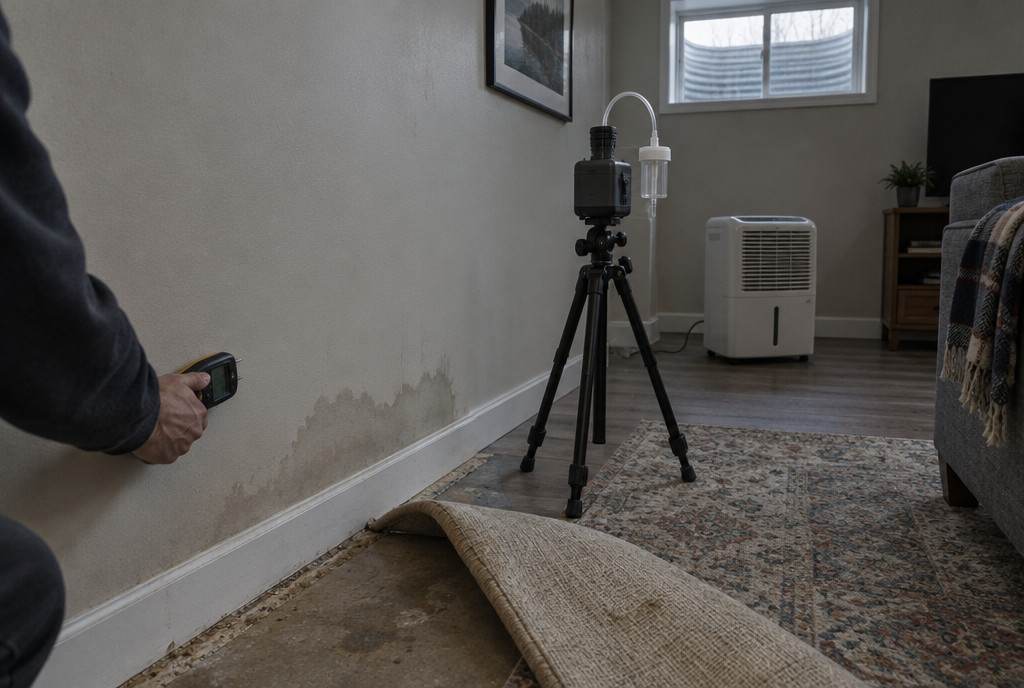
Every mould problem is a moisture problem wearing a costume. Condensation on cold corners and window frames, a bathroom fan venting into the attic, a grading or gutter leak, a chronically damp basement — the audit's thermal imaging and humidity assessment locate these without opening walls.
-
Decide: ventilation problem or cold-surface problem?
The two get confused constantly and the wrong guess costs thousands. Too much humidity for the air exchange → fix ventilation (fans that actually duct outside, an HRV). Normal humidity condensing on uninsulated surfaces → fix insulation. The audit's measurements make the call.
-
Size the visible mould honestly
Up to three patches under 1 m² total: clean it yourself — water and detergent, gloves, goggles, N95, and toss porous materials that are mouldy through. 1–3 m²: get a professional assessment. One patch over 3 m², or anything from sewage or flooding: professional remediation.
-
Sample only with a reason
Hidden-mould suspicion behind a wall, symptoms that persist after cleanup, or the need for documentation — those justify an IAQ professional's air or surface sampling. A number without a suspected source is $300–$600 spent describing the symptom.
-
Fix the cause, then verify
After the leak is sealed, the fan ducted out, or the wall insulated, watch humidity (a $15–$25 hygrometer; target 30–50%) and confirm the musty smell doesn't return. If remediation was professional, a clearance check confirms the job.
Mold and your retrofit — never insulate over an active problem
Insulating or air-sealing over damp, mouldy assemblies locks the problem in and can make it invisible until it's structural. The retrofit sequence puts moisture diagnosis before envelope work for exactly this reason — and ventilation upgrades (an HRV in a tightened house) are how the fix holds. If you flagged condensation or musty air in the planner, this is why it routed you here.
Common questions
Should I pay for mold air sampling?
Usually not first. Health Canada explicitly does not recommend routine air testing for mould, because a spore count doesn't tell you where the moisture is coming from or what to fix — and any visible or smellable mould should be dealt with regardless of species. Sampling earns its $300–$600 when you suspect hidden mould inside walls or ceilings, when symptoms persist after visible mould is gone, or when you need documentation for a dispute or a clearance after remediation.
Is "black mold" the dangerous one?
Colour doesn't determine risk — many moulds look black, and Stachybotrys is only one of them. Health Canada's position is that any indoor mould growth should be removed and its moisture source fixed, whatever the species. That's also why speciation via sampling rarely changes what you actually do.
Can I clean it myself?
Small areas — up to about three patches totalling under 1 m² — yes: water and dish detergent (bleach isn't recommended), gloves, goggles, and an N95. Between 1 and 3 m², get a professional assessment first. A single patch bigger than 3 m², or contamination from sewage or a flood, is professional remediation territory. Porous materials like drywall that have mould through them get cut out, not wiped.
The house smells musty but I can't find anything. Now what?
That's the case for diagnostics before sampling: an energy audit's thermal imaging finds the cold, damp wall sections and hidden condensation planes, and its ventilation assessment establishes whether the house can actually exhaust the moisture it makes. If those point at a concealed cavity, targeted sampling or an inspection camera confirms it — you'll open the wall knowing why.
Start with the diagnosis
A registered advisor's moisture and ventilation diagnostics find the cause. Tell us what you're seeing — condensation, musty rooms, ice dams — and we'll match you.
Email us what you’re planning, your postal code and the type of building (a house, a duplex or triplex, or a larger multi-unit building) — we’ll reply with registered service organizations for your area and which rebates apply.
Email dave@clickshift.ca