$300–$800
Hand-sealing accessible runs
Mastic and foil tape (never fabric 'duct tape', which dries and falls off) on the joints you can reach — basement trunks, boots, panned returns. High return when the leaks are accessible.
Which tests does my home need?
Era, heating, water, symptoms in — your flagged tests out, in 30 seconds.
Run the screener →
Heat & energy
Air
Water & moisture
Your city, read like an auditor
70 Canadian cities, each with its climate, housing age and 16 local audit and testing services.
All 70 cities →
Across Canada
Ontario region guides
Energy test guide · verified October 2, 2026
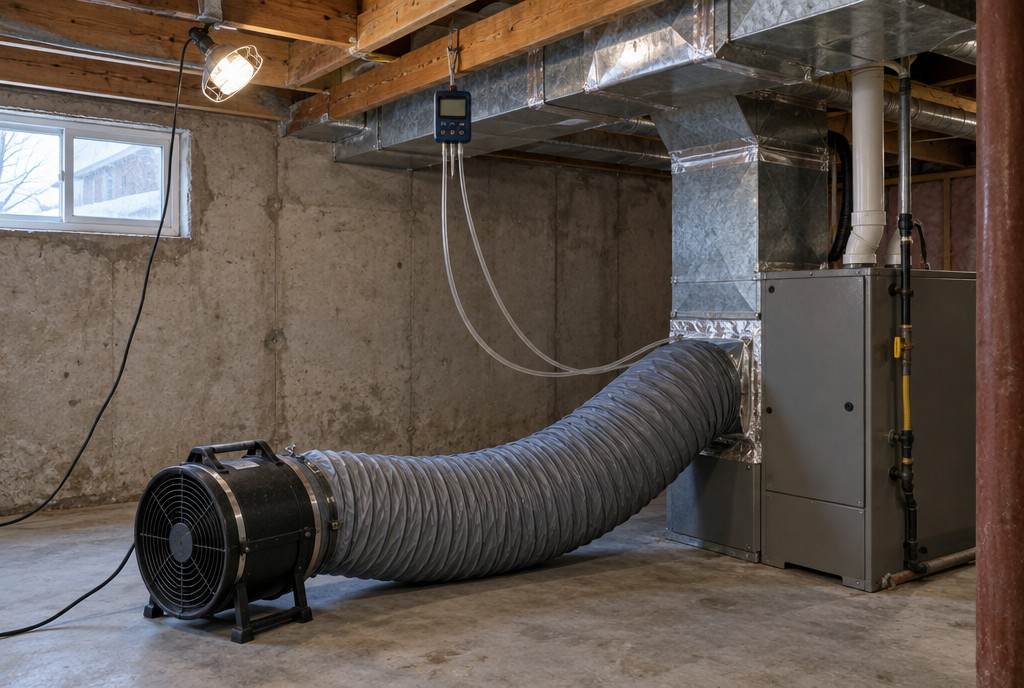
Forced-air homes routinely lose a meaningful share of their conditioned air into walls, attics, and garages before it ever reaches a room — and the rooms at the end of the line pay for it. This test pressure-measures the duct system's leakage and reads the real airflow at every register, which is why it answers comfort complaints that new equipment never fixes.
Cost
$200–$450
Measures
Leakage % + per-room CFM
Explains
Cold far rooms
Fixes
$300 mastic → $3,000 sealing
Registers get taped off, a calibrated fan connects to the system, and the pressure it takes to hold a standard test level reveals total leakage — the same logic as the blower door, applied to the ductwork alone.
A flow hood over every supply and return reads actual delivered air. Labels and design drawings say what should arrive; the hood says what does.
Runs through attics, garages, and bulkheads; disconnected boots; crushed flex duct; panned joist returns that leak from every seam. The test localizes the loss so the fix is surgical.
High static pressure means the system is straining — usually undersized returns or restrictive filters — which quietly wrecks both comfort and equipment life, and matters double for a future heat pump.
Leakage as a share of system airflow, and per-room delivered CFM against each room's need (which the F280 calculation defines). Together they say whether your comfort problem is distribution — and exactly where.
HVAC contractors with duct-testing gear and some energy advisors offer it — ask for it by name when comfort is your complaint, and pair it with the F280 room-by-room calculation so delivered air can be compared to required air. If you're quoted new equipment for a comfort problem without anyone measuring the ducts, that's the tell.
Duct findings have a clean cost ladder:
$300–$800
Mastic and foil tape (never fabric 'duct tape', which dries and falls off) on the joints you can reach — basement trunks, boots, panned returns. High return when the leaks are accessible.
$2,000–$3,000
Sealant mist injected through the system plugs leaks from the inside — the answer when ducts run through closed walls and ceilings you're not opening.
$300–$1,500
Sometimes air arrives but in the wrong proportions: balancing dampers, a return added to a starved room, or a rerouted run fixes distribution without touching leakage.
$200–$600 DIY-able
Runs through unconditioned attics and garages lose heat even when airtight — wrap them after sealing them.
And sometimes the honest finding is that the ducts are fine — the room loses too much heat through its walls and windows, and the fix is envelope, not airflow. That's a good $300 to have spent: it just saved you a duct renovation that wouldn't have worked.
This test plus the thermal scan answers it definitively: the flow hood says whether enough air arrives, and the IR camera says whether the room bleeds heat faster than any airflow could replace. Chasing either fix without the measurements is coin-flipping with thousands of dollars.
No — cleaning removes dust; it doesn't find or fix leakage, airflow, or balance, and it rarely changes comfort or efficiency. If a company leads with cleaning for a comfort complaint, keep looking.
It backfires: closing registers raises system pressure, which increases duct leakage and strains the blower — and in the worst cases stresses the heat exchanger. Balance dampers at the trunk, set by measurement, are the legitimate version of the same idea.
Tell us which rooms never work — we'll match you with an advisor and flag duct and airflow testing in your request.
Email us what you’re planning, your postal code and the type of building (a house, a duplex or triplex, or a larger multi-unit building) — we’ll reply with registered service organizations for your area and which rebates apply.
Email dave@clickshift.ca