Get your free plan → Six short steps for a home in the Chicago area: what to fix first, the tests to ask for and the programs open to you. No email.

Illinois · Indiana · #3 metro by population

Home energy audits in Chicago

Where to get a home energy audit in the Chicago area, what it costs, which rebates are open now and where Illinois and Indiana stand on the federal Home Energy Rebates. Every program links to its official page and was checked on October 12, 2026.

Metro area: Chicago-Naperville-Elgin, IL-IN Metropolitan Statistical Area.

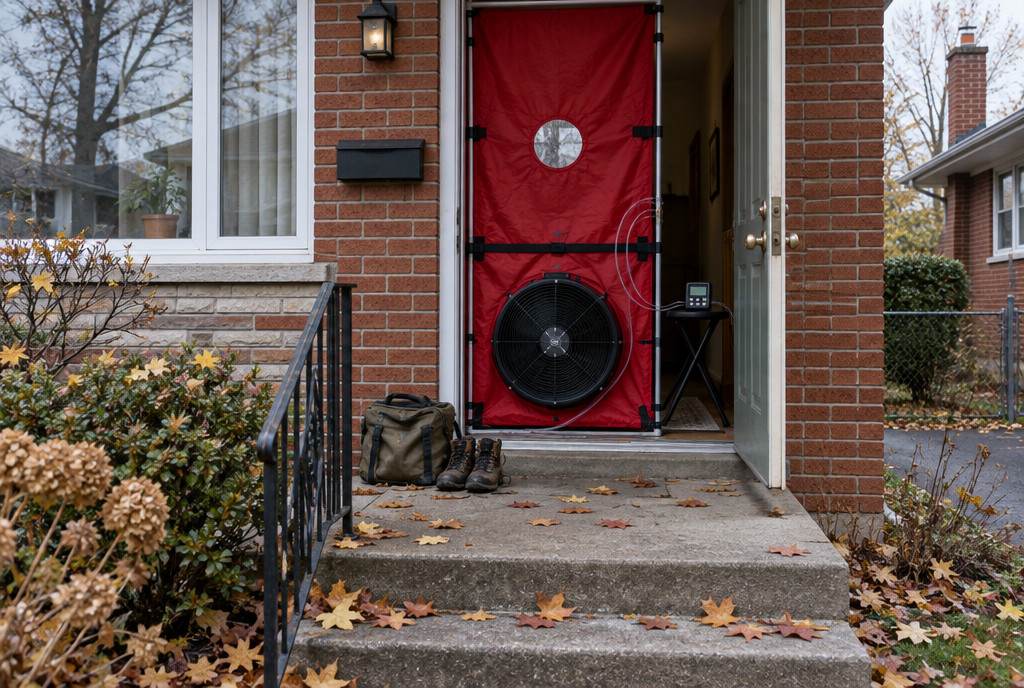
A red blower-door panel with a large fan fitted into the front doorway of a brick bungalow, a pressure gauge on a stool inside
Start here Free Home Energy Savings in-home assessment (ComEd with Nicor Gas, Peoples Gas and North Shore Gas) · Income-qualified
Rebates and incentives open now 9 of 10 1 closed or fully reserved
Federal Home Energy Rebates Not open yet What that means here

Chicago at a glance

Climate zone 5A

IECC 2021 climate zone for Cook County, IL. PNNL ↗

What it means: Cold and humid climate. Heating drives your bills, and older homes lose heat through attics, walls and basements.

Heating and cooling 5,974 HDD · 1,003 CDD

Heating and cooling degree days, base 65°F, 1991–2020 normals at CHICAGO OHARE INTL AP, IL US (USW00094846). NOAA ↗

What it means: Long, cold winters drive the bills here: air sealing, insulation and heating efficiency pay back fastest.

Homes 1953 median year built

46.0% of occupied homes are owner-occupied. Chicago city, Illinois, 2020–2024 ACS 5-year. Census ↗

What it means: Most homes here are old enough that walls may be uninsulated and wiring, lead paint or vermiculite need checking before insulation work; an audit sorts out what to do first.

Radon EPA zone 2

moderate potential: predicted average 2–4 pCi/L (Cook County, IL). EPA says not to use the zone to decide whether to test: high levels turn up in all three zones, so test every home. Radon testing guide · EPA ↗

What energy costs here

State Electricity¢ per kWh · July 2026 Natural gas$ per therm · 2025 average Heating oil$ per gallon · week of Oct 5, 2026 Propane$ per gallon · week of Oct 5, 2026
Illinois 19.2¢ $1.09 $11.25 per thousand cu ft Not reported $1.83
Indiana 16.7¢ $1.11 $11.49 per thousand cu ft $5.76 $2.47

What this means for your bills: Electricity in Illinois costs about the US average (19.2¢ against 18.3¢ per kWh).

  • Electricity: EIA’s average residential price, July 2026 (preliminary; released September 24, 2026). The U.S. average was 18.3¢ per kWh. EIA ↗
  • Natural gas: EIA’s 2025 average residential price per thousand cubic feet, which EIA says includes taxes and delivery, divided by 10.36 therms per thousand cubic feet (EIA’s 2025 average heat content of 1,036 Btu per cubic foot). A full-year average is used because summer months run far higher. EIA ↗
  • Heating oil and propane: EIA’s weekly residential prices, excluding taxes, for the week of October 5, 2026. EIA surveys them only in some states. EIA ↗

Cold and humid Northeast and Great Lakes

What homes in Chicago need

Heating drives your bills, and older homes lose heat through attics, walls and basements.

Heating is the main bill here, and many homes are decades old, with heat escaping through attics, walls and basements. Older houses may need knob-and-tube wiring, vermiculite or lead paint handled before insulation goes in. Air sealing, attic insulation and a combustion safety test are the core of a good audit.

In Chicago: With about 6 nights a year at or below 0°F, Chicago-area heat pumps should be cold-climate models with backup heat. Most homes here heat with gas furnaces, and most houses have basements, so rim-joist sealing and venting checks matter.

What drives bills and comfort here

  • Heating dominates: about 5,500 to 6,100 heating degree days a year, against 800 to 1,000 cooling degree days.
  • Old housing: about 7 to 8 in 10 homes in the core counties were built before 1980, many before 1940.
  • Heating systems differ: boilers heat about 4 in 10 Boston-area homes, while furnaces dominate around Chicago and Detroit.
  • Electricity prices vary: about 19 cents/kWh in Illinois, 23 in Michigan and 30 in Massachusetts (August 2026), which shapes heat pump savings.

Local risks to plan for

  • Winter storms and ice: FEMA rates winter-weather and ice-storm risk very high.
  • Flooding: FEMA rates inland-flood risk very high, so check your basement for water entry.
  • Severe cold: 43 days a year stay below freezing; watch for frozen pipes and ice dams.
  • Radon: Cook and the collar counties are Zone 2, so test every home.

What to check first, and why

  1. Seal the attic and wall tops first

    Air leaks into the attic waste heat and cause ice dams. Seal them, then insulate. ENERGY STAR suggests an R-value of R60 for an uninsulated attic in this zone.

    Ask your auditor: Ask for a blower door test with infrared imaging, and a written list of attic bypasses to seal.

    Blower door testInfrared (thermal) scanAttic inspection

  2. Clear old-house hazards before insulating

    Live knob-and-tube wiring and vermiculite or asbestos must be dealt with before insulation goes in. Paid work that disturbs paint in pre-1978 homes must follow EPA lead-safe rules.

    Ask your auditor: Ask the auditor to check for knob-and-tube wiring, vermiculite and old paint before writing the insulation scope.

    Asbestos and vermiculite checkLead paint test

  3. Test fuel-burning appliances for safe venting

    Air sealing can make open-flue appliances spill exhaust when fans run. A combustion safety test catches backdrafting, and EPA guidance calls for CO testing and alarms.

    Ask your auditor: Ask for a combustion safety test before and after air sealing, and keep CO alarms working.

    Combustion safety testCarbon monoxide check

  4. Fix basement water, then seal rim joists

    Most houses here have basements. Rim joists leak air, and any water problem should be fixed before insulation goes on basement walls.

    Ask your auditor: Ask the auditor to check for water entry and to include rim-joist sealing in the plan.

    Infrared (thermal) scanMold and humidity check

  5. Test for radon, whatever your county's zone

    Zones change sharply around these cities. Suffolk and Wayne are Zone 3 and Cook is Zone 2, but Middlesex County, next to Boston, is Zone 1. EPA says test every home.

    Ask your auditor: Test before work starts and again after air sealing.

    Radon test

  6. Check attic ducts added for central AC

    If central AC was added to a radiator-heated house, its ducts may run through the attic. Typical duct systems lose 20–30% of their air through leaks.

    Ask your auditor: Ask for a duct leakage test, and have any attic ducts sealed and insulated.

    Duct leakage test

Tests that matter most here

  • Blower door test Measures total air leakage and guides sealing. Pair it with infrared to find bypasses and rim-joist leaks. Best timing: Winter, on a calm day.
  • Infrared (thermal) scan Finds missing wall insulation, attic bypasses and rim-joist leaks. Best timing: Winter, when it's at least 18°F colder outside for about 4 hours. Avoid walls that just had sun.
  • Combustion safety test Needed whenever air sealing affects natural-draft boilers, furnaces or water heaters. Best timing: Before and after air sealing, in the heating season.
  • Radon test Radon zones vary from county to county here, so test every home. Best timing: Heating season, with the house closed up. Retest after air sealing.
  • Asbestos and vermiculite check Vermiculite and asbestos must be handled before insulating, and accredited professionals should take any samples. Best timing: During the audit walk-through, before the insulation scope is written.

Upgrades that usually pay off here

  1. Air sealing plus attic insulation. Usually the lowest-cost, highest-impact upgrade in older, heating-dominated homes. ENERGY STAR says sealing and insulating can save up to 10% on annual energy bills.
  2. Dense-pack insulation for empty walls. If your older home's walls have no insulation, dense-pack can fill them. Any knob-and-tube wiring has to be cleared first.
  3. Rim joist and basement wall insulation. Rim joists are a big, often-missed air leak in basement homes. Seal them, and insulate basement walls once any water problems are fixed.
  4. Cold-climate heat pumps. Ductless units suit radiator homes, and ducted ones work where ducts exist. They can displace oil, propane or electric resistance heat. In Massachusetts, Mass Save lists up to $8,500 in 2026 equipment rebates. Choose ENERGY STAR cold-climate or NEEP-listed models.
  5. Sealed-combustion heating or a heat pump water heater. When it's time to replace, sealed-combustion equipment cuts spillage risk in a tighter house. A heat pump water heater suits a basement that stays between 40°F and 90°F.

Heating and cooling equipment

  • A cold-climate heat pump is strongly advised around Chicago (6.5 nights a year at or below 0°F) and Detroit (3.6), and recommended in Boston (0.6).
  • Size to the Manual J heating load. A dual-fuel setup, with your furnace as backup, is one way to cover the coldest days.
  • Federal minimums: 13.4 SEER2 for a split AC, and 14.3 SEER2 with 7.5 HSPF2 for a split heat pump. ENERGY STAR's cold-climate tier for ducted models is 8.1 HSPF2.
  • Radiator and steam homes usually have no ducts. Ductless mini-splits avoid new attic ductwork; if you add ducts, keep them inside the insulated part of the house.

Health and comfort

  • Radon zones change sharply between city and suburban counties, so test every home.
  • Homes built before 1978 are more likely to have lead paint, and most homes here were built before 1980. Hire a lead-safe certified firm for paid work that disturbs paint.
  • Wildfire smoke reached the Midwest and Northeast in 2023. MERV 13 filters and portable air cleaners help on smoky days.
  • Keep relative humidity below 60%. Summer basements often need a dehumidifier, and winter window condensation means the air is too humid.

Common mistakes in this climate

  • Insulating over live knob-and-tube wiring. Old wiring, vermiculite and asbestos need to be handled first. Have suspect material sampled by accredited professionals.
  • Air sealing without combustion and ventilation checks. Open-flue appliances risk backdrafting in a tighter house. At 5 ACH50 or tighter, the code calls for whole-house mechanical ventilation.
  • Plastic sheeting over fiberglass on basement walls. Interior poly against below-grade walls with fiberglass batts can trap moisture.
  • Sizing a heat pump on the cooling load. Heating is the bigger load here. Size to the Manual J heating load, not a rule of thumb.

When to book: Book in the heating season: cold weather gives the clearest infrared images, and closed-house conditions suit radon tests. Allow time to clear wiring or vermiculite before insulation.

Sources for this climate guide · checked October 26, 2026

Common problems in Chicago homes

What each one usually means in this climate, the tests that confirm it and the fixes, cheapest first.

Utilities in the Chicago area

Utility efficiency programs follow the company that delivers your power or gas, so check your bill before you book anything.

Electric

  • ComEd (Commonwealth Edison) Electric delivery for the City of Chicago and most of northern Illinois (ComEd says it delivers energy 'for over 9 million people in northern Illinois'). Its efficiency programs are open only to ComEd residential delivery customers. Source ↗
  • NIPSCO (Northern Indiana Public Service Co.) Electric and gas utility for northern Indiana, which covers the metro's Indiana side (Lake, Porter, Jasper and Newton counties). Check your bill or the utility’s website to confirm it serves your address. Source ↗

Natural gas

  • Peoples Gas City of Chicago. The rebate application says the program 'serves Peoples Gas customers in the city of Chicago'. Source ↗
  • North Shore Gas The '54 communities between Winnetka and the Illinois-Wisconsin border'. It shares rebate programs with Peoples Gas. Source ↗
  • Nicor Gas 'Most of the northern third of Illinois, excluding the city of Chicago', which means most Illinois suburbs in the metro. Source ↗

Chicago homes pair ComEd (electric) with Peoples Gas (gas). Most Illinois suburbs pair ComEd with Nicor Gas, and the north-shore suburbs pair ComEd with North Shore Gas. Some suburbs buy power from municipal or cooperative utilities, which ComEd and Nicor programs don't cover. Illinois EPA's Residential Electrification Catalyst Grant is aimed at those 'municipal and cooperative utility service areas', but only through weatherization agencies. The Indiana counties are served by NIPSCO.

How to get a home energy audit in Chicago

4 programs we track, open ones first. Prices are as each program publishes them. If you want a full diagnostic audit outside these programs, look for a certified auditor: how to find one and what audits cost.

Home Energy Savings in-home assessment (ComEd with Nicor Gas, Peoples Gas and North Shore Gas)

ComEd Energy Efficiency Program, jointly with Nicor Gas, Peoples Gas and North Shore Gas

Open Open to income-eligible customers (at or below 80% AMI) as of October 12, 2026. ComEd says program details are 'subject to change or cancellation due to funding limits'.
Free Income-qualified

Official page ↗ · verified October 12, 2026

Who qualifies
ComEd residential delivery customers in single-family homes, two-flats, condos, mobile or manufactured homes and townhomes. Renters need the landlord's permission. Total household income must be at or below 80% of area median income. ComEd's limits for most of the Chicago metro are $67,150 for 1 person, $76,750 for 2, $86,350 for 3, $95,900 for 4, $103,600 for 5, $111,250 for 6, $118,950 for 7 and $126,600 for 8. Homes without gas service can still take part. Market-rate households can't get the in-home visit; they can do the online self-assessment described below.
What you get
A 60-90 minute in-person walkthrough by a ComEd-authorized energy advisor. ComEd says it is 'a visual walkthrough only – no diagnostic testing is performed'. Free installed products may include LEDs, a programmable or ENERGY STAR smart thermostat, WaterSense showerheads and aerators, hot-water pipe insulation and door sweeps. Advanced power strips, smart sockets and air filters can follow for self-install. You get a personalized report. Households that would benefit most may then get a separate 3-4 hour weatherization assessment (thermal imaging, blower door and combustion safety testing) and free insulation and air sealing, or a referral to IHWAP.
How to book
Online at eesavings.com or call 1-855-433-2700. Nicor customers can also call 855.660.9378. Have your ComEd and gas account numbers ready.

Home Energy Savings online self-assessment

Nicor Gas and ComEd (Home Energy Savings offering)

Open Listed as available on Nicor's page as of October 12, 2026. No dates or funding status are given.
Free Online tool

Official page ↗ · verified October 12, 2026

Who qualifies
Nicor Gas customers, owners and renters. Nicor's page states no income test for the self-assessment, unlike the in-home visit. Customer Select customers who get their gas bill from Nicor Gas are eligible.
What you get
A short online survey (about 20 minutes) that sends free or discounted energy-saving products to your home for self-install, plus recommendations. Nicor notes: 'Customers who complete a self-assessment will not be able to receive additional services through the Home Energy Savings offering.'
How to book
Start at eesavings.com or call 855.660.9378.

Chicago Bungalow Association: Home Energy Savings intake

Chicago Bungalow Association (nonprofit), with ComEd, Nicor Gas, Peoples Gas and North Shore Gas

Open · limits apply Taking applications, but the page warns 'Funding for this program is extremely limited this year' and 'services cannot be guaranteed'.
Free Income-qualified

Cost, as published Free assessment

Official page ↗ · verified October 12, 2026

Who qualifies
Homeowners, or renters with the owner's consent, in single-family homes, two-flats, condos and townhomes in ComEd territory. Household income must be at or below 80% AMI. You can't have taken part in Energy Savers or Home Energy Savings before. For two-flats, both units must take part to be considered for additional products and services.
What you get
The same ComEd Home Energy Savings assessment and free products, with weatherization for certain eligible customers.
How to book
Online application at chicagobungalow.org/apply2025, which asks for your 10-digit ComEd Choice ID. If you're eligible, they contact you to schedule.

NIPSCO Home Energy Assessment (Indiana side of the metro)

NIPSCO, delivered by TRC

Open · limits apply Open as of October 12, 2026. The page says 'Program funds for 2026 are limited' (first come, first served), and insulation and air sealing must be finished before the end of the 2026 program year.
Free

Official page ↗ · verified October 12, 2026

Who qualifies
NIPSCO residential customers with active service in a home more than five years old. You can't have had a NIPSCO-sponsored assessment or Income Qualified Weatherization in the past three years, or a NIPSCO Virtual Home Energy Assessment in the last 12 months. Renters need written landlord permission before permanent products are installed. There is no income test.
What you get
A 1-2 hour visit that includes an HVAC efficiency review, a custom home energy report (NIPSCO values it at $250) and direct install of some or all of these: ENERGY STAR LEDs, duct sealing, aerators, showerheads, pipe wrap, a smart Wi-Fi thermostat and outlet gaskets. Follow-up incentives are up to $200 off air sealing (blower door tested) and up to $700 off attic insulation from R-11 or less to R-38 or more, both by a licensed contractor.
How to book
Use the 'Schedule Now' link on the page or call TRC at 1-800-721-7385.

Rebates and incentives now

10 offers we track for the Chicago metro; 9 are open as of October 12, 2026. Many require the program’s own contractor or an audit first, so read the terms before you buy.

Insulation and air sealing 2 open of 2

Nicor Gas insulation, air sealing, duct sealing and window rebates

Nicor Gas Energy Efficiency Program

Open Open for 2026. Install between January 1 and December 31, 2026, and apply within 90 days of installation or by January 31, 2027, whichever comes first.

Official page ↗ · verified October 12, 2026

Amount Air sealing $500 (at least a 200 CFM reduction). Attic insulation $400 (from R20 or less to R49 or more, after air sealing). Exterior wall insulation $150. Foundation sidewall insulation $200. Duct sealing $600. Low-e storm window inserts $100 per window, up to $1,000. ENERGY STAR windows $100-$125 per window, up to $3,000 per home.

Who qualifies Nicor Gas residential customers. Air sealing, insulation, duct sealing and window work must be done by a program-approved contractor.

Peoples Gas / North Shore Gas Home Energy Rebates (weatherization and HVAC)

Peoples Gas and North Shore Gas energy efficiency program (applications are processed by Franklin Energy)

Open · limits apply Open for 2026. The application is 'Valid Jan. 1, 2026 - Dec. 31, 2026', and applications are due within 30 days of installation or by December 31, 2026, whichever comes first. 'Funds are limited.'

Official page ↗ · verified October 19, 2026

Amount Weatherization, as an instant discount through an approved contractor, capped at $1,200 per project: air sealing 40 cents per CFM reduction (up to $400); wall insulation 50 cents per sq ft (up to $400, only with air sealing); attic insulation 30 cents per sq ft (up to $500, existing R0-R14 raised to R49 or more, only with air sealing); duct sealing $2 per CFM25 reduction (up to $400). Equipment: furnace $200 at 95% AFUE or more, $225 at 97% or more; hot-water boilers up to $350; boiler plus integrated domestic hot water up to $500; steam boiler at 82.5% AFUE or more $150; tankless or indirect water heater $150; smart thermostat $25; programmable thermostat $20; pipe insulation $1 per linear foot. Confirm current amounts with the program before you buy.

Who qualifies Single-family homes, two-flats and individually metered condos or townhomes with an active Service Classification 1 Peoples Gas (City of Chicago) or North Shore Gas account. Insulation and duct sealing must be done by an approved contractor.

Heat pumps 2 open of 2

ComEd heat pump instant discounts (ducted air-source and ductless mini-split)

ComEd Energy Efficiency Program

Open Available as of October 12, 2026, with no end date stated. Taken off the contractor's invoice, with no application. 'Program details are subject to change or cancellation due to funding limits.'

Official page ↗ · verified October 12, 2026

Amount Ducted air-source: Tier 1 (at least 15.2 SEER2, 9.4 EER2 and 8.1 HSPF2) up to $900, or up to $1,400 at 2.5 tons or more. Tier 2 (at least 17 SEER2, 9.4 EER2 and 8.5 HSPF2) up to $2,000 at 2.5 tons or more, or up to $1,500 below that. Ductless mini-split (at least 17 SEER2, 9.4 EER2 and 9 HSPF2) up to $500, or up to $1,000 at 1.5 tons or more. Plus $75 for an ENERGY STAR smart thermostat installed with the heat pump.

Who qualifies ComEd residential customers. The work must be installed by a ComEd Heat Pump Trained Contractor, and self-installs don't qualify. Equipment must be AHRI-listed and use refrigerant with a global warming potential of 700 or less. ComEd says sell-through R-410A equipment became eligible 'effective July 27, 2026'.

ComEd geothermal (ground-source) heat pump incentive

ComEd Energy Efficiency Program

Open Available as of October 12, 2026. Paid as an invoice credit or a check after completion.

Official page ↗ · verified October 12, 2026

Amount Up to $6,000 per home for qualifying water-to-air or water-to-water systems, closed or open loop, or DGX. Indoor-unit replacements get $800 at 17 EER or more and $1,200 at 20 EER or more.

Who qualifies ComEd residential customers. The installer must be an ICC-certified ComEd Energy Efficiency Service Provider with geothermal certification, and every project needs pre-approval.

Appliances and equipment 3 open of 3

ComEd heat pump water heater discount

ComEd Energy Efficiency Program

Open Available as of October 12, 2026.

Official page ↗ · verified October 12, 2026

Amount Up to $750 per unit. Integrated units need a UEF of 3.30 or more; 120V/15A and split systems need 2.20 or more.

Who qualifies ComEd residential customers. Taken off the invoice through a ComEd Heat Pump Water Heater Contractor, or claimed as a $750 appliance rebate.

ComEd ENERGY STAR appliance rebates (standard)

ComEd Energy Efficiency Program

Open Open for 2026 purchases. Buy by December 31, 2026 and apply within 60 days of purchase or by February 28, 2027, whichever comes first.

Official page ↗ · verified October 12, 2026

Amount Air purifier $50; all-in-one washer with electric dryer $250; all-in-one washer with heat pump dryer $350; clothes washer $40; dehumidifier $45; electric dryer $40; heat pump dryer $200; heat pump water heater $750; select induction cooktops and ranges $100; smart thermostat $75; weatherization products up to $3 off in stores.

Who qualifies Current ComEd residential delivery customers. Limits are two air purifiers and two dehumidifiers per account per program year, and one of each other appliance. The rebates can't be combined with other ComEd efficiency offers.

Nicor Gas heating, water heating and thermostat rebates

Nicor Gas Energy Efficiency Program

Open Open for 2026. Install between January 1 and December 31, 2026; apply within 90 days or by January 31, 2027.

Official page ↗ · verified October 12, 2026

Amount Furnace: $225 at 97% AFUE or more, $150 at 95% or more. Furnace plus smart thermostat bundle: $275 at 97% or more, $200 at 95% or more. Boiler at 95% AFUE or more: $350. Combination boiler: $500. Tankless or tanked water heater: $150. Smart thermostat: $25 (one per household). Pool covers: $1.25 per sq ft indoor, $0.75 per sq ft outdoor.

Who qualifies Nicor Gas residential customers. Products must be installed by a professional contractor.

Income-qualified offers 1 open of 2

ComEd income-eligible appliance rebates and instant discounts (higher amounts)

ComEd Energy Efficiency Program

Open Open for 2026 purchases (buy by December 31, 2026; apply within 60 days or by February 28, 2027).

Official page ↗ · verified October 12, 2026

Amount Air purifier $75; all-in-one washer with electric dryer $350; all-in-one washer with heat pump dryer $550; clothes washer $150; dehumidifier $75; electric dryer $150; heat pump dryer $400; select induction cooktops and ranges $150; room AC $75 (seasonal); smart thermostat $100. In-store discounts: advanced power strips up to $13, smart plugs up to $7, low-flow showerheads up to $9, weatherization products up to $5, LED night lights up to $10.

Who qualifies ComEd residential customers with total household income at or below 80% AMI (for example, $95,900 for a 4-person household in most of the Chicago metro).

ComEd Whole Home Electric (free heat pump and electric appliances for income-eligible homes)

ComEd Energy Efficiency Program (Chicago Bungalow Association also takes applications)

Closed Closed for gas-heated homes for 2026. ComEd: '2026 funding for homes currently heated with natural gas has been fully allocated... Please check back in January 2027.' Ask the program whether electric- or propane-heated homes are still being enrolled; call 855-433-2700.

Official page ↗ · verified October 12, 2026

Amount Free for single-family customers: an air-source heat pump, a heat pump water heater (or ENERGY STAR electric water heater), an induction or electric stove, and a heat pump or electric dryer, depending on the home.

Who qualifies ComEd customers with household income at or below 80% AMI. The Chicago Bungalow Association version also requires a single-family home or two-flat, a furnace, and heating or cooling equipment 5 or more years old.

Financing 1 open of 1

Illinois Energy Efficiency Loan Program (on-bill financing)

Energy Finance Solutions with ComEd, Nicor Gas, Peoples Gas, North Shore Gas and Ameren Illinois

Ending soon ComEd's on-bill financing is closing. The site says ComEd 'expects to stop accepting new OBF applications on October 15, 2026' and that 'Beginning January 1, 2027, the OBF Program will no longer be offered to new customers.' Nicor Gas, Peoples Gas and North Shore Gas measures are still listed, with no end date shown.

Official page ↗ · verified October 12, 2026

Amount $500-$20,000, unsecured, at a 7.49% fixed rate for 1-10 years. 7- and 10-year terms need a loan over $8,000. No fees and no prepayment penalty. Repaid as a monthly charge on the utility bill.

Who qualifies Owner- or tenant-occupied 1-4 unit homes, condos and mobile homes. The account must be current, and all borrowers must be on the utility bill.

Statewide rebate programs and federal options: rebates and programs.

Heat pumps in Chicago → What a heat pump costs to run here for cooling and heating, each heat pump rebate with the equipment rule that decides which models qualify, and the certified systems and brands that suit the climate.

Federal Home Energy Rebates in Illinois and Indiana

The two federal rebate programs, HOMES (whole-home efficiency) and the high-efficiency electric home rebates (HEAR, renamed HEEHR in 2026), are run by each state, so availability depends on the state. DOE rewrote the rules effective May 29, 2026 (Program Notice 26-2 ↗): no more federal rebates for switching from gas, oil or propane to electric equipment, and insulation and air sealing come before heating and cooling upgrades unless a home already meets a state-set level.

Status for the Chicago metro
Not open yet Illinois hasn't launched either federal Home Energy Rebate program: HEEHR for electric appliances or HOMES for whole-home upgrades. Official page ↗ verified October 12, 2026

Program: Illinois Home Energy Rebate Programs: Home Efficiency Rebates (HOMES, IRA Section 50121) and Home Electrification and Appliance Rebates (HEAR, Section 50122)

Run by: Illinois EPA Office of Energy. HOMES is to be run by the Illinois Department of Commerce and Economic Opportunity (DCEO).

Illinois was allocated $263 million and neither program has launched as of October 12, 2026. On HOMES, Illinois EPA says it 'intends to launch a pilot... with two Local Administering Agencies' and 'The program launch is pending USDOE approval.' On HEAR, the application 'has not yet been processed by USDOE or provided to Illinois EPA for administration or distribution.' Illinois plans to put 100% of rebate funds toward households below 80% AMI at first, with at least 10% for low-income multifamily. It will not pay retroactive rebates. The page gives no launch date or rebate amounts. On the Indiana side of the metro, the Indiana Energy Saver Program (HOMES and HEAR, about $182 million, run by the Indiana Office of Energy Development) launched May 14, 2025, and its official pages show applications open (indianaenergysaver.com).

StateHEAR / HEEHR (electric appliances)HOMES (whole-home efficiency)
Illinois Illinois rebate guide
Not open yet not launched (state says its HEAR application has not yet been processed by DOE) Official page ↗ verified October 12, 2026
Not open yet not launched (pilot pending DOE approval) Official page ↗ verified October 12, 2026
Indiana Indiana rebate guide
Open open (applications open per OED) Official page ↗ verified October 12, 2026

How the programs work: Home Energy Rebates explained · every state’s status.

Help for lower-income households

Illinois Home Weatherization Assistance Program (IHWAP), delivered in Cook County by CEDA

Illinois DCEO (statewide). CEDA (Community and Economic Development Association of Cook County) delivers it locally.

Free weatherization: air sealing, insulation, heating repair or replacement and ventilation (windows usually not eligible), up to $20,000 per home. Household income must be at or below 200% of the federal poverty level. CEDA serves owner-occupied buildings of up to four units that are structurally sound and haven't had IHWAP in the last 15 years. Elderly, disabled and young-child households get priority. Apply through DCEO's online pre-application, by calling 1-800-571-2332, or at a CEDA partner intake site. Peoples Gas (the City of Chicago's gas utility) sends customers to CEDA for weatherization. DCEO's directory sends 'Cook County (Outside of Chicago)' to CEDA, and 'Chicago only' to the City's Department of Family and Support Services, which lists only CSBG services. Collar-county agencies on DCEO's list include DuPage County Department of Community Services, Will County Center for Community Concerns, Community Action Partnership of Lake County, McHenry County Housing Authority, Kendall-Grundy Community Action and Family Services Agency of DeKalb County.

Official page ↗ · verified October 12, 2026

ComEd Home Energy Savings weatherization path

ComEd with Nicor Gas, Peoples Gas and North Shore Gas. The work is done by Community Action Agencies or participating efficiency contractors.

Households at or below 80% AMI that complete the free in-home assessment may get a diagnostic weatherization assessment and free insulation, air sealing and duct sealing. Some also get heating or cooling repair or replacement and health and safety fixes, sometimes coordinated with IHWAP.

Official page ↗ · verified October 12, 2026

Green Homes Chicago

City of Chicago Department of Housing and Department of Environment, with Elevate and Zero Homes. ComEd committed $1 million from Whole Home Electric to cost-share.

Free whole-home retrofits (insulation, cold-climate heat pumps, efficient appliances, health and safety repairs) for owner-occupied 1-2 unit homes that are the owner's only residence, with income at or below 80% AMI. Condos, mixed-use and 3+ unit buildings don't qualify, and windows, doors and boilers aren't covered. Registration is closed. The last window ran from 9:00 am February 17 to 4:30 pm February 27, 2026, and registering didn't guarantee service.

Official page ↗ · verified October 12, 2026

City of Chicago Emergency Heating Repair Program

City of Chicago Department of Housing

Free emergency heating system repair or replacement (not water heaters) for owner-occupants of 1-4 unit Chicago properties at or below 80% AMI who have been on the deed at least a year. As of October 12, 2026 the page says it 'is currently closed and not accepting applications.'

Official page ↗ · verified October 12, 2026

City of Chicago Home Repair Program (roof and porch)

City of Chicago Department of Housing

Roof and porch repairs plus small accessibility fixes for homeowners at or below 50% AMI. This is a repair program, not energy-specific. 'Home Repair Program registration will not be opening in 2026.' Applicants from 2024-2025 stay on the waitlist.

Official page ↗ · verified October 12, 2026

Chicago Bungalow Association programs

Chicago Bungalow Association (nonprofit)

Takes applications for ComEd Home Energy Savings and Whole Home Electric (both at or below 80% AMI, ComEd territory) and points to CEDA weatherization, furnace assistance and the Illinois Energy Efficiency Loan. Its programs page still lists the federal 25C tax credit as available, but that credit ended for property placed in service after 2025 (IRS).

Official page ↗ · verified October 12, 2026

Indiana Weatherization Assistance Program (Indiana side of the metro)

Indiana Housing & Community Development Authority (IHCDA) through local agencies

Indiana's Office of Energy Development says IHCDA runs the Weatherization Assistance Program for low-income Hoosiers. I didn't verify the local agency for Lake and Porter counties.

Official page ↗ · verified October 12, 2026

Local energy rules

None of the 3 rules we found reach ordinary homes.

Not for ordinary homes

Chicago Energy Benchmarking Ordinance

Who it applies to Large buildings only: existing commercial, institutional and residential buildings over 50,000 sq ft. It does not affect ordinary homeowners.

Owners benchmark whole-building energy use in ENERGY STAR Portfolio Manager every year, report to the City by June 1, and have the data verified by a credentialed professional every three years.

Official page ↗ · verified October 12, 2026

Not for ordinary homes

Chicago Energy Rating System (placard)

Who it applies to Large buildings only (50,000 sq ft or more). It does not affect single-family homes.

Benchmarked buildings get a 1-4 star rating placard that must be posted in a prominent place and shared when the property is listed for sale or lease.

Official page ↗ · verified October 12, 2026

Proposed · not in force

Clean and Affordable Buildings Ordinance (proposed)

Who it applies to New construction only, as proposed. It does not cover existing homes.

Introduced January 24, 2024 to set an emissions standard that would push most new buildings to all-electric. It was sent to the Rules Committee. Check whether it passed. Treat it as pending, not as a rule homeowners must follow.

Official page ↗ · verified October 12, 2026

Notes worth knowing

  • As of October 12, 2026: (1) The free utility in-home assessment in ComEd territory is now income-qualified (80% AMI or less).
  • Market-rate Chicago-area homeowners get only the online self-assessment and kit, so a diagnostic (blower door) audit means paying a private auditor.
  • Nicor itself says an energy audit 'may cost between $100 and $500 or more'.
  • ComEd's on-bill financing stops taking new applications about October 15, 2026 and closes to new customers January 1, 2027.
  • ComEd Whole Home Electric funding for gas-heated homes is fully allocated for 2026.
  • Illinois has not launched its IRA HOMES or HEAR rebates (pending USDOE).
  • Green Homes Chicago registration closed February 27, 2026.
  • Some partner pages (Chicago Bungalow Association, Indiana OED) still describe the federal credits as available.

Chicago: common questions

How do I get a home energy audit in Chicago?

Start with Home Energy Savings in-home assessment (ComEd with Nicor Gas, Peoples Gas and North Shore Gas). Run by: ComEd Energy Efficiency Program, jointly with Nicor Gas, Peoples Gas and North Shore Gas. It’s for income-qualified households. Cost: Free. Who qualifies: ComEd residential delivery customers in single-family homes, two-flats, condos, mobile or manufactured homes and townhomes. Renters need the landlord's permission. Total household income must be at or below 80% of area median income. ComEd's limits for most of the Chicago metro are $67,150 for 1 person, $76,750 for 2, $86,350 for 3, $95,900 for 4, $103,600 for 5, $111,250 for 6, $118,950 for 7 and $126,600 for 8. Homes without gas service can still take part. Market-rate households can't get the in-home visit; they can do the online self-assessment described below. How to book: Online at eesavings.com or call 1-855-433-2700. Nicor customers can also call 855.660.9378. Have your ComEd and gas account numbers ready. We track 4 audit programs for the Chicago metro, checked October 12, 2026; all of them are on this page.

Are the federal Home Energy Rebates available in Chicago?

Illinois hasn't launched either federal Home Energy Rebate program: HEEHR for electric appliances or HOMES for whole-home upgrades. Checked October 12, 2026. Nationally, DOE rewrote the rules effective May 29, 2026: federal appliance rebates no longer pay for switching from gas, oil or propane to electric equipment, and homes must get insulation and air sealing before heating and cooling upgrades unless they already meet a state-set level.

Is there help for lower-income households in Chicago?

Yes. Programs for income-qualified households in the Chicago metro include Illinois Home Weatherization Assistance Program (IHWAP), delivered in Cook County by CEDA, ComEd Home Energy Savings weatherization path, Green Homes Chicago, City of Chicago Emergency Heating Repair Program, City of Chicago Home Repair Program (roof and porch), Chicago Bungalow Association programs and Indiana Weatherization Assistance Program (Indiana side of the metro). Each one’s rules and contacts are listed on this page, with a link to its official page.

Which local energy rules affect homeowners in Chicago?

None of the local energy rules we track applies to ordinary existing homes. 2 rules apply only to larger buildings. Proposed, not in force: Clean and Affordable Buildings Ordinance (proposed).

Can I claim a federal tax credit for an energy audit in Chicago?

Not for an audit done in 2026. The federal credit of up to $150 for a home energy audit was part of the Energy Efficient Home Improvement Credit (25C), and the IRS says it can’t be claimed for audits paid for or done after December 31, 2025. Public Law 119-21 ended 25C and the Residential Clean Energy Credit (25D) for 2026 work. An audit done in 2025 is claimed on the 2025 return (Form 5695).

Sources and checks

Every source below was opened and checked on October 12, 2026.

Planning upgrades in Chicago?

Tell us your ZIP code, the kind of home you have and what you’re planning. A person reads every message and replies with the certified auditors and utility programs that serve your area.

A person replies by email. We don’t sell your details or share them with contractors. See our privacy note.