Get your free plan → Six short steps for a home in the Charlotte area: what to fix first, the tests to ask for and the programs open to you. No email.

North Carolina · South Carolina · #21 metro by population

Home energy audits in Charlotte

Where to get a home energy audit in the Charlotte area, what it costs, which rebates are open now and where North Carolina and South Carolina stand on the federal Home Energy Rebates. Every program links to its official page and was checked on October 12, 2026.

Metro area: Charlotte-Concord-Gastonia, NC-SC Metropolitan Statistical Area.

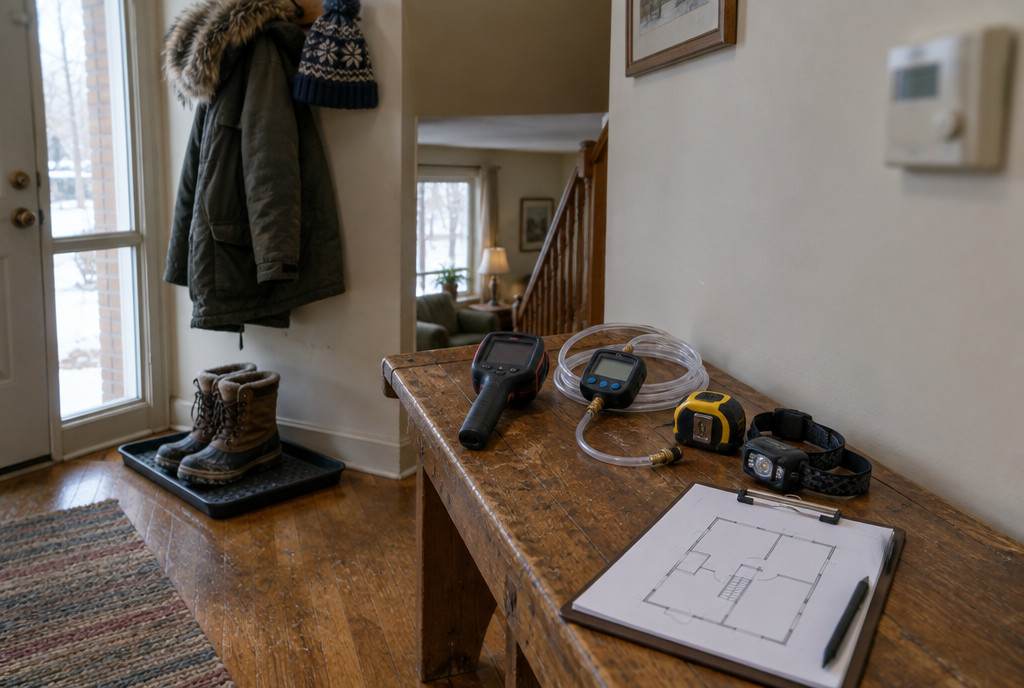
An energy advisor’s kit on a front-hall bench: infrared camera, pressure gauge with tubing, tape measure, headlamp and a floor sketch
Start here Free Duke Energy Home Energy House Call
Rebates and incentives open now 3 of 7 4 not open yet or without a posted status
Federal Home Energy Rebates Open What that means here

Charlotte at a glance

Climate zone 3A

IECC 2021 climate zone for Mecklenburg County, NC. PNNL ↗

What it means: Warm mixed-humid climate. Long, muggy summers and short winters; ducts, crawlspaces and humidity drive comfort.

Heating and cooling 3,058 HDD · 1,769 CDD

Heating and cooling degree days, base 65°F, 1991–2020 normals at CHARLOTTE DOUGLAS AP, NC US (USW00013881). NOAA ↗

What it means: Mild winters and modest summers: comfort fixes and efficient equipment matter more than big heating savings.

Homes 1995 median year built

51.0% of occupied homes are owner-occupied. Charlotte city, North Carolina, 2020–2024 ACS 5-year. Census ↗

What it means: Homes from the 1980s and 1990s usually have insulation, but ducts, attic air leaks and aging heating and cooling equipment are common audit findings.

Radon EPA zone 3

low potential: predicted average below 2 pCi/L (Mecklenburg County, NC). EPA says not to use the zone to decide whether to test: high levels turn up in all three zones, so test every home. Radon testing guide · EPA ↗

What energy costs here

State Electricity¢ per kWh · July 2026 Natural gas$ per therm · 2025 average Heating oil$ per gallon · week of Oct 5, 2026 Propane$ per gallon · week of Oct 5, 2026
North Carolina 15.2¢ $1.58* $16.42 per thousand cu ft $5.82 $3.58
South Carolina 15.5¢ $1.63* $16.91 per thousand cu ft Not reported Not reported

What this means for your bills: Electricity in North Carolina is cheaper than the US average (15.2¢ against 18.3¢ per kWh), which keeps air conditioning and heat pumps cheaper to run.

  • Electricity: EIA’s average residential price, July 2026 (preliminary; released September 24, 2026). The U.S. average was 18.3¢ per kWh. EIA ↗
  • Natural gas: EIA’s 2025 average residential price per thousand cubic feet, which EIA says includes taxes and delivery, divided by 10.36 therms per thousand cubic feet (EIA’s 2025 average heat content of 1,036 Btu per cubic foot). A full-year average is used because summer months run far higher. EIA ↗ *North Carolina: 2024 average; EIA published no 2025 average. *South Carolina: 2024 average; EIA published no 2025 average.
  • Heating oil and propane: EIA’s weekly residential prices, excluding taxes, for the week of October 5, 2026. EIA surveys them only in some states. EIA ↗

Warm mixed-humid Southeast Piedmont

What homes in Charlotte need

Long, muggy summers and short winters; ducts, crawlspaces and humidity drive comfort.

Summers here are long and muggy, and winters are short but bring regular freezes. Ducts running through hot attics and damp crawlspaces waste energy, and controlling humidity matters as much as temperature. A good audit tests the ducts, checks the attic and crawlspace, and includes a radon test in the Atlanta area.

In Charlotte: Half of Mecklenburg County's homes were built in 1997 or later, and more than half heat with electricity, so heat pump efficiency shows up in winter bills. Mecklenburg is radon Zone 3, but EPA still says to test.

What drives bills and comfort here

  • Both seasons count: 47–49 days a year reach 90°F, and 36–58 nights fall to 32°F or below.
  • Very humid summers: July dew points average about 68°F, so your AC must dry the air as well as cool it.
  • Where ducts run through attics or crawlspaces, leaks and heat loss can waste 10–45% of heating and cooling energy.
  • Electric heat is common: about half of homes heat with electricity, so heat pump efficiency shows up in winter bills too.

Local risks to plan for

  • Ice storms: FEMA rates ice-storm risk relatively high, so plan for winter outages.
  • Severe storms: FEMA rates tornado and strong-wind risk relatively high.
  • Freezes: about 58 nights a year; protect pipes in crawlspaces and attics.
  • Extreme heat: about 49 days a year reach 90°F or more.

What to check first, and why

  1. Test and seal ducts in attics and crawlspaces

    Leaky or poorly insulated ducts in unconditioned space can waste 10–45% of heating and cooling energy, and typical systems lose 20–30% of their air to leaks.

    Ask your auditor: Ask for a duct leakage test that measures both total leakage and leakage to outside.

    Duct leakage test

  2. Dry out and close up the crawlspace

    EPA's retrofit guidance favors turning vented crawlspaces into sealed, insulated and drained spaces, with a sealed vapor barrier over any dirt floor.

    Ask your auditor: Ask the auditor to check crawlspace humidity, wood moisture and standing water, and whether closing it makes sense.

    Mold and humidity check

  3. Test for radon

    Radon zones vary sharply here: Atlanta's core counties are EPA Zone 1, the highest-potential zone, while Mecklenburg (Charlotte) is Zone 3. EPA says test every home.

    Ask your auditor: Test before air sealing and again after.

    Radon test

  4. Seal, insulate and shade the attic

    ENERGY STAR suggests an R-value of R49 for an uninsulated attic in this zone. A radiant barrier typically trims 8–12% of cooling costs and helps most when ducts run through the attic.

    Ask your auditor: Ask for attic air sealing first, then insulation, and whether a radiant barrier suits your roof and ducts.

    Attic inspectionBlower door testInfrared (thermal) scan

  5. Right-size cooling and control humidity

    An oversized AC or heat pump short-cycles and leaves indoor humidity high. Aim to keep relative humidity below 60%.

    Ask your auditor: Ask for a Manual J load calculation before replacing equipment, and log indoor humidity for a few days.

    Manual J load calculationMold and humidity check

  6. Check gas furnaces and water heaters vent safely

    Where gas equipment remains, open-flue appliances can spill exhaust after air sealing.

    Ask your auditor: Ask for a combustion safety test if you have gas appliances.

    Combustion safety testCarbon monoxide check

Tests that matter most here

  • Duct leakage test Measures total leakage and leakage to outside for ducts in attics and crawlspaces. Best timing: Any season.
  • Blower door test Measures whole-house leakage. With infrared, it finds attic bypasses, knee-wall gaps and missing insulation. Best timing: Winter mornings, when lows average 32–36°F, or hot afternoons with the AC running.
  • Mold and humidity check A crawlspace check of humidity, wood moisture, standing water and ground cover shows mold risk; indoor humidity logs show whether the AC dries the air. Best timing: Late summer, when crawlspace humidity peaks.
  • Radon test Zones run from 1 to 3 across this region, and EPA says test every home. Best timing: With the house closed up, before and after air sealing.
  • Manual J load calculation A Manual J load calculation sizes a new AC or heat pump so it runs long enough to dry the air. Best timing: Before you get quotes for new equipment.

Upgrades that usually pay off here

  1. Seal and insulate ducts, or move them inside. Ducts in attics and crawlspaces can waste 10–45% of heating and cooling energy, so this is often the biggest avoidable loss.
  2. Attic sealing, R49 insulation and a radiant barrier. Cuts winter heat loss and summer attic heat. A radiant barrier pays off most when ducts run through the attic.
  3. Closed crawlspace with drainage and dehumidification. Controls humidity, mold and musty odors under the house.
  4. Right-sized variable-speed heat pump. It handles mild winters and long, humid summers. Cold-climate models aren't required here, but check heating capacity on freezing nights. Ask how the system controls humidity.
  5. Heat pump water heater. It works in a garage or indoor space that stays between 40°F and 90°F, and it cools and dehumidifies that space.

Heating and cooling equipment

  • Southeast rules apply: a new split AC must be at least 14.3 SEER2 (13.8 for the largest sizes), based on installation date.
  • Split heat pumps must meet at least 14.3 SEER2 and 7.5 HSPF2. ENERGY STAR models start at 15.2 SEER2 and 7.8 HSPF2.
  • If relative humidity stays above 60% after the system is right-sized, add dehumidification. A dehumidifier won't fix an oversized AC or leaky ducts.

Health and comfort

  • Radon can be high even in the South: test every home, before and after air sealing.
  • Damp crawlspaces can bring mold and musty smells into the house. Keep indoor relative humidity below 60%.
  • AC failure is the usual reason homes here get uncomfortably hot, so keep your system serviced before summer.

Common mistakes in this climate

  • Plastic or vinyl on the inside of exterior walls. The code requires no interior vapor retarder in this zone, and plastic or vinyl wallcovering can trap summer moisture inside the wall.
  • Venting the crawlspace or leaving bare dirt. Humid summer air vented into a cool crawlspace adds moisture. Cover dirt floors with a sealed vapor barrier.
  • Buying a bigger AC than you need. Oversized systems short-cycle and leave the house humid.
  • Skipping radon because 'the South is low'. Radon turns up in all three EPA zones, and some counties here are Zone 1, the highest-potential zone.

When to book: Book any time. Late summer shows crawlspace moisture best, and winter mornings or hot afternoons suit infrared. Test radon with the house closed up, before and after air sealing.

Sources for this climate guide · checked October 26, 2026

Common problems in Charlotte homes

What each one usually means in this climate, the tests that confirm it and the fixes, cheapest first.

Utilities in the Charlotte area

Utility efficiency programs follow the company that delivers your power or gas, so check your bill before you book anything.

Electric

  • Duke Energy Carolinas About 2.3 million households and businesses in central and western North Carolina, 'including Charlotte, Durham and the Triad' (July 17, 2026). It has 3 million customers across a 24,000-square-mile area in NC and SC. Source ↗

Natural gas

  • Piedmont Natural Gas Duke Energy subsidiary distributing gas to more than 1.2 million customers in North Carolina, South Carolina and Tennessee (Jan. 16, 2026). Charlotte and the surrounding area are among 'the communities it serves' (July 13, 2026). Source ↗

Duke and Piedmont details here come from Duke's official newsroom (news.duke-energy.com) and are dated. City-owned systems and electric co-ops in outlying counties, and utilities on the South Carolina side (Chester, Lancaster, York), aren’t covered in this guide.

How to get a home energy audit in Charlotte

3 programs we track, open ones first. Prices are as each program publishes them. If you want a full diagnostic audit outside these programs, look for a certified auditor: how to find one and what audits cost.

Duke Energy Home Energy House Call

Duke Energy Carolinas

Open open (promoted by Duke on 2026-03-06, 2026-06-06 and 2026-07-27)
Free

Official page ↗ · verified October 12, 2026

Who qualifies
Duke Energy Carolinas residential customers. Check the eligibility rules with the program before you apply.
What you get
A home energy assessment, a customized usage report, low-cost tips, expert recommendations and a free energy-efficiency kit. Since Jan. 1, 2025 it also includes free products customized to the home and installed at no charge, with virtual assessments for eligible customers.
How to book
Sign up through the Home Energy House Call page on duke-energy.com, linked from Duke's 2026 news releases.

Piedmont Natural Gas Energy Advisor

Piedmont Natural Gas

Open open (online tool, per Piedmont release of 2026-01-16)
Free Online tool

Official page ↗ · verified October 12, 2026

Who qualifies
Piedmont customers with an online account.
What you get
An online tool showing 'how energy efficient their home is' and where to improve, based on the home's own data. Piedmont also offers water heater, cooking and dryer cost calculators.
How to book
Online through the customer's Piedmont account.

Energy Saver North Carolina (HOMES) home energy assessment

NC Department of Environmental Quality, State Energy Office

Open · limits apply open (available in all 100 NC counties since 2026-02-10; first come, first served)
Free Income-qualified

Official page ↗ · verified October 12, 2026

Who qualifies
NC homeowners and renters (with landlord approval) with household income under 150% of area median income, after income eligibility is confirmed.
What you get
A certified assessor does a free home energy assessment. You then review quotes from Energy Saver NC-registered contractors with the rebate already applied.
How to book
Start the prequalification form at energysavernc.org, or call 866-998-8555 (Mon-Fri 8-5).

Rebates and incentives now

7 offers we track for the Charlotte metro; 3 are open as of October 12, 2026. Many require the program’s own contractor or an audit first, so read the terms before you buy.

Whole-home upgrades 1 open of 1

Energy Saver NC: HOMES (Homeowners Managing Efficiency Savings)

NC DEQ State Energy Office (federal IRA funds)

Open · limits apply open (statewide since 2026-02-10, including Mecklenburg; first come, first served; expected to run until 2031 or until funds run out)

Official page ↗ · verified October 12, 2026

Amount Up to $16,000 for whole-home efficiency upgrades such as air sealing or efficient HVAC

Who qualifies Homeowners and renters under 150% AMI. Under 80% AMI: up to 100% of project costs, up to a set amount. 80-150% AMI: up to 50%, up to a set amount. All work must be done by a registered contractor, and self-installs don't qualify. Enrollment in programs like LIEAP or Medicaid can qualify you for higher rebates without extra income checks.

Heat pumps 1 open of 1

Energy Saver NC: HEAR (Home Electrification and Appliance Rebates)

NC DEQ State Energy Office

Open open (rules changed 2026-09-01)

Official page ↗ · verified October 12, 2026

Amount Up to $14,000 per household. Caps: heat pump for space heating/cooling $8,000; electric panel $4,000; electric wiring $2,500 (the program page's rebate table says $2,000); heat pump water heater $1,750; insulation, air sealing and ventilation $1,600; heat pump dryer and/or electric stove/cooktop/range/oven $840.

Who qualifies Households under 150% AMI (full coverage under 80%, up to 50% at 80-150%). Since Sept. 1, 2026, new and unreserved applications must follow DOE's new rules: 'Fuel Switching Projects are NOT allowed', so a gas or other fossil-fuel appliance can't be replaced with HEAR money. Replacing existing electric equipment with more efficient electric equipment is allowed, and insulation and air sealing may be required with heat pump projects.

Appliances and equipment 0 open of 1

Piedmont Natural Gas appliance rebates (NC)

Piedmont Natural Gas

Unconfirmed Ask the program whether it is taking applications now.

Official page ↗ · verified October 12, 2026

Amount Not published

Income-qualified offers 0 open of 2

Duke Energy Income-Qualified Weatherization (NC)

Duke Energy, through service providers

Unconfirmed Ask the program whether it is taking applications now.

Official page ↗ · verified October 12, 2026

Amount Free measures. As of Jan. 1, 2025: HVAC replacement incentive up to $8,000 (up from $6,000) and refrigerator replacement $1,500 (up from $1,000).

Who qualifies Duke Energy customers with income under 200% of federal poverty guidelines.

Duke Energy Neighborhood Energy $aver (NC)

Duke Energy

Unconfirmed Ask the program whether it is taking applications now.

Official page ↗ · verified October 12, 2026

Amount Free walk-through energy assessment and free energy-saving products

Who qualifies Customers in qualifying neighborhoods, where 50% or more of residents have income under 200% of federal poverty guidelines.

Other incentives 1 open of 2

Duke Energy Power Manager (smart thermostat / demand response)

Duke Energy Carolinas

Open open (promoted 2026-03-06 and 2026-06-06)

Official page ↗ · verified October 12, 2026

Amount Smart thermostat programs: 'up to $150 in initial bill credits and $50 annually for qualifying devices' (March 6, 2026). Electric water heater owners get an extra $25 a year (new for 2025).

Who qualifies Duke Energy Carolinas customers who enroll a qualifying smart thermostat or device in Power Manager.

Duke Energy Carolinas Smart $aver home improvement rebates (NC)

Duke Energy Carolinas

Unconfirmed Confirm current amounts with the program before you buy.

Official page ↗ · verified October 12, 2026

Amount From Jan. 1, 2025: 'HVAC, insulation, water heaters and heat pump incentives have increased from $350 to $500', and pool pump incentives went from $300 to $900.

Who qualifies Duke Energy NC residential customers making qualifying energy-efficient upgrades. Check the eligibility rules with the program before you apply.

Statewide rebate programs and federal options: rebates and programs.

Heat pumps in Charlotte → What a heat pump costs to run here for cooling and heating, each heat pump rebate with the equipment rule that decides which models qualify, and the certified systems and brands that suit the climate.

Federal Home Energy Rebates in North Carolina and South Carolina

The two federal rebate programs, HOMES (whole-home efficiency) and the high-efficiency electric home rebates (HEAR, renamed HEEHR in 2026), are run by each state, so availability depends on the state. DOE rewrote the rules effective May 29, 2026 (Program Notice 26-2 ↗): no more federal rebates for switching from gas, oil or propane to electric equipment, and insulation and air sealing come before heating and cooling upgrades unless a home already meets a state-set level.

Status for the Charlotte metro
Open In North Carolina, HEEHR rebates for electric appliances are open with limits, and HOMES rebates for whole-home upgrades are open. Official page ↗ verified October 12, 2026

Program: Energy Saver North Carolina: HOMES and HEAR

Run by: North Carolina Department of Environmental Quality (DEQ), State Energy Office

Energy Saver NC launched Jan. 16, 2025 in a few counties and reached all 100 counties on Feb. 10, 2026. Wake and Mecklenburg were added last. Over $200 million is available. HOMES gives up to $16,000 and HEAR up to $14,000. Households under 80% AMI get up to 100% of costs (to set limits), 80-150% AMI up to 50%, and households over 150% AMI are not eligible. The process is: prequalify at energysavernc.org, get a free assessment, get quotes from registered contractors, receive approval, then the contractor is paid the rebate. Funding is first come, first served. After DOE's May 29, 2026 guidance, HEAR stopped funding fuel-switching on Sept. 1, 2026. South Carolina counties in the MSA (Chester, Lancaster, York): the SC Energy Office says 'Rebates are not currently available' and expects to launch HOMES (about $2,000-$16,000) and HEAR (up to $14,000, under 150% AMI) statewide in 2026.

StateHEAR / HEEHR (electric appliances)HOMES (whole-home efficiency)
North Carolina North Carolina rebate guide
Open · limits apply open (income-qualified; electric-to-electric only from Sept. 1, 2026) Official page ↗ verified October 12, 2026
Open open (income-qualified) Official page ↗ verified October 12, 2026
South Carolina South Carolina rebate guide
Not open yet not launched ('rebates are not yet available'; anticipated availability in 2026) Official page ↗ verified October 12, 2026
Not open yet not launched (program still being developed) Official page ↗ verified October 12, 2026

How the programs work: Home Energy Rebates explained · every state’s status.

Help for lower-income households

NC Weatherization Assistance Program: Charlotte-area providers

NC DEQ State Energy Office through local agencies

Free weatherization for households under 200% of federal poverty guidelines (2026: 1 person $31,920; 2 $43,280; 3 $54,640; 4 $66,000) or receiving Work First or SSI. Annual Weatherization Assistance Program (WAP) providers by county (NC agency finder): Blue Ridge Community Action (Mecklenburg, Gaston, Cabarrus, Union; 828-438-6255); ICARE (Iredell, Lincoln; 704-872-8141); Yadkin Valley Economic Development District (Rowan; 336-367-3535); Action Pathways (Anson; 910-485-6131). The separate IIJA-funded WAP is run by the Piedmont Triad Regional Council for Mecklenburg, Gaston, Iredell, Lincoln and Rowan (336-904-0338).

Official page ↗ · verified October 12, 2026

Energy Saver NC for households under 80% AMI

NC DEQ State Energy Office

Up to 100% of project costs (HOMES up to $16,000; HEAR up to $14,000), with no income verification needed if enrolled in programs like LIEAP or Medicaid.

Official page ↗ · verified October 12, 2026

Duke Energy Income-Qualified Weatherization

Duke Energy

Free conservation measures, including HVAC replacement up to $8,000, for Duke customers under 200% of federal poverty guidelines. Figures are from Duke's Jan. 6, 2025 announcement.

Official page ↗ · verified October 12, 2026

Duke Energy Neighborhood Energy $aver

Duke Energy

Free walk-through assessments and products in neighborhoods where 50%+ of residents are under 200% of federal poverty guidelines (Jan. 6, 2025 announcement).

Official page ↗ · verified October 12, 2026

Local energy rules

None of the 1 rule we found reaches ordinary homes.

No local mandate found

No mandatory building energy benchmarking or performance standard (Charlotte / North Carolina)

Who it applies to Not applicable. Nothing affects homeowners or large buildings.

IMT's January 2026 national comparison of commercial building benchmarking policies lists no North Carolina jurisdiction. Charlotte has no mandatory benchmarking ordinance for private buildings in that comparison.

Official page ↗ · verified October 12, 2026

Notes worth knowing

  • The Energy Saver NC program page lists electric wiring at $2,500 in its FAQ but $2,000 in its rebate table.
  • The Feb. 10, 2026 press release says $2,500.
  • Duke Energy's program amounts for NC are from its Jan. 6, 2025 announcement (changes launched Jan. 1, 2025).
  • Its 2026 releases confirm that Home Energy House Call and the smart thermostat credits are still offered but don't restate Smart $aver amounts.
  • On the SC side, Duke raised residential incentives on Aug. 1, 2025 (Home Energy House Call with installed products, and Smart $aver rebates for insulation, water heaters and smart thermostats); amounts were not stated.
  • SC-side Weatherization Assistance Program (WAP) providers and SC utility programs (York, Lancaster, Chester counties) aren’t covered in this guide.

Charlotte: common questions

How do I get a home energy audit in Charlotte?

Start with Duke Energy Home Energy House Call. Run by: Duke Energy Carolinas. Cost: Free ('no out-of-pocket cost'). Who qualifies: Duke Energy Carolinas residential customers. Check the eligibility rules with the program before you apply. How to book: Sign up through the Home Energy House Call page on duke-energy.com, linked from Duke's 2026 news releases. We track 3 audit programs for the Charlotte metro, checked October 12, 2026; all of them are on this page.

Are the federal Home Energy Rebates available in Charlotte?

In North Carolina, HEEHR rebates for electric appliances are open with limits, and HOMES rebates for whole-home upgrades are open. Checked October 12, 2026. Nationally, DOE rewrote the rules effective May 29, 2026: federal appliance rebates no longer pay for switching from gas, oil or propane to electric equipment, and homes must get insulation and air sealing before heating and cooling upgrades unless they already meet a state-set level.

Is there help for lower-income households in Charlotte?

Yes. Programs for income-qualified households in the Charlotte metro include NC Weatherization Assistance Program: Charlotte-area providers, Energy Saver NC for households under 80% AMI, Duke Energy Income-Qualified Weatherization and Duke Energy Neighborhood Energy $aver. Each one’s rules and contacts are listed on this page, with a link to its official page.

Which local energy rules affect homeowners in Charlotte?

None of the local energy rules we track applies to ordinary existing homes. No mandatory building energy benchmarking or performance standard (Charlotte / North Carolina).

Can I claim a federal tax credit for an energy audit in Charlotte?

Not for an audit done in 2026. The federal credit of up to $150 for a home energy audit was part of the Energy Efficient Home Improvement Credit (25C), and the IRS says it can’t be claimed for audits paid for or done after December 31, 2025. Public Law 119-21 ended 25C and the Residential Clean Energy Credit (25D) for 2026 work. An audit done in 2025 is claimed on the 2025 return (Form 5695).

Sources and checks

Every source below was opened and checked on October 12, 2026.

Planning upgrades in Charlotte?

Tell us your ZIP code, the kind of home you have and what you’re planning. A person reads every message and replies with the certified auditors and utility programs that serve your area.

A person replies by email. We don’t sell your details or share them with contractors. See our privacy note.