Multi-unit buildings · verified October 5, 2026
Energy audits for duplexes, triplexes and apartment buildings
A duplex, a six-plex and a 1960s apartment tower all count as multi-unit buildings, but they get different audits. Low-rise buildings can get an EnerGuide rating from an energy advisor who has passed NRCan's separate MURB exam; larger buildings get an engineering energy audit. Which one you need also decides which programs will pay.
Which audit fits your building
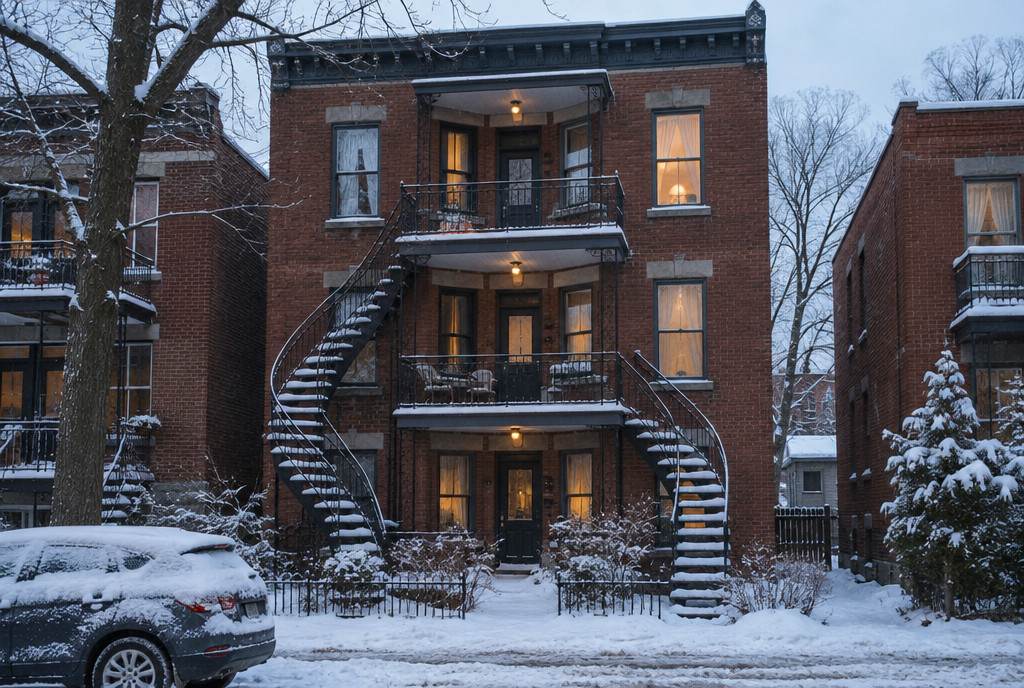
NRCan's EnerGuide Rating System covers low-rise multi-unit residential buildings (MURBs). When the federal Greener Homes Grant funded them, NRCan defined an eligible MURB as one with three or fewer storeys above ground, a building area of 600 m² or less, 2 to 100 units stacked or joined by a common space, and at least half its floor area used as living space. It also required one evaluation of the whole building, every unit and common area included, rather than unit-by-unit ratings (NRCan ↗).
High-rise buildings are a different job: NRCan says they involve very different engineering and fall outside the EnerGuide Rating System. Mid- and high-rise apartment buildings and condos get an engineering energy audit scoped to ASHRAE Standard 211, from a mechanical engineering firm or a certified energy manager. Our guide to commercial and multi-residential audits explains the three ASHRAE levels.
Who can rate a MURB
Not every energy advisor can. Advisors register with NRCan for houses first, then can add EnerGuide for MURBs by passing a separate, optional MURB exam. NRCan requires it for anyone who evaluates MURBs, issues a MURB label or submits MURB files (NRCan ↗). When you call a service organization about a duplex, triplex or small apartment building, ask whether the advisor they'd send is registered for MURBs.
Tell us it's a multi-unit building when you ask to be matched, and we'll only introduce you to an advisor who confirms MURB registration.
Ontario programs and multi-unit buildings
Ontario's main house program leaves multi-unit buildings out, but city loans and the gas utility pick up much of the gap:
| Program | Which buildings | What it offers |
|---|---|---|
| Home Renovation Savings (assessment path) | Not duplexes, triplexes, stacked townhouses or multi-unit buildings | Houses only (requirements ↗) |
| Toronto HELP | Houses, duplexes, triplexes and low-rise residential buildings of up to three storeys and six units | Loans up to $125,000 or 10% of assessed value, repaid on the property tax bill (toronto.ca ↗) |
| Toronto Hi-RIS | Toronto apartment buildings at least 20 years old, with 7 or more units and 3 or more storeys: private rentals, social housing and co-ops | Loans up to 10% of current value assessment or $2.5 million per building, repaid on the tax bill over 5–20 years, interest-free during construction; needs an energy assessment report at ASHRAE Level 2 or above (toronto.ca ↗) |
| Better Homes Ottawa | Includes multi-unit residential buildings of three storeys or less | 20-year loans at 4.33% fixed, from $10,000 up to $125,000 or 10% of assessed value; EnerGuide evaluations before and after (betterhomesottawa.ca ↗) |
| Better Homes Peterborough | Includes multi-unit buildings of three storeys or less in the City of Peterborough; landlords are eligible | Property-tax loans of $10,000–$50,000 at 4.5% fixed over 15 years (betterhomesptbo.ca ↗) |
| Enbridge Gas Commercial Multi-Residential | Condos and apartment buildings of three storeys or more | Up to $0.40 per m³ of gas saved, at most 75% of the cost and $100,000 per project; equipment installed, commissioned and submitted by October 31, 2026 (Enbridge ↗) |
| Enbridge Gas Affordable Housing Multi-Residential | Purpose-built rentals with at least 30% of units below market rent, or in a government affordable housing program | Up to $2.50 per m³ of gas saved, at most 85% of the cost and $200,000 per project; same October 31, 2026 deadline (Enbridge ↗) |
| Ontario energy and water reporting (EWRB) | Buildings of 50,000 sq ft or more | Not funding: owners must report energy and water use every year (ontario.ca ↗) |
Federal options for owners and landlords
- CMHC Eco Improvement refunds 25% of your CMHC mortgage insurance premium after $20,000 of energy upgrades. It covers owner-occupied loans on 1–4 units and small rental loans on 2–4 units (our guide).
- CMHC MLI Select gives owners of rental buildings with 5 or more units points toward better mortgage-insurance terms when they commit to cutting an existing building's energy use and emissions: a 15% cut earns 20 points, 25% earns 35, and 40% earns 50. The energy analysis has to come from a professional engineer, architect, certified engineering technologist or certified energy manager, using energy simulation software (CMHC ↗).
Before you book
- Count storeys and units. Three storeys or fewer, with a building area of 600 m² or less, points to an EnerGuide MURB evaluation. Anything larger points to an engineering audit.
- Ask about MURB registration before you book an EnerGuide evaluation.
- Match the audit to the money. Hi-RIS asks for an ASHRAE Level 2 report or better, MLI Select for an energy analysis by an engineer, architect, technologist or energy manager, and the city loan programs for EnerGuide evaluations before and after.
Common questions
Can a duplex or triplex get an EnerGuide rating?
Yes, as a multi-unit residential building, if the advisor is registered for EnerGuide for MURBs, which takes a separate NRCan exam. Low-rise buildings within NRCan's MURB limits qualify: three storeys or fewer above ground and a building area of 600 m² or less. High-rises fall outside the EnerGuide Rating System.
Does Ontario's Home Renovation Savings program cover multi-unit buildings?
Its assessment path doesn't: duplexes, triplexes, stacked townhouses and multi-unit buildings are excluded. In Toronto, Ottawa and Peterborough, the city loan programs do cover small multi-unit buildings.
What audit does a Toronto apartment building need for Hi-RIS?
An energy assessment report at ASHRAE Level 2 or above; the City may accept a decarbonization study for non-profit housing. Hi-RIS is for Toronto apartment buildings at least 20 years old with 7 or more units and 3 or more storeys.
Who can do the energy analysis for CMHC MLI Select?
A professional engineer, architect, certified engineering technologist or certified energy manager, using energy simulation software. For existing buildings, cuts of 15%, 25% or 40% earn 20, 35 or 50 points.
Sources
- NRCan — multi-unit residential buildings (MURB) definition and whole-building evaluation
- NRCan — becoming a registered energy advisor (optional MURB exam)
- Home Renovation Savings — assessment path requirements (eligible home types)
- City of Toronto — Home Energy Loan Program (eligible buildings)
- City of Toronto — Hi-RIS apartment retrofit loans
- Better Homes Ottawa — loan program
- Better Homes Peterborough — loan program
- Enbridge Gas — multi-unit residential incentives
- CMHC — MLI Select (energy efficiency for existing properties)
- Ontario — energy and water reporting for large buildings
Program facts checked against these pages on October 5, 2026. Programs change — confirm on the official page before you spend.
Get matched with an advisor who rates multi-unit buildings
Tell us where you are and what you’re planning. We’ll connect you with a registered service organization for your area — no spam, no shared lead lists.
Email us what you’re planning, your postal code and the type of building (a house, a duplex or triplex, or a larger multi-unit building) — we’ll reply with registered service organizations for your area and which rebates apply.
Email dave@clickshift.ca