Article · verified October 2, 2026
What is a home energy audit?
A home energy audit is a measurement visit: a registered professional tests your house with real instruments and hands you a prioritized, modelled plan — the difference between renovating on evidence and renovating on vibes. Here's the whole thing, properly defined.
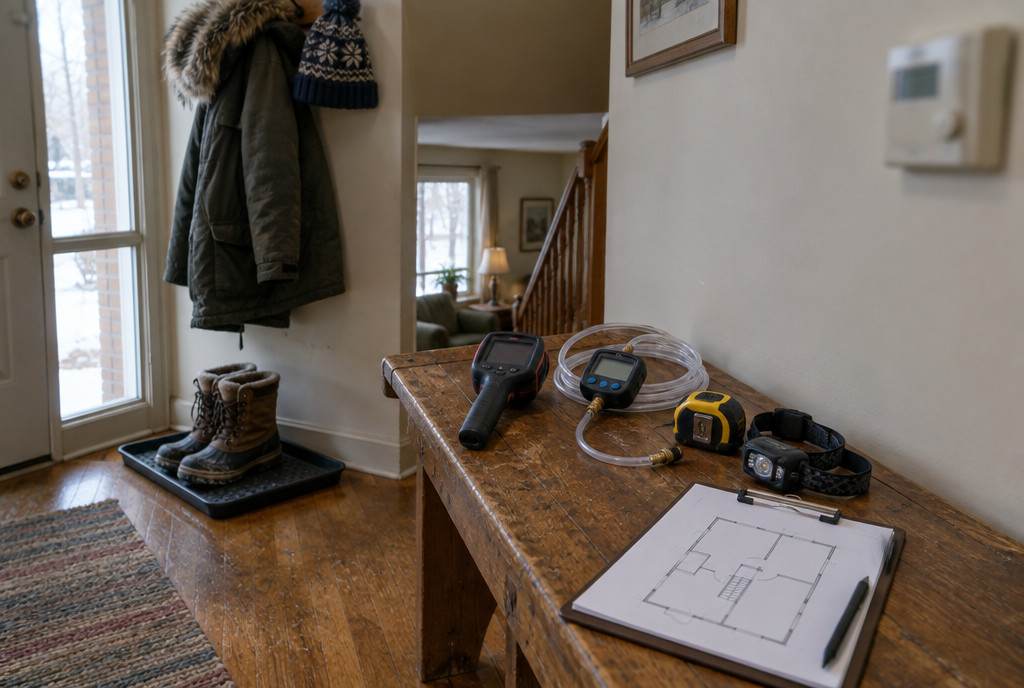
The definition that matters
In Canada, the audit that counts is the EnerGuide home evaluation, delivered by an energy advisor registered with Natural Resources Canada working under a licensed service organization (NRCan ↗). The visit produces three things: your EnerGuide rating — your home's modelled annual energy use in gigajoules, where lower is better and 0 is a net-zero home — an official label, and a renovation upgrade report that ranks improvements by impact for your house specifically. That document is what rebate and financing programs across the country are built around.
What gets measured
The centrepiece is the blower door test — a calibrated fan depressurizes the house and measures exactly how leaky it is, to the national CGSB airtightness testing standard. Most advisors pair it with infrared imaging, which maps missing insulation and hidden moisture without opening walls, plus attic inspection, equipment inventory, and — when a heat pump is in play — the CSA F280 heat-loss calculation that sizes it correctly. Our complete testing guide covers every instrument, including the ones (like radon) the energy audit doesn't include.
What it is not
It is not the "free energy audit" a sales rep offers before quoting you windows. Those walkthroughs carry no blower door, no rating, no rebate eligibility — and their findings reliably match the seller's product line. The honest tell: ask whether the visit includes a blower door test and produces an EnerGuide rating. If the answer is no, it's a sales call, whatever it's named.
Why bother: the audit is the key, not the lock
Audit-guided whole-home retrofits of older Canadian homes typically land in the 15–35% range of total energy savings — but the more immediate reason is that governments pay you to get one, because their rebate programs need its documentation. Which programs, and what they require, depends entirely on where you live:
What an audit unlocks where you live
Live programs
The Home Renovation Savings Program is the live rebate engine: a $600 rebate toward your initial + follow-up EnerGuide assessments (paid once you finish two upgrades; only assessments from the seven HRSP-approved organizations qualify, with the follow-up done within 180 days or by December 31, 2026, whichever comes first), insulation up to $7,700, windows at $100 per opening on the assessment path, and heat pumps up to $7,500 ($12,000 ground-source) on the no-assessment stream. HomeRenovationSavings.ca ↗
Requirements & standards
Audits are required for: the HRSP assessment path (pre + post EnerGuide through one of the program's seven approved service organizations), and large buildings over 50,000 sq ft must report energy and water use annually under Ontario's EWRB regulation. New homes are built to the Building Code's SB-12 energy efficiency rules. Ontario EWRB (ontario.ca)
Live programs
Toronto stacks three layers: Home Renovation Savings rebates, the City's HELP loans up to $125,000 or 10% of assessed value (fixed rates the City resets every quarter), and the $600 assessment rebate through one of the seven HRSP-approved organizations. CMHC-insured recent buyers can add the 25% Eco Improvement premium refund. Toronto HELP (toronto.ca) ↗
Requirements & standards
HELP requires an EnerGuide assessment for most projects (heat-pump-only and solar-only are exempt). New construction follows the Toronto Green Standard on top of the Building Code, and 50,000+ sq ft buildings fall under provincial EWRB reporting. Toronto guide
Live programs
The utility Home Renovation Rebate program (BC Hydro/FortisBC) runs equipment and envelope rebates, and the Home Energy Improvement Bonus pays $20 per percentage-point EnerGuide improvement ($750–$2,000) when you complete 3+ eligible upgrades with pre and post evaluations within 18 months; a separate $300 Two Upgrade Bonus needs no evaluation (one bonus per home). Income-qualified households can access the CleanBC Energy Savings Program. Better Homes BC requirements ↗
Requirements & standards
The Improvement Bonus requires pre + post EnerGuide evaluations by a program-qualified advisor. Heat pump rebates require a CSA F280 heat-load calculation. New construction is governed by the BC Energy Step Code's tiered performance targets. BC Energy Step Code
Live programs
Rénoclimat delivers evaluations at $150 + tax (the $150 is refunded when you receive Rénoclimat assistance, and the first post-retrofit evaluation is free) with government-assigned advisors, feeding insulation and air-sealing subsidies; Hydro-Québec's LogisVert covers heat pumps and efficient equipment with no audit required. Rénoclimat (quebec.ca) ↗
Requirements & standards
Rénoclimat subsidies require its evaluation (booked through the program, not a chosen advisor). Novoclimat certifies high-efficiency new construction. LogisVert (Hydro-Québec)
Live programs
Manitoba is the strongest prairie market: Efficiency Manitoba pays a $400 EnerGuide evaluation rebate plus insulation and heating programs. Saskatchewan's HERR rebate ended in April 2026, and Alberta is municipal-only (PACE-style Clean Energy Improvement financing where offered). Efficiency Manitoba evaluation rebate ↗
Requirements & standards
Manitoba's evaluation rebate requires an EnerGuide evaluation through a listed service organization. Elsewhere on the prairies, audits are driven by bill savings, pre-purchase clarity, and financing eligibility rather than rebate mandates. Program tracker
Live programs
New Brunswick's Total Home Energy Savings Program charges $99 + HST for both evaluations; efficiencyPEI subsidizes assessments to $99 + HST via contracted partners; Efficiency Nova Scotia runs assessment-based rebates (up to $5,000, plus up to $5,000 more for moderate-income homes not heated by electricity) and free upgrades for income-qualified homeowners. Save Energy NB ↗
Requirements & standards
PEI's insulation rebates require the subsidized assessment first; NB and NS rebate streams are built around their evaluations. Oil-heated homes throughout the region see the fastest conversion paybacks in Canada. efficiencyPEI assessments
How to get one
Start with the Home Energy Planner — six questions, and it tells you what your home's era likely needs, which tests to request by name, and every registered advisor serving your area with their reviews. Or go straight to the directory. Either way: measurements first, purchases second.
Common questions
What exactly happens during a home energy audit?
A registered energy advisor spends 2–3 hours measuring your house: insulation levels in the attic and walls, a window and door inventory, heating and cooling equipment details, and the centrepiece — a blower door test that depressurizes the house with a calibrated fan to measure air leakage precisely. Afterwards you receive your EnerGuide rating (in gigajoules per year — lower is better, 0 is net-zero) and a renovation upgrade report ranking improvements for your specific home.
What's the difference between an energy audit, assessment, and evaluation?
In Canada they're the same service under different names — the official term is "EnerGuide home evaluation," programs say "home energy assessment," and everyone else says "energy audit." What matters is the credential: performed by an energy advisor registered with Natural Resources Canada, working under a licensed service organization, producing an official EnerGuide rating.
Is a free energy audit real?
Usually not in the EnerGuide sense. A "free audit" from an insulation, window, or HVAC company is a sales walkthrough — no blower door, no rating, no rebate eligibility, and recommendations that reliably match what the company sells. Some provincial programs do subsidize real evaluations (New Brunswick's and PEI's cost $99 + HST), which is different: those are program-delivered EnerGuide evaluations.
How much does a home energy audit cost?
In Ontario, expect about $500–$700 for the initial evaluation and $200–$450 for the follow-up, plus HST where it applies. A $600 Home Renovation Savings rebate covers most of that, but only for assessments from its seven approved organizations, once you install two or more upgrades and finish the follow-up within 180 days or by December 31, 2026. Costs vary by province — Quebec's Rénoclimat charges $150 + tax (refunded except the tax when you get its assistance), and New Brunswick and PEI charge $99 + HST.
Sources
Ready to measure instead of guess?
Tell us where you are and what you’re planning. We’ll connect you with a registered service organization for your area — no spam, no shared lead lists.
Email us what you’re planning, your postal code and the type of building (a house, a duplex or triplex, or a larger multi-unit building) — we’ll reply with registered service organizations for your area and which rebates apply.
Email dave@clickshift.ca