Quebec · Home health · checked September 28, 2026

Well water testing in Montréal

Montréal is a densely built island city served by municipal water plants, so private wells are uncommon. If yours is, here's how testing works in Quebec.

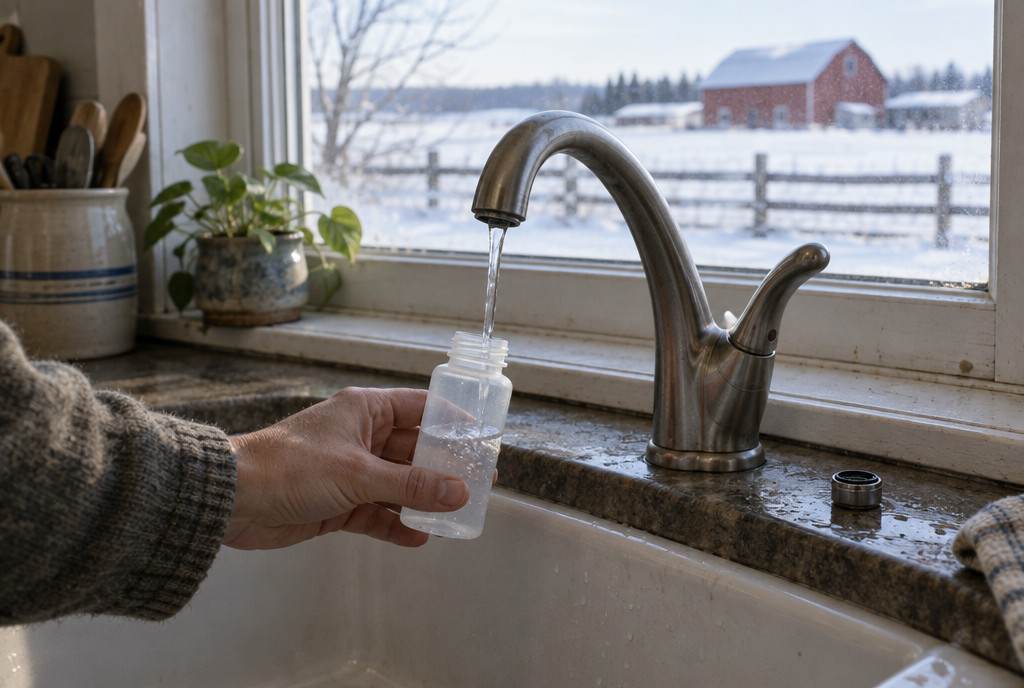
Filling a water-sample bottle at a farmhouse kitchen tap with the aerator removed, snowy fields and a barn outside

Private wells in Montréal

Rare

Testing cost

Paid, accredited lab

Test for

Bacteria yearly or more

Extended panels

Nitrate, metals, more

How Montréal is built

Montréal's houses by when they were built Ten house shapes, one for each tenth of Montréal's 221,340 houses. Before 1961: 48%, 1961–1990: 38%, 1991–2000: 6%, 2001 or later: 8%. Older houses glow hotter.
  • Before 1961 48%
  • 1961–1990 38%
  • 1991–2000 6%
  • 2001 or later 8%
Each house stands for one in ten of Montréal's 221,340 houses (single-detached, semi-detached, row and duplex), drawn by when it was built. The glow shows the usual pattern: older houses tend to be leakier and less insulated. Snowfall scales with heating degree-days. Sources: Statistics Canada 2021 Census (table 98-10-0233-01), NRCan HOT2000 climate data.

Wells in Montréal

Montréal is a densely built island city served by municipal water plants, so private wells are uncommon.

How testing works in Quebec

There's no free provincial service: send samples to a lab accredited by Quebec's environment ministry (the CEAEQ list), which supplies the bottles. The ministry recommends testing for bacteria at least twice a year, in spring and fall, plus a chemical analysis while the well is in use.

What to test for

  • Bacteria (total coliforms and E. coli): at least once a year, and after flooding, heavy rain or work on the well.
  • Nitrate, especially near farmland or septic systems.
  • Metals and naturally occurring contaminants such as arsenic, uranium or manganese when a well is new and every few years after, depending on local geology.

Our well water guide.

Well water testing in Montréal: common questions

Is well water testing free in Quebec?

There's no free provincial service: send samples to a lab accredited by Quebec's environment ministry (the CEAEQ list), which supplies the bottles. The ministry recommends testing for bacteria at least twice a year, in spring and fall, plus a chemical analysis while the well is in use.

How often should I test my well?

For bacteria, at least once a year and after flooding, heavy rain or well work; many health units recommend more often. Test chemistry when the well is new and every few years after.

Are private wells common in Montréal?

Montréal is a densely built island city served by municipal water plants, so private wells are uncommon.

Well water testing near Montréal

Ask about well water testing in Montréal

Tell us your postal code and what you’re dealing with. We’ll reply with the right kind of certified professional or lab for your area, and which programs apply.

Email us what you’re planning, your postal code and the type of building (a house, a duplex or triplex, or a larger multi-unit building) — we’ll reply with registered service organizations for your area and which rebates apply.

Email dave@clickshift.ca

This inbox is answered by a person. Participating advisors pay us a referral fee — you pay nothing, and it never affects the directory.