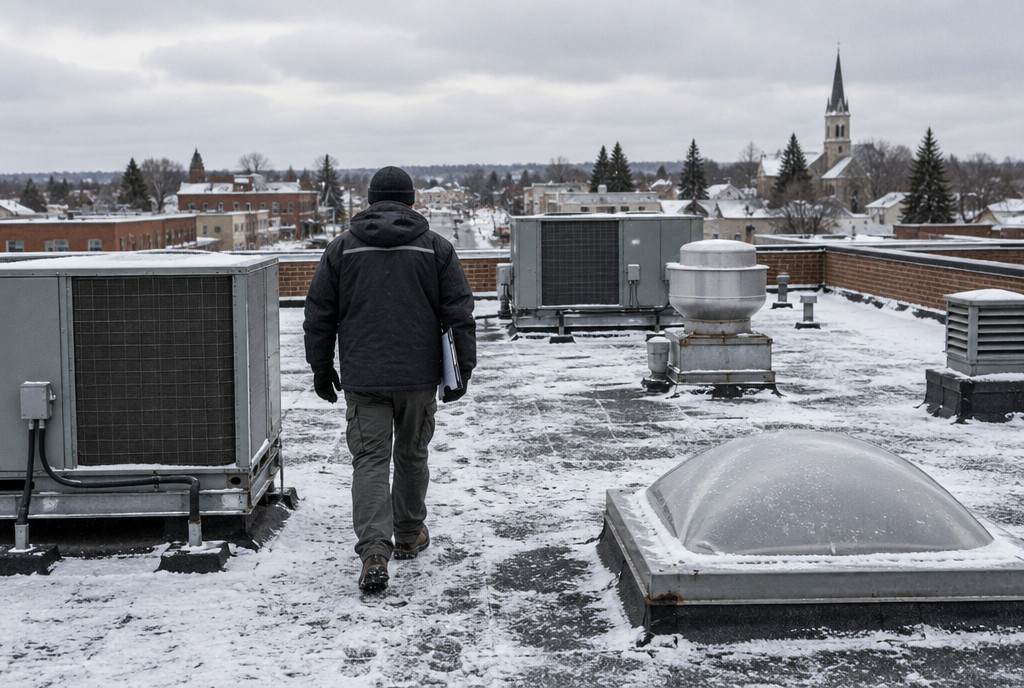
How Montréal is built
- Before 1961 48%
- 1961–1990 38%
- 1991–2000 6%
- 2001 or later 8%
Reporting rules that apply in Montréal
- Règlement 21-042 sur la divulgation et la cotation des émissions de GES des grands bâtiments (in force): 2,000 m2 (21,528 sq ft) or larger, or 25+ dwelling units (phased: 15,000 m2+ non-residential and City-owned 2,000 m2+ from 2022; 5,000 m2+ and 50+ units from 2023; 2,000 m2+ and 25+ units from 2024). Source
- Règlement sur la déclaration obligatoire de la performance environnementale de certains bâtiments (Loi sur la performance environnementale des bâtiments, chapitre P-9.02) (in force - first declarations due June 30, 2027): From Jan 1, 2027: buildings of 5,000 m2+ (not exclusively residential), residential or partly residential buildings with 50+ units, and buildings owned by public bodies other than municipal bodies (buildings under 100 m2 excepted, subject to a metering condition in the text). From Jan 1, 2028: buildings of 2,000 m2+ (not exclusively residential) and residential buildings with 25+ units. Source
Incentives for audits and studies
- Efficient Solutions Program - Energy Analysis component (Hydro-Québec): Pays for eligible costs of an energy analysis (including in-house labour): 40% of eligible costs when the report is accepted and 60% after at least one measure is implemented (up to 100% in total). Caps for energy-efficiency analyses: existing buildings with 1-2 GWh reference use, $8,000 + $12,000 ($20,000 total), analysis must identify at least 100,000 kWh/yr of savings; over 2 GWh, $20,000 + $30,000 ($50,000 total), at least 200,000 kWh/yr. Analyses that also cover demand-response measures: up to $60,000 ($24,000 + $36,000 for buildings over 2 GWh). Details
- ÉcoPerformance - Analyse de mesures de réduction des GES (Gouvernement du Québec (MELCCFP)): Standard analysis (energy study, fuel-switching study, fugitive-emissions study): 50% of eligible expenses, max $25,000 per site for small/medium energy users (under 36,000 GJ/yr non-electric) or $75,000 for large users. Complex analysis: 75%, max $100,000 / $300,000. Paid 50% on the signed purchase order and the rest after the engineer-signed report is accepted; project must finish within 24 months. Details
- Energy audit and implementation - Feasibility Study grant (Énergir): 50% of the pre-tax cost of a feasibility study, max $50,000. Follow-on implementation grant: $1 per m3 of natural gas saved in the first year (max $1,000,000 per account), plus up to $15,000 for energy tracking. Details
- Recommissioning of mechanical systems grant (Énergir): Investigation phase: 75% of eligible costs; implementation: $1 per m3 of gas saved up to 75% of eligible costs (measures with payback over 1 year); transfer and continuous-monitoring phases: 75% of eligible costs. Up to $100,000 per project in total. Details
Audit levels
- Level 1, walk-through: a site visit and bill review that benchmarks the building and lists low-cost measures.
- Level 2, energy survey and analysis: where the energy goes, with savings and cost estimates per measure. Most incentive applications use this level.
- Level 3, detailed analysis: monitoring and modelling for capital-intensive projects.
Ask which level a quote covers. Audits are done by engineering firms and energy consultants; look for a P.Eng. and credentials such as the Certified Energy Manager (CEM). How commercial energy audits work.
Commercial energy audit in Montréal: common questions
Do Montréal buildings have to report energy use?
Yes, above certain sizes: Règlement 21-042 sur la divulgation et la cotation des émissions de GES des grands bâtiments; Règlement sur la déclaration obligatoire de la performance environnementale de certains bâtiments (Loi sur la performance environnementale des bâtiments, chapitre P-9.02).
Are there incentives for commercial energy audits in Montréal?
Yes: Efficient Solutions Program - Energy Analysis component; ÉcoPerformance - Analyse de mesures de réduction des GES; Energy audit and implementation - Feasibility Study grant; Recommissioning of mechanical systems grant. Check eligibility and pre-approval rules before you commission the audit.
What does a commercial energy audit cost?
It depends on the building's size and the ASHRAE level. Get quotes that state the level and the deliverables.