Quebec · Energy · checked September 28, 2026

Duct leakage and ductwork pressure testing in Laval

If some rooms never get warm, the problem is often the ductwork, not the furnace. In the Montréal area, only 10% of households heat with a forced-air furnace, so the test matters mainly for homes with ducts or those adding a ducted heat pump.

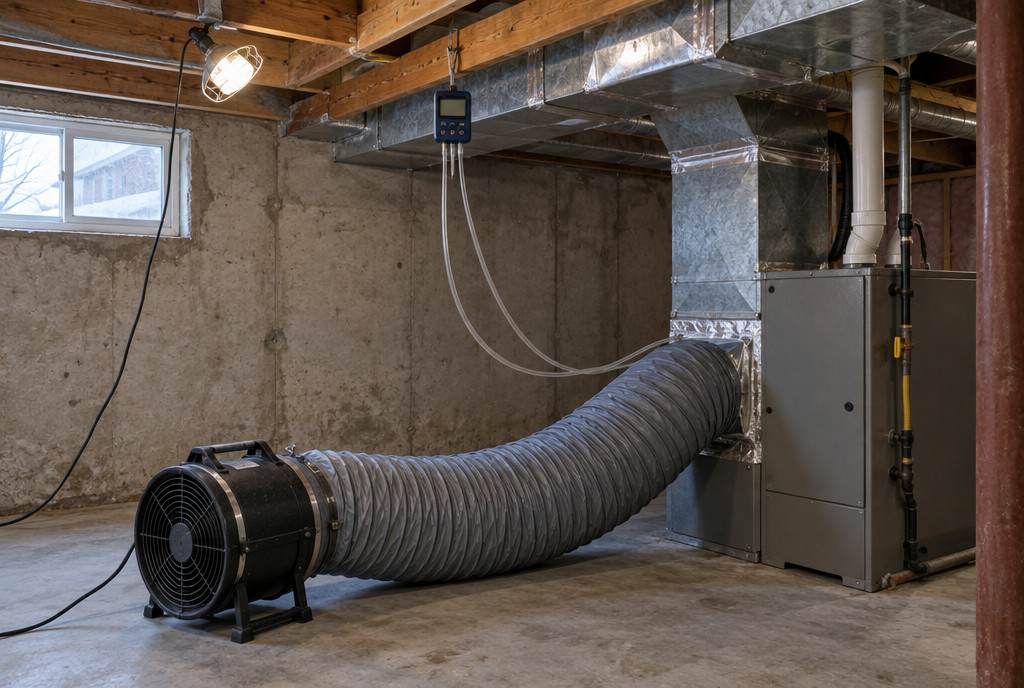
A duct-testing fan on a basement floor connected by flexible duct to a furnace, a pressure gauge hanging from a joist

Typical cost

$200–$450

Forced-air furnaces

10%

Electric baseboards

54%

Houses built before 1991

67%

How Laval is built

Laval's houses by when they were built Ten house shapes, one for each tenth of Laval's 101,460 houses. Before 1961: 17%, 1961–1990: 50%, 1991–2000: 13%, 2001 or later: 20%. Older houses glow hotter.
  • Before 1961 17%
  • 1961–1990 50%
  • 1991–2000 13%
  • 2001 or later 20%
Each house stands for one in ten of Laval's 101,460 houses (single-detached, semi-detached, row and duplex), drawn by when it was built. The glow shows the usual pattern: older houses tend to be leakier and less insulated. Snowfall scales with heating degree-days. Sources: Statistics Canada 2021 Census (table 98-10-0233-01), NRCan HOT2000 climate data.

Who needs it in Laval

In the Montréal area, 54% of households heat mainly with electric baseboards, 15% with a heat pump, 10% with a forced-air furnace and 6% with a boiler and radiators; electricity is the main heating energy for 71% of households, natural gas for 5% and oil for about 2% (Statistics Canada, 2023).

Electric baseboards outnumber furnaces here, and a baseboard-heated house has no ducts to test. The test matters if you have forced air, or before you add a ducted heat pump to existing ductwork.

Of Laval's 101,460 houses (single-detached, semi-detached, row houses and duplexes), 17% were built before 1961 and 67% before 1991, according to the 2021 Census. Ducts in older houses often run through unheated spaces with taped or unsealed joints, and supply runs to the far rooms are the first to suffer.

What the test shows

  • Total duct leakage, as a share of the system's airflow, measured by pressure-testing the ductwork with a calibrated duct-pressurization fan.
  • Airflow at each register, which explains why one bedroom is always cold.
  • Whether sealing and balancing will fix comfort problems before you buy bigger equipment.

Duct leakage testing in detail.

What it costs

About $200–$450 (a September 2026 planning range; quotes vary). It isn't part of a standard EnerGuide evaluation, so ask for it when you book if comfort is your main complaint.

NRCan-licensed service organizations serving Laval

In Quebec, EnerGuide evaluations for existing homes run through the provincial Rénoclimat program; the organizations below are the ones NRCan lists for Laval postal codes.

Duct leakage testing isn't part of a standard EnerGuide evaluation. Some of these organizations offer it, as do HVAC contractors with duct-testing equipment, so ask when you call.

Source: NRCan list of licensed service organizations, checked September 28, 2026. Call to confirm your street is covered and ask about wait times.

Programs in Laval

Provincial Rénoclimat (Quebec) Since October 1, 2026: up to $21,500 per house for roof, wall and foundation insulation and ENERGY STAR Most Efficient windows, no evaluation required, plus a new flood-protection component Open Provincial Hydro-Québec LogisVert Hydro-Québec grants for heat pumps (thermopompes) of $50–$120 per 1,000 BTU/h, up to $6,700, plus $1,500 for roof insulation with caulking, appliances and solar — no audit needed Open Federal National Heat Pump Rebate Announced October 8, 2026 and opening early 2027: up to $10,000 below the median income, $2,000 for other eligible homeowners Announced · opens 2027 Federal CMHC Eco Improvement premium refund A 25% energy-efficiency rebate on your CMHC mortgage insurance premium after $20,000 of energy renovations Open Federal Canada Greener Homes Affordability Program Free retrofits for low-to-median-income households through provincial partners in BC, Manitoba, Newfoundland and Labrador, Nova Scotia, PEI and Quebec (Quebec's 2026–27 intake has closed) — not available in Ontario Open · deadline Municipal Subvention pour le remplacement d'un système de chauffage au mazout City of Laval subsidy for replacing oil heating with a system powered only by electricity or renewables (geothermal, wind, solar, air-source heat pumps; propane and natural gas are excluded). Oil-only systems: $2,000 for a single-family home, $1,400 for a semi-detached or row house, $1,400 for a condo, $1,700 for a mobile home, $1,400 per eligible unit in a duplex or triplex, and $900 per unit (up to 20 units) in buildings of 30 units or fewer. Dual-energy (oil plus electric) systems get half those amounts. Apply through Mon dossier after the work is done (work completed since Sept 5, 2017), with proof the old system was decommissioned by a licensed contractor. Page updated Jan 30, 2026; no end date stated.

Duct leakage testing in Laval: common questions

How much does duct leakage testing cost in Laval?

Plan on about $200–$450. It is usually a separate service from an EnerGuide evaluation.

Is duct cleaning the same thing?

No. Cleaning removes dust; it doesn't find or seal leaks. A leakage test measures where air is lost.

What is ductwork pressure testing?

The same thing as a duct leakage test: registers are sealed, a calibrated fan pressurizes the ducts, and the airflow needed to hold the test pressure shows how leaky they are.

Should I close vents in unused rooms?

Usually not. Closing registers raises duct pressure and can increase leakage elsewhere in the system.

Duct leakage testing near Laval

Get matched with a registered advisor in Laval

Tell us your postal code and what you’re planning. We’ll connect you with one licensed service organization serving your area. No spam, no shared lead lists.