The envelope · verified October 8, 2026
Windows and doors: what your windows' age tells you
Windows, doors and skylights can account for up to 35% of a home's heat loss, according to NRCan. What you gain from upgrading depends on what you have now: a single pane loses about four times as much heat as an ENERGY STAR window, while a sound double-glazed unit may need only sealing.
- Up to 35% of a home's heat loss can go through windows, doors and skylights Source: NRCan ↗
- 10–20× Heat lost through single glazing compared with the same area of insulated wall Source: NRCan ↗
- U ≤ 1.22 ENERGY STAR Canada maximum U-factor for windows and doors, in W/m²·K Source: NRCan ↗
How heat escapes through windows and doors
Glass conducts heat, cold panes draw radiant heat from your body, and air leaks around sashes and frames (NRCan ↗; NRCan ↗). Radiation is less than 10% of heat loss in most houses, and most of it goes through windows (NRCan ↗). Single-glazed windows lose about 10 to 20 times as much heat as the same area of insulated wall (NRCan ↗). Some “drafts” near windows are cold air sliding down the glass, a convection current rather than a leak (NRCan ↗).
A window's U-factor measures how fast heat passes through the whole unit: glass, edges and frame. Lower is better; it is the inverse of an R-value (NRCan ↗).
How window age matters
| Window | U-factor (W/m²·K) | Source |
|---|---|---|
| Single-glazed wood double-hung | About 5.0 | PNNL, US DOE ↗ |
| Single-glazed with a clear storm | About 2.7 | PNNL, US DOE ↗ |
| Single-glazed with a low-e storm | About 2.0 | PNNL, US DOE ↗ |
| Double-glazed, clear glass | About 2.9 | PNNL, US DOE ↗ |
| Average window in new homes built 1990–96 | About 2.7 (RSI 0.37) | NRCan researchers ↗ |
| Better double-glazed (with low-e coating and gas fill) | Can reach 1.2 or lower | NRCan ↗ |
| ENERGY STAR Canada | 1.22 or lower | NRCan ↗ |
| Best triple-glazed | As low as 0.8 | NRCan ↗ |
PNNL figures are whole-window values for wood windows, converted from imperial units (1 Btu/h·ft²·°F = 5.678 W/m²·K) (NRCan ↗). For new windows, the 2020 National Building Code sets a maximum of 1.84 in zones 4 and 5, 1.61 in zones 6 and 7A, and 1.44 in zones 7B and 8 (National Building Code ↗).
Doors
Doors usually matter less than windows simply because there are fewer of them, unless you have patio or garden doors (NRCan ↗). Insulated-core doors resist heat flow better than solid doors or doors with glass (NRCan ↗). Worn weatherstripping, misplaced strike plates, poorly fitting frames and warped doors are the main causes of door air leaks (NRCan ↗).
Signs your windows and doors are costing you
- Fog or condensation between the panes of a sealed unit: the seal has failed, and NRCan says replacing the glazing unit is the lasting fix (NRCan ↗).
- Condensation between a storm window and the inner window: house air is leaking past the inner sash, which is common upstairs where the stack effect pushes air out (NRCan ↗).
- Heavy condensation or frost on the room side, usually a sign that humidity is too high for the glass. With the house at 21°C and −20°C outside, NRCan's table shows condensation starting above about 34% indoor humidity on double glazing, 50% on double low-e and 67% on triple low-e (NRCan ↗).
- Rot, mould or staining around frames, cracked putty or paint, worn weatherstripping, or hardware that no longer closes tightly (NRCan ↗).
- Doors out of square with their frames, letting drafts in at the edges or threshold (NRCan ↗).
What an energy advisor checks
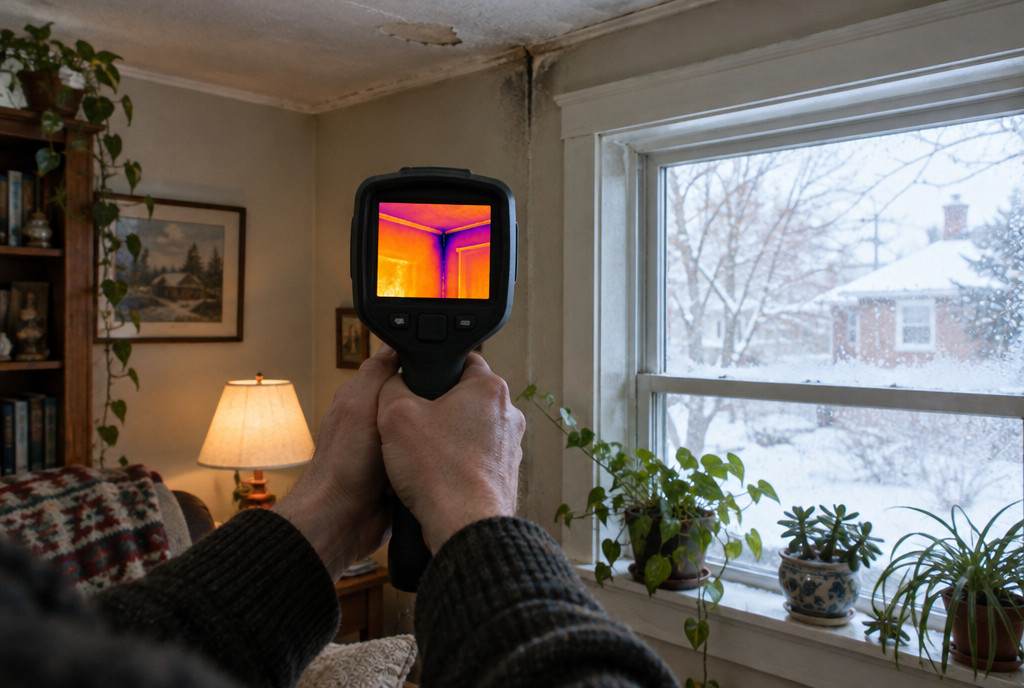
An EnerGuide evaluation records the number, type and location of all windows and exterior doors and measures airtightness with a blower door (NRCan ↗). With the house under pressure, smoke or a thermal camera can show where air leaks in at frames and sashes (NRCan ↗). If condensation is your complaint, ask about humidity and ventilation too; NRCan's suggested solutions start with lowering humidity and improving ventilation (NRCan ↗).
Before working on old windows, doors or trim, consider a lead paint test: homes built before 1950 were often painted with lead-based paint (NRCan ↗).
When replacement pays, and when it doesn't
The U-factors tell most of the story. By our arithmetic from those figures, swapping a single-glazed window (about 5.0) for an ENERGY STAR unit (1.22 or lower) cuts heat flow through that opening by about three-quarters, and replacing a clear double-glazed unit (about 2.9) cuts it by a little over half (PNNL, US DOE ↗; NRCan ↗). Adding a storm panel to a single-glazed window lowers its U-factor by 47 to 53% with clear glass and 59 to 64% with low-e glass (PNNL, US DOE ↗).
Replacement makes the most sense when glazing is single or a sealed unit has failed, or when frames are rotten. NRCan suggests a new sealed glazing insert where the frame is sound and full replacement where it is not; a full tear-out also lets the installer make an airtight, insulated seal to the wall opening (NRCan ↗). It pays least when windows are already double-glazed and sound: NRCan notes some windows need only minor air sealing, and ranks air leakage control first in any upgrade strategy (NRCan ↗; NRCan ↗). Test the numbers for your fuel and climate in the upgrade payback calculator.
The ENERGY STAR Canada criteria
Since January 1, 2020, ENERGY STAR windows and doors sold in Canada must have a U-factor of 1.22 W/m²·K or lower, or an Energy Rating (ER) of 34 or higher, plus air leakage of 1.5 L/s/m² or less; skylights must be 2.29 or lower (NRCan ↗). Products designated Most Efficient for 2025 reach 1.05 or lower, or an ER of 40 or more (NRCan ↗).
Glass also lets in free solar heat, measured as the solar heat gain coefficient (SHGC). For new or substantially renovated homes NRCan suggests an SHGC of 0.3 to 0.4; above 0.4 suits homes built before 1980 or not well insulated and air sealed (NRCan ↗).
Fixes, from simplest to biggest
| Fix | Typical cost | What it does | DIY or pro? |
|---|---|---|---|
| Caulk inside trim and seal behind casings | Low | Caulk where trim meets the wall and frame. Gaps over 6 mm need backer rod or low-expansion foam (NRCan ↗). | DIY |
| Weatherstrip sashes and doors | Low | V-strip suits hung sashes and door frames; compression or magnetic seals are the tightest; door-bottom gaskets or threshold seals stop floor drafts (NRCan ↗). | DIY |
| Heat-shrink film inside | Low | Inexpensive kits seal well for a season, but the window can't open while the film is on, and most film is single-use (NRCan ↗). | DIY |
| Storm windows, inside or out | Low to moderate | Over single glazing, clear storms cut the U-factor by 47 to 53% and low-e storms by 59 to 64% (PNNL, US DOE ↗). | DIY or pro |
| New sealed glazing or sash in a sound frame | Moderate | Replaces single or failed glass while keeping the frame and trim (NRCan ↗). | Pro |
| Full ENERGY STAR replacement | High | U-factor of 1.22 or lower (NRCan ↗); a full tear-out allows an airtight, insulated seal to the opening (NRCan ↗). | Pro |
| Replace a worn entry or patio door | Moderate to high | Insulated-core doors resist heat flow better; NRCan suggests ENERGY STAR units to replace patio doors in poor condition (NRCan ↗). | Pro |
Mistakes to avoid
- Expecting new windows to cure condensation. Tighter windows can raise humidity and make it worse; reduce moisture and improve ventilation as well (NRCan ↗).
- Caulking outside first. It can trap warm, moist air in the wall; seal inside, then outside (NRCan ↗).
- Sealing the storm tighter than the window. With exterior storms the inner window must be the tighter one, and the storm's weep holes must stay open (NRCan ↗).
- Comparing centre-of-glass ratings. They make a product look more efficient than it is; compare whole-window U-factor or ER (NRCan ↗).
- Sealing shut or shrinking a bedroom window. Each bedroom needs a window or door that opens from inside, with an opening of at least 0.35 m² and no dimension under 380 mm (National Building Code ↗).
- Losing the labels. Keep ENERGY STAR labels until any rebate claim is processed (NRCan ↗).
- Solar-control film on every window. It adds little insulation and cuts useful winter sun (NRCan ↗).
Rebates and next steps
Programs open and close often, so check our rebates by province for what is available now. In Ontario, start with Home Renovation Savings assessments. Some programs include a post-upgrade EnerGuide evaluation that needs proof of the work, so keep paid invoices and receipts (NRCan ↗).
To compare this work with other upgrades at your local fuel prices, try the upgrade payback calculator, then put the order of work into your home plan. You can also find a registered energy advisor near you.
Run your numbers
See what this kind of upgrade could pay back at your city’s energy prices, then put the work in a sensible order in your home plan.
Common questions
Is it worth replacing windows to save energy?
It depends on what you have. By our arithmetic from published U-factors, replacing single glazing with ENERGY STAR windows cuts heat flow through those openings by about three-quarters. Replacing sound double-glazed windows saves less, and NRCan puts air sealing first.
What U-factor should new windows have in Canada?
ENERGY STAR Canada requires 1.22 W/m²·K or lower, or an Energy Rating of 34 or more. Most Efficient 2025 products reach 1.05 or lower, and the 2020 building code caps new windows at 1.44 to 1.84 depending on climate zone.
Are storm windows worth it?
For sound single-glazed windows they can be. A US national laboratory study found clear storm panels cut single-pane U-factors by 47 to 53%, and low-e storm panels by 59 to 64%.
Double or triple glazing for a Canadian winter?
Better double-glazed units reach U-factors of 1.2 or lower, and triple-glazed units as low as 0.8. NRCan says triple glazing also helps where glass edges fog up and freeze in more extreme climates.
Why do my new windows have condensation?
New windows make a house tighter, which can raise humidity. At −20°C outside, NRCan's table shows condensation starting above about 50% indoor humidity on double low-e glass, so lowering humidity or adding ventilation is the usual fix.
Should I replace my front door?
Weatherstrip and adjust it first, since worn weatherstripping, misplaced strike plates and warped doors are the main causes of leaks. NRCan suggests replacing a badly deteriorated door with an insulated unit.
Sources
- NRCan, Keeping the Heat In, Section 8: Upgrading windows and exterior doors (modified 2025-01-14) ↗
- NRCan, Keeping the Heat In, Section 2: How your house works (modified 2025-01-14) ↗
- NRCan, Keeping the Heat In, Section 1: Introduction (modified 2025-01-14) ↗
- NRCan, Keeping the Heat In, Section 4: Comprehensive air leakage control (modified 2025-01-14) ↗
- NRCan, Keeping the Heat In, Section 9: Operating your house (modified 2025-09-29) ↗
- NRCan, Windows, doors and skylights: ENERGY STAR Canada technical specification, Version 5.0 (effective January 1, 2020) ↗
- NRCan, Most Efficient criteria for windows and sliding glass doors 2025 (modified 2025-02-11) ↗
- NRCan, Buyer's guide when shopping for windows and doors (modified 2025-06-10) ↗
- Pacific Northwest National Laboratory (US DOE), Thermal and Optical Properties of Low-E Storm Windows and Panels, PNNL-24444 (July 2015), Table 1 ↗
- Gusdorf and Parekh (NRCan Buildings Group), Energy Efficiency and Indoor Air Quality in R-2000 and Conventional New Houses in Canada, ACEEE Summer Study 2000 (Tables 2 and 4) ↗
- National Research Council Canada, National Building Code of Canada 2020, second printing (2025): Part 9 and Appendix C Table C-2 ↗
- NRCan, EnerGuide energy efficiency home evaluations (modified 2024-12-23) ↗
- NRCan, Consumer's Guide to Buying Energy-Efficient Windows and Doors (2003, PDF via publications.gc.ca) ↗
- NRCan, How do I prepare for an EnerGuide home evaluation? (modified 2025-01-14) ↗
Figures checked against these pages on October 8, 2026. Programs and prices change, so confirm on the official page before you spend.
Have your own house measured
Tell us where you are and what you’re planning. We’ll connect you with a registered service organization for your area — no spam, no shared lead lists.