Air and moisture · verified October 8, 2026
Airflow and moisture control: keeping indoor humidity in the safe range
A family of four adds about 50 litres of water a week to indoor air through breathing, cooking, bathing and washing, according to Natural Resources Canada. Whether that moisture leaves through fans or ends up on windows and inside walls decides whether a house stays dry.
- ≈50 L a week Moisture a family of four adds to indoor air Source: NRCan ↗
- 30–50% Indoor relative humidity range Health Canada recommends Source: Health Canada ↗
- 100× Moisture one small air leak lets in, compared with diffusion over the same area Source: NRCan ↗
Where the moisture comes from
NRCan's Keeping the Heat In ↗ estimates that a family of four generates about 50 litres (L) of water a week through normal household activities. Its weekly breakdown:
- Breathing and skin evaporation: 38.0 L
- Cooking three meals a day: 6.3 L
- Bathing: 2.4 L (about 0.2 L per shower)
- Washing clothes: 1.8 L
- Mopping 9.3 m² (100 sq ft) of floor: 1.3 L
Other sources can add more: groundwater wicking through a foundation, small plumbing leaks, firewood stored indoors, humidifiers, houseplants and new building materials. Health Canada ↗ notes that hanging wet laundry indoors can also raise indoor humidity.
Moisture moves through a house in two ways. It diffuses slowly through materials such as drywall, and it rides along with air leaking through gaps. NRCan says one small air leak can let in 100 times more moisture than diffusion through the same area. That is why its guide calls for both a vapour barrier, to slow diffusion, and an air barrier that is continuous and well sealed, to stop moisture carried by leaking air.
How much humidity is right in winter
Relative humidity (RH) is the amount of water vapour in the air compared with the most the air could hold at that temperature. Warm air holds far more than cold air, so when room air touches cold glass it cools to its dew point and water condenses.
Health Canada recommends keeping indoor RH between 30% and 50%. NRCan adds that humidity above 20% helps prevent dry, sore throats, while higher levels can cause frosting and fogging of windows, staining, peeling paint, mould and odours. In cold weather, aim low: CMHC ↗ recommends 30% to 50% during the heating season to prevent window condensation, and 30% when it is colder than −10°C (14°F) outside.
NRCan's window table ↗ shows the highest indoor RH, with the house at 21°C, before condensation forms on the glass. Low-e glass has a thin, transparent metal coating that cuts heat loss.
| Outdoor temperature | Double-glazed | Double-glazed low-e | Triple-glazed low-e |
|---|---|---|---|
| 0°C | 58% | 70% | 81% |
| −10°C | 44% | 59% | 74% |
| −20°C | 34% | 50% | 67% |
| −30°C | 25% | 42% | 60% |
A hygrometer, a small humidity meter, gives you the number. CMHC suggests checking its accuracy once a year: seal it in a plastic bag with a cup holding about 125 mL of table salt and 50 mL of water. After 8 to 12 hours it should read about 75%.
Signs of trouble
- Condensation or frost that keeps forming on the inside of windows. NRCan says occasional condensation is not a problem; excessive condensation means you should cut moisture or increase ventilation.
- Staining or mould in bathrooms and closets, or on walls and ceilings along exterior walls.
- A stuffy, musty smell or odours that linger.
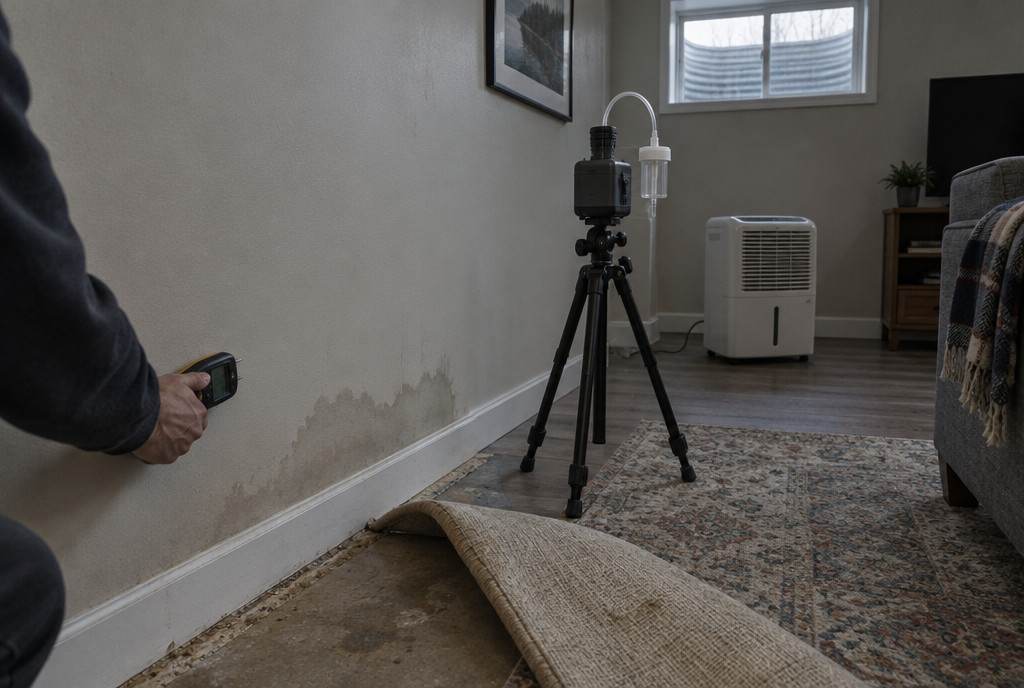
- In the basement: efflorescence (a whitish mineral deposit), blistering or peeling paint, crumbling concrete surfaces or a musty smell.
- The opposite problem: static shocks, chapped lips and a scratchy throat. CMHC links very dry winter air to cold, dry air leaking in from outside.
Health Canada says mould will begin to grow within 48 hours in an area with excessive moisture. It considers an area of 1 m² or less small enough to clean yourself with proper procedures and protective equipment, and recommends that a qualified professional assess and clean up any single patch larger than 3 m². If you smell mould but can't find it, see mould and indoor air quality testing and our guide to window condensation and musty air.
What an energy advisor checks
An energy advisor certified by NRCan evaluates the house from the attic to the foundation, including a blower door test that measures airtightness (NRCan ↗). For moisture problems, three parts of an assessment matter most:
- Air leaks. The blower door depressurizes the house, and an infrared camera used at the same time shows where air is leaking and insulation is missing. See thermal imaging.
- Ventilation against moisture load. A ventilation and humidity assessment checks whether bathroom and kitchen fans actually exhaust outdoors and whether air exchange suits the number of occupants. Health Canada ↗ recommends measuring airtightness before adding a ventilation system, because the result helps pick the right one.
- Combustion safety. NRCan notes that tightening a house raises humidity and leaves less air for fuel-burning appliances. If you have a chimney-vented furnace, water heater or fireplace, include a combustion safety test in the plan.
Fixes, from simplest to biggest
NRCan's first step for high humidity or condensation is to reduce the water vapour going into the air. If windows still run with water after that, increase ventilation.
| Fix | Typical cost | What it does | DIY or pro? |
|---|---|---|---|
| Run the bathroom fan during showers and for at least 30 minutes after | Electricity only | Removes shower moisture at the source (Health Canada) | DIY |
| Use the range hood whenever you cook, preferably on its highest setting | Electricity only | Captures cooking moisture; the hood must vent outdoors | DIY |
| Vent the dryer outdoors, avoid drying laundry inside, keep firewood outside, unplug humidifiers while windows sweat | No cost | Cuts the moisture sources NRCan lists first | DIY |
| Keep blinds and curtains open; dry window frames and sills when wet | No cost | Lets warm air reach the glass and stops dripping water from feeding mould (Health Canada) | DIY |
| Measure RH with a hygrometer; run a dehumidifier in a damp basement with windows closed | Varies by model | Replaces guesswork with a number and dries the basement | DIY |
| Slope the ground away from the foundation, fix eavestroughs, cover exposed earth floors with a moisture barrier | Get quotes for grading | Keeps ground and roof water away from the basement | DIY or pro |
| Air-seal leaks into the attic and walls | Get quotes | Stops warm, moist air reaching cold framing where it condenses | DIY or pro |
| Add balanced ventilation with an HRV or ERV | Get quotes | Removes moisture continuously while recovering heat | Pro (HRAI-certified) |
Mistakes to avoid
- Fans that vent into the attic. Health Canada says bathroom fans must vent outside, not into the attic, and the National Building Code ↗ bars exhaust ducts from discharging into enclosed spaces.
- Insulating a damp basement from the inside. NRCan warns not to insulate basement walls that show leaks, dampness, efflorescence or blistering paint from the inside until the moisture is corrected, or the new walls will rot (NRCan, Section 6 ↗).
- Air sealing with no ventilation plan. Tightening raises indoor humidity. If moisture sources can't be reduced, NRCan says any retrofit that makes the house more airtight has to include mechanical ventilation.
- Expecting new windows to fix a humidity problem. Better glazing tolerates more humidity before it fogs, as the table above shows, but it does nothing to reduce the moisture being produced.
- Running a humidifier without checking. CMHC warns that humidifiers that are not installed, used and maintained properly can become sources of excess moisture and mould.
- Dropping the heat too low in an empty house. NRCan advises against going below 17°C because of the risk of moisture build-up in exterior walls.
Rebates and next steps
Rebates for air sealing, insulation and ventilation vary by province and change often. Check what is available where you live in our rebate program tracker, estimate the return on an upgrade with the upgrade payback calculator, and use the home energy planner to put moisture fixes in the right order before insulation.
For a damp basement, start with our guide to a cold, damp basement and NRCan's simple test: tape a 1 m (40 in.) square of plastic to the wall or slab and check it after a day or two. Condensation on top means the indoor air is humid. Condensation underneath means moisture is moving up from the ground, which NRCan says can also point to possible radon entry; see radon testing.
Run your numbers
See what this kind of upgrade could pay back at your city’s energy prices, then put the work in a sensible order in your home plan.
Common questions
What humidity should my house be in winter in Canada?
Health Canada recommends 30% to 50%. In cold weather stay toward the low end: CMHC suggests about 30% when it is colder than −10°C outside, and NRCan's table shows ordinary double-glazed windows start to condense at about 34% when it is −20°C.
Why do my windows get condensation on the inside in winter?
Warm indoor air cools when it touches cold glass and drops its moisture once it reaches the dew point. Too much indoor moisture, too little ventilation or cold glass, often in combination, are the usual causes.
How long should I run the bathroom fan after a shower?
Health Canada says to keep it running for at least 30 minutes after a shower or bath. The fan must vent outdoors, not into the attic.
Is it bad to dry clothes inside in winter?
If humidity or condensation is a problem, yes. NRCan lists avoiding indoor laundry drying among the first steps, and Health Canada notes that wet laundry raises indoor humidity; a dryer vented outdoors avoids it.
Can I clean mould myself?
Health Canada considers an area of 1 m² or less small enough to clean yourself with proper procedures and protective equipment. A single patch larger than 3 m² should be assessed and cleaned up by a qualified professional.
Does my basement need a dehumidifier?
If it feels damp or you see condensation on cold surfaces, Health Canada recommends running one with the windows closed and the drain pan emptied or piped to a drain. NRCan's plastic-sheet test shows whether the moisture is coming through the foundation.
Sources
- NRCan, Keeping the Heat In, Section 2: How your house works (page modified 2025-01-14) ↗
- NRCan, Keeping the Heat In, Section 9: Operating your house (page modified 2025-09-29) ↗
- NRCan, Keeping the Heat In, Section 6: Basement insulation (page modified 2024-12-23) ↗
- NRCan, Keeping the Heat In, Section 8: Upgrading windows and exterior doors (page modified 2025-01-14) ↗
- NRCan, Keeping the Heat In, Section 1: Introduction (page modified 2025-01-14) ↗
- NRCan, Keeping the Heat In, Section 4: Comprehensive air leakage control (page modified 2025-01-14) ↗
- Health Canada, Guide to addressing moisture and mould indoors ↗
- Health Canada, Ventilation and the indoor environment (March 2018) ↗
- CMHC, About Your House: Measuring Humidity in Your Home (revised 2009, PDF) ↗
- NRC, National Building Code of Canada 2025, Section 9.32 and Notes (PDF, 15 MB) ↗
Figures checked against these pages on October 8, 2026. Programs and prices change, so confirm on the official page before you spend.
Have your own house measured
Tell us where you are and what you’re planning. We’ll connect you with a registered service organization for your area — no spam, no shared lead lists.