Ratings and audits · verified October 8, 2026
EnerGuide ratings: what the number means and how to get one
An EnerGuide rating estimates how much energy your house uses in a year under standard conditions, in gigajoules (GJ). The average Canadian household uses about 100 GJ a year; lower is better, and zero means the house produces as much energy as it uses.
- 100 GJ Average yearly energy use of a Canadian household Source: NRCan ↗
- $600–$1,000 NRCan's average for pre- and post-retrofit evaluations together (as of October 2026) Source: NRCan ↗
- About 2 hours for an initial evaluation; about 1 hour for the follow-up (Ontario program) Source: Home Renovation Savings ↗
How the rating works
An energy advisor measures your home and enters the data into HOT2000, NRCan's energy simulation software, which calculates the rating (NRCan ↗). One gigajoule is roughly the energy to run a typical fridge for 30 weeks.
- Net energy in GJ per year. The scale runs toward zero; a home rated 0 GJ produces as much energy as it consumes (NRCan ↗).
- Reference house. Each rated home gets its own reference: the same house as if built to typical new-construction standards, so you can see how far yours is from a new home (NRCan ↗).
- Standard operating conditions. The software assumes standard thermostat settings, hot water use and number of occupants, so the rating applies to the house, not your household. NRCan says your bills shouldn't be expected to match it, and large extra loads such as a pool or hot tub are listed separately as “atypical energy loads”.
- Old 0–100 scale. NRCan retired the 0–100 scale at the end of 2018; since January 1, 2019, all new evaluations use GJ per year, and old ratings can't be converted.
Reading the label and reports
After the visit you receive three documents (NRCan ↗):
- EnerGuide label: your rating as a number and on the GJ scale, energy use by source, how you compare with your reference house, the share going to heating, cooling, ventilation and other uses, and your greenhouse gas emissions.
- Homeowner Information Sheet: how the rating was calculated, a breakdown of your rated energy use, and the details of your building envelope and mechanical equipment as the advisor recorded them. Check these against your house.
- Renovation Upgrade Report: recommended upgrades with estimated savings, before-and-after charts of heat loss by building component, your rating before and after the upgrades, the advisor's comments and energy-saving tips.
Expect the reports about two weeks after the visit in Quebec's Rénoclimat program (Québec ↗) and two to three weeks after through Efficiency Manitoba (Efficiency Manitoba ↗).
Who can do an evaluation, and what happens on the day
EnerGuide evaluations are booked through service organizations licensed by NRCan, which send an energy advisor registered with NRCan (NRCan ↗). Advisors must pass NRCan's foundation and energy advisor exams, and every licensed organization must employ a quality assurance specialist. Organizations are independent businesses, not agents of NRCan, and NRCan doesn't endorse any of them; it is not accepting applications from new organizations at present (NRCan ↗). Quebec's 2026 Rénoclimat guide says the EnerGuide Rating System, designed by NRCan, is now administered by Environment and Climate Change Canada (Québec ↗). We could not confirm this change on a federal page, and NRCan's own pages still describe NRCan licensing and registration.
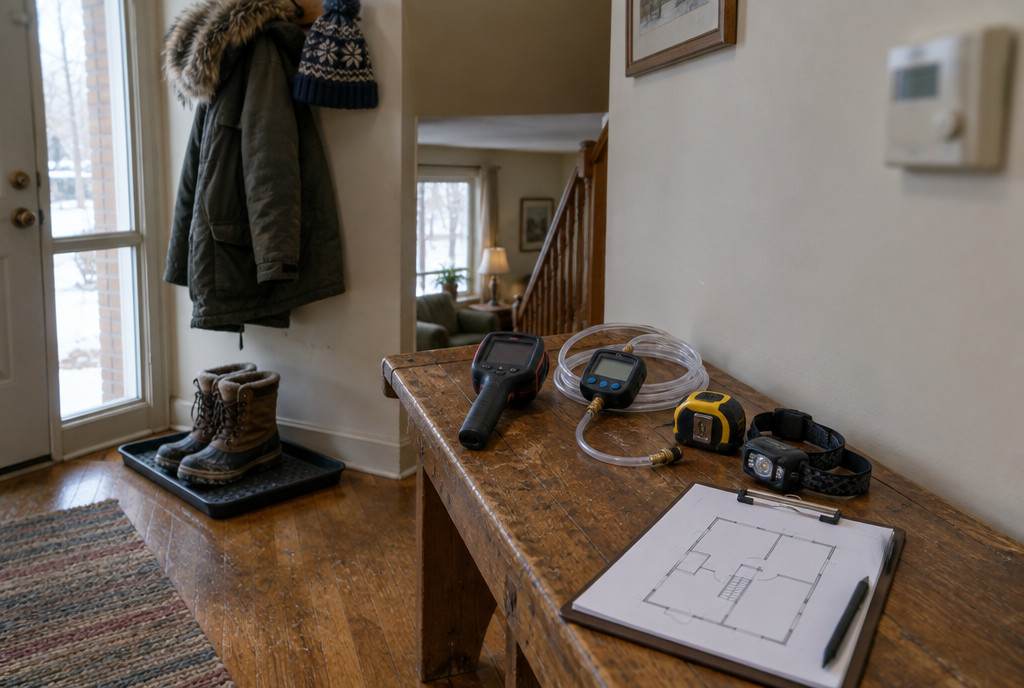
On the day, you sign a consent form (the Notice to Homeowner). The advisor usually starts outside, photographs the exterior, mechanical systems, attic and any wood-burning appliances, and runs a blower door test to measure airtightness; fuel-fired heating and water heating are turned down during the test. The home must be able to hold 22°C, with windows, doors and the building envelope intact. Remove ashes from any wood stove beforehand and have your property tax roll number ready (NRCan ↗). Licensed organizations don't sell door to door or through unsolicited calls or emails.
Pre- and post-retrofit evaluations, and how long a rating stays useful
A pre-retrofit evaluation sets your baseline and gives you the upgrade plan; a post-retrofit evaluation after the work produces a new rating that shows the improvement and, in most rebate programs, unlocks payment. Programs generally require the first evaluation before any work starts, and set their own deadlines: Ontario's Home Renovation Savings needs the follow-up within 180 days of the first visit or by December 31, 2026, whichever comes first (program terms ↗), and New Brunswick's Total Home Energy Savings allows 9 months for the work (NB Power ↗).
NRCan's public pages don't give an expiry date for a rating. A rating describes the house on the day it was measured, so renovations or new equipment since then put it out of date, and each program decides which evaluations it accepts. NRCan says the recommendations on an old 0–100 report remain valid, but a current GJ rating needs a new evaluation (NRCan ↗).
Evaluation types compared
| Type | What you get | Time on site | Cost (as of October 2026) |
|---|---|---|---|
| Pre-retrofit EnerGuide evaluation | Rating, label, Homeowner Information Sheet and Renovation Upgrade Report | About 2 hours (Ontario program); 2–3 hours (Rénoclimat) | NRCan average: $600–$1,000 for pre- and post-retrofit together |
| Post-retrofit evaluation | New rating and label showing the improvement | About 1 hour (Ontario program); 45–90 minutes (Rénoclimat) | Included in NRCan's range above; free for the first one in Rénoclimat |
| Subsequent evaluation (Rénoclimat) | Updated label for later work, measured against your last evaluation | 45–90 minutes | $150 plus tax |
| Virtual home label | An estimate built from data and software rather than an on-site EnerGuide evaluation; NRCan does not allow the EnerGuide name on it | No on-site EnerGuide evaluation | Not an EnerGuide product |
Rénoclimat changed its rules on October 1, 2026, and some of its evaluation pages may still describe the earlier rules, so confirm Rénoclimat costs with the program.
What it costs and what programs pay back
NRCan says pre- and post-retrofit evaluations together cost between $600 and $1,000 on average, varying by provider and province, and are typically paid after the service (NRCan ↗). Several programs cut that cost (as of October 2026):
- Ontario, Home Renovation Savings: $600 back toward both assessments after two or more qualifying upgrades (program ↗).
- Manitoba, Efficiency Manitoba: a $400 rebate for a pre-retrofit evaluation, if you apply within 90 days.
- New Brunswick, Total Home Energy Savings: $99 plus HST covers the initial and final evaluations (NB Power ↗).
- Quebec, Rénoclimat: since October 1, 2026, up to $500 toward an evaluation when you also claim at least one eligible upgrade (Québec ↗); under the earlier rules, $150 plus tax for the first evaluation, refunded except the tax when aid is paid (Québec ↗).
See energy audit costs, or find an advisor near you.
Mistakes to avoid and next steps
- Booking with a company that isn't licensed: check NRCan's list of service organizations by postal code.
- Starting work before the pre-retrofit evaluation when you want a rebate.
- Expecting your bills to match the rating, which uses standard conditions.
- Treating a virtual label as an EnerGuide rating (NRCan ↗).
- Losing paperwork: keep your file number, reports and paid invoices, which programs with a post-retrofit evaluation ask to see.
Next steps: read what a home energy audit is, check rebates where you live, estimate running costs with the energy cost calculator and build your plan.
Run your numbers
Compare what heating, cooling and hot water cost to run at your city’s energy prices, then put any upgrade in order in your home plan.
Common questions
What is a good EnerGuide rating?
Lower is better, and 0 GJ a year means the house produces as much energy as it uses. The most useful comparison is your own reference house on the label, which shows the rating your home would get if built to typical new-home standards.
Why doesn't my EnerGuide rating match my energy bills?
The rating uses standard thermostat settings, hot water use and occupancy, so it describes the house rather than your household. Weather and habits also change your bills, and extras like a pool or hot tub are listed separately.
How much does an EnerGuide evaluation cost?
NRCan says $600 to $1,000 on average for the pre- and post-retrofit evaluations together. Programs such as Ontario's Home Renovation Savings ($600 back) and New Brunswick's Total Home Energy Savings ($99 plus HST for both) reduce the cost.
Does an EnerGuide rating expire?
NRCan's public pages don't give an expiry date. The rating reflects the house on the day it was measured, and each rebate program sets its own rules on which evaluations it accepts.
How do I know an energy advisor is legitimate?
Book through a service organization on NRCan's list for existing homes, searchable by postal code, or contact NRCan to verify a company. Licensed organizations don't sell door to door or through unsolicited calls or emails.
How long does an EnerGuide evaluation take?
About two hours for an initial evaluation and about one hour for a follow-up in Ontario's Home Renovation Savings program. Quebec's Rénoclimat lists 2 to 3 hours and 45 to 90 minutes.
Is an online or "virtual" home energy label the same as an EnerGuide rating?
No. NRCan's 2026 guidelines for virtual home labelling describe assessments built from existing records and statistical methods, say they are not equivalent to the EnerGuide Rating System, and don't allow them to use the EnerGuide name. A rebate that asks for an EnerGuide evaluation needs a registered energy advisor's visit.
Sources
- NRCan, After your EnerGuide home evaluation (modified Nov. 28, 2025) ↗
- NRCan, EnerGuide energy efficiency home evaluations ↗
- NRCan, EnerGuide Rating System version 15 ↗
- NRCan, Tools for industry professionals (HOT2000) ↗
- NRCan, Find service organizations for existing homes (modified Sept. 17, 2026) ↗
- NRCan, Learn about licensed service organizations ↗
- NRCan, Guidelines for virtual home labelling (June 2026) ↗
- Home Renovation Savings, Help and support ↗
- Home Renovation Savings, Assessment program stream terms and conditions (Nov. 2025) ↗
- SaveEnergyNB (NB Power), Total Home Energy Savings Program ↗
- SaveEnergyNB (NB Power), Total Home Energy Savings FAQ ↗
- Efficiency Manitoba, EnerGuide home evaluation rebate ↗
- Gouvernement du Québec, Rénoclimat: évaluation énergétique avant travaux ↗
- Gouvernement du Québec, Rénoclimat: évaluation énergétique après travaux ↗
- Gouvernement du Québec, Rénoclimat: évaluation énergétique ultérieure ↗
- Gouvernement du Québec, Rénoclimat: tarifs des évaluations ↗
- Gouvernement du Québec, Rénoclimat participant guide, 2026 edition ↗
- NRCan, Guidelines for virtual home labelling (June 2026) ↗
Figures checked against these pages on October 8, 2026. Programs and prices change, so confirm on the official page before you spend.
Have your own house measured
Tell us where you are and what you’re planning. We’ll connect you with a registered service organization for your area — no spam, no shared lead lists.