Air and moisture · verified October 8, 2026
HRVs and ERVs: fresh air that keeps most of the heat
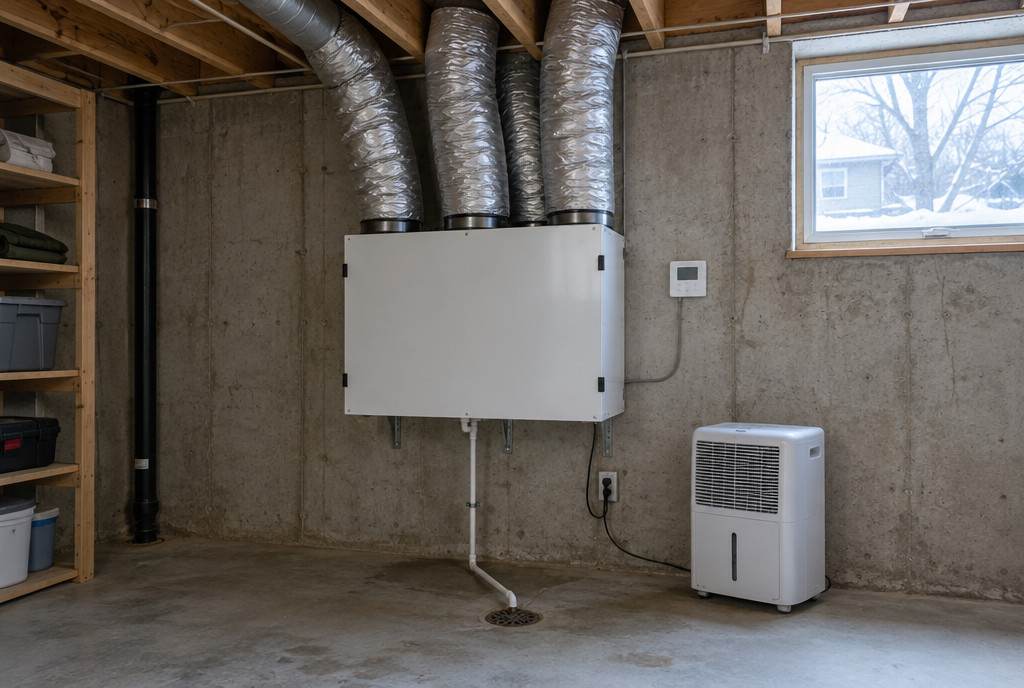
A heat recovery ventilator (HRV) replaces stale indoor air with fresh outdoor air and, according to NRCan, typically recovers 70 to 80% of the heat from the air it exhausts. An energy recovery ventilator (ERV) does the same and also moves some moisture between the airstreams.
- 70–80% Heat a typical HRV recovers from outgoing air Source: NRCan ↗
- 65% / 60% ENERGY STAR minimum sensible recovery efficiency at 0°C / −25°C Source: NRCan ↗
- 1–3 months How often to clean HRV and ERV filters Source: NRCan ↗
How an HRV or ERV works
An HRV pulls stale, moist air from rooms such as the kitchen, bathrooms and laundry and sends it outdoors, while bringing in the same amount of fresh outdoor air. The two airstreams pass each other in a heat-exchange core without mixing, and heat moves from the warm outgoing air to the cold incoming air. In summer the process reverses and some heat is kept out (NRCan HRV guide ↗).
NRCan's Keeping the Heat In ↗ says a typical HRV recovers 70 to 80% of the heat from the exhaust air; NRCan's ventilation fact sheet ↗ gives a range of 60 to 90% across models. An energy recovery ventilator (ERV) is a type of HRV that exchanges moisture as well as heat.
Fresh air reaches rooms through the furnace ducts or through dedicated ducts. With furnace ducts, the furnace fan has to run for the air to circulate, and Health Canada ↗ notes that an older furnace fan can draw 500 to 800 watts, compared with the 30 W fan motor in the most efficient HRVs. NRCan says a brushless DC (ECM) furnace motor can cut average furnace electricity use by more than 70% in continuous circulation, and that an HRV with its own ducts can be the most efficient setup, especially in a house without ductwork.
Ratings, sizing, and HRV versus ERV
Two ratings, both measured to the CSA C439 test standard, tell you how good a unit is:
- Sensible recovery efficiency (SRE): the share of heat recovered after accounting for fan energy, air leakage, frost control and other losses. ENERGY STAR certification in Canada (Version 2.3 ↗, effective December 13, 2021) requires at least 65% SRE at 0°C and 60% at −25°C.
- Fan efficacy: airflow per watt of fan power. ENERGY STAR requires at least 1.2 cfm per watt (0.57 L/s per watt) for units under 75% SRE, and 0.8 cfm per watt (0.38 L/s per watt) at 75% SRE or higher.
NRCan suggests choosing an ENERGY STAR model or one with Home Ventilating Institute (HVI) certification, with a high SRE and a low-energy fan motor. For an ERV, make sure it was tested at low temperature; all ENERGY STAR models are. Rated units are listed in NRCan's searchable product list ↗ and the HVI directory.
For sizing, NRCan's HRV guide allows 10 L/s (20 cfm) for the master bedroom, 10 L/s for an unfinished basement and 5 L/s (10 cfm) for each other room. A ten-room home works out to 60 L/s (120 cfm) at high speed, and low speed should be 40 to 60% of that.
HRV or ERV? NRCan recommends an ERV where cooling loads are high, where indoor moisture levels are very low, or in very dry climates such as northern Canada. Health Canada adds that an ERV can be the better choice for a house that is already dry in winter, and is preferable to an HRV for avoiding excess indoor humidity in summer. An HRV sends more of the winter moisture outdoors, which helps where windows sweat. If an HRV leaves the house too dry, NRCan says over-ventilation may be the cause; try a lower speed before changing equipment. Some HRVs can be converted to ERVs for less than a new unit.
Balancing and signs of trouble
An HRV is meant to move the same amount of air in as out. NRCan's guide explains that an unbalanced system recovers less heat and causes problems either way. More air out than in depressurizes the house, which can pull carbon monoxide and other combustion gases from a furnace, water heater or fireplace back indoors. More air in than out pushes moist indoor air into walls and the roof, where it can condense, and can frost the core.
The National Building Code 2025 ↗ requires installers to follow the manufacturer's start-up procedures, including air balancing and airflow measurement. NRCan recommends a balance check by a qualified contractor once a year, and a service with a balance test when you buy a home that already has an HRV.
For a rough check, CMHC ↗ suggests taping a large garbage bag to a coat hanger, holding it flat over the outdoor exhaust hood and timing how long it takes to inflate, then holding the inflated bag over the supply hood and timing how long it takes to deflate. The times should be roughly equal; if the bag inflates twice as fast as it deflates, the unit is unbalanced.
Warning signs from NRCan's troubleshooting guide:
- Little or no airflow at the grilles: blocked hoods, dirty filters, a frozen core or loose ducts.
- A core that keeps freezing. Most HRVs defrost automatically when incoming air is colder than −5°C, so repeated freezing points to dirty filters, a defrost fault or imbalance.
- Cold drafts near supply grilles, wet duct insulation or water on the floor.
- Stale air or condensing windows, or the reverse, air that is too dry in winter.
When you need one, and what an energy advisor checks
NRCan's rule: if a house already shows excessive condensation and the moisture sources can't be reduced, any retrofit that makes it more airtight has to include mechanical ventilation. It calls an energy-efficient HRV or ERV one of the best ways to ventilate a home. Health Canada notes that some jurisdictions require HRVs in new construction, while balanced and exhaust-only systems may be allowed in retrofits.
- Airtightness: a blower door test measures it, and Health Canada says the result helps determine which ventilation system best fits the house.
- Actual airflow: a ventilation assessment checks whether fans and any existing HRV move air outdoors as they should.
- Pressure safety: a combustion safety test confirms an unbalanced system or exhaust fan isn't depressurizing the house around fuel-burning appliances.
For installation, NRCan recommends a contractor trained through HRAI (the Heating, Refrigeration and Air Conditioning Institute of Canada) or, in Quebec, the CMMTQ. HRAI certifies HRV and ERV installation and balancing (VIBF).
Maintenance and upgrades, from simplest to biggest
In NRCan's maintenance chart, everything except the annual service is homeowner work. Disconnect the power first.
| Fix | Typical cost | What it does | DIY or pro? |
|---|---|---|---|
| Clean or replace the filters every 1 to 3 months | No cost for washable filters; replacements vary | Keeps airflow, balance and heat recovery up | DIY |
| Clear outdoor intake and exhaust hoods of leaves, snow and frost | No cost | Prevents blocked airflow; check more often in fall and winter | DIY |
| Inspect and clean the core and the condensate drain and pan every 6 months, pouring 2 to 3 L of warm water into the pan | No cost | Restores heat recovery and keeps the drain flowing | DIY |
| Adjust the dehumidistat seasonally | No cost | Avoids over-drying in winter or condensation on windows | DIY |
| Annual service: defrost test, controls check, airflows measured and rebalanced, written report | Get quotes; ask whether a report costs extra | Keeps the unit balanced and working as designed | Pro (HRAI-accredited) |
| If the HRV uses furnace ducts, fit an ECM (brushless DC) furnace motor | Get quotes | Can cut furnace electricity use by more than 70% in continuous circulation | Pro |
| Install a new HRV or ERV, on dedicated ducts where none exist | Get quotes | Balanced ventilation with heat recovery | Pro (HRAI-certified) |
Mistakes to avoid
- Turning it off. NRCan's ENERGY STAR guidance ↗ says never to turn an HRV or ERV off except for servicing. Low speed year-round usually meets ventilation needs; use high speed for cooking, showers or a full house.
- Counting on it for combustion air. NRCan cautions not to rely on an HRV to remove combustion by-products or to supply combustion air for fuel-burning appliances.
- Using the wrong filters. Filters not designed for your unit can restrict airflow and impair operation.
- Expecting an air cleaner. NRCan says an HRV is not an air cleaner and may not handle strong pollutant sources such as smelly glues.
- Covering the hoods with fine mesh. NRCan says screen mesh finer than about 6 mm (¼ in.) blocks airflow. Keep garbage, pesticides and the barbecue away from the intake.
- Skipping commissioning. NRCan notes that historically many HRVs and ERVs were not installed or maintained properly, and says they must be installed, balanced and commissioned by a certified technician.
Rebates and next steps
Rebates vary by province and change often. Check current offers in our rebate program tracker, estimate the payback with the upgrade payback calculator, and use the home energy planner to sequence ventilation with air sealing. To find someone to measure your current airflow, see our ventilation assessment providers.
Run your numbers
See what this kind of upgrade could pay back at your city’s energy prices, then put the work in a sensible order in your home plan.
Common questions
What is the difference between an HRV and an ERV?
Both replace stale indoor air with fresh outdoor air and recover heat from the outgoing air. An ERV also transfers some moisture, so it keeps more humidity indoors in a dry winter and keeps some out in a humid summer.
Should an HRV run all the time?
Yes. NRCan's ENERGY STAR guidance says not to turn an HRV or ERV off except for servicing; continuous low speed usually meets ventilation needs, with high speed for showers, cooking or a full house.
How often should I clean my HRV filters?
Every one to three months, according to NRCan. Inspect and clean the core and condensate drain about every six months, and book a professional service once a year.
Why does my HRV core freeze?
Most HRVs defrost automatically when incoming air is colder than −5°C. Repeated freezing usually points to dirty filters, a defrost problem or an unbalanced system that a contractor needs to adjust.
Do I need an HRV in an older house?
Not always. NRCan says that if a house shows excessive condensation that can't be fixed by reducing moisture sources, any retrofit that makes it more airtight has to include mechanical ventilation.
What efficiency rating should I look for?
Compare the sensible recovery efficiency (SRE) at 0°C and −25°C. ENERGY STAR models sold in Canada must reach at least 65% and 60%, and a higher number means more heat recovered.
Sources
- NRCan, Keeping the Heat In, Section 9: Operating your house (page modified 2025-09-29) ↗
- NRCan, How to get the ventilation you need in your house (fact sheet, 2018, PDF) ↗
- NRCan, Heat Recovery Ventilators (booklet, revised February 2012, PDF) ↗
- NRCan, ENERGY STAR: Heat and energy recovery ventilators (page modified 2025-10-07) ↗
- NRCan, ENERGY STAR technical specification for HRVs and ERVs, Version 2.3 (effective December 13, 2021) ↗
- NRCan, Searchable product list (ENERGY STAR and rated HRVs/ERVs) ↗
- Health Canada, Ventilation and the indoor environment (March 2018) ↗
- CMHC, About Your House: Maintaining Your Heat Recovery Ventilator (revised 2010, PDF) ↗
- NRC, National Building Code of Canada 2025, Section 9.32 and Notes (PDF, 15 MB) ↗
- HRAI, Certified Installers and Designers database ↗
Figures checked against these pages on October 8, 2026. Programs and prices change, so confirm on the official page before you spend.
Have your own house measured
Tell us where you are and what you’re planning. We’ll connect you with a registered service organization for your area — no spam, no shared lead lists.