Northwest Territories · Home health · checked September 28, 2026

Carbon monoxide testing in Yellowknife

Carbon monoxide is odourless and can kill. We found no NWT requirement for CO alarms in existing homes; the territory's fire regulations adopt the national codes for new construction.

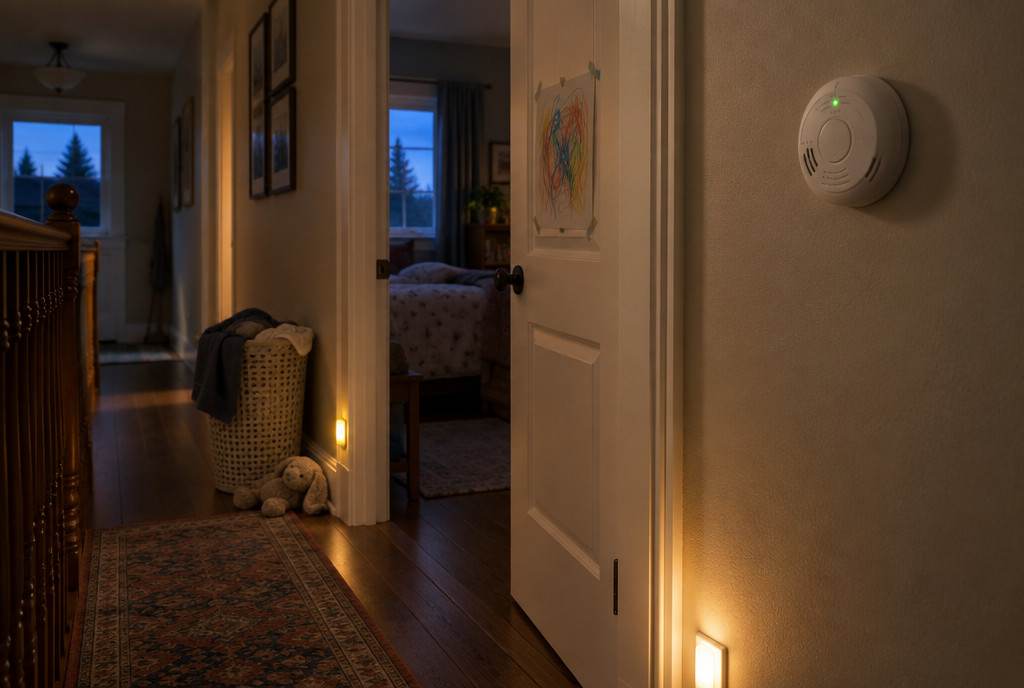
A carbon monoxide alarm on an upstairs hallway wall outside the bedrooms at night

CO alarm rule

No requirement found

Natural gas heat

No piped gas

Single-detached share

44%

Alarm cost

$40–$80 each

How Yellowknife is built

Yellowknife's houses by when they were built Ten house shapes, one for each tenth of Yellowknife's 5,225 houses. Before 1961: 3%, 1961–1990: 54%, 1991–2000: 21%, 2001 or later: 22%. Older houses glow hotter.
  • Before 1961 3%
  • 1961–1990 54%
  • 1991–2000 21%
  • 2001 or later 22%
Each house stands for one in ten of Yellowknife's 5,225 houses (single-detached, semi-detached, row and duplex), drawn by when it was built. The glow shows the usual pattern: older houses tend to be leakier and less insulated. Snowfall scales with heating degree-days. Sources: Statistics Canada 2021 Census (table 98-10-0233-01), NRCan HOT2000 climate data.

The rule in Northwest Territories

We found no NWT requirement for CO alarms in existing homes; the territory's fire regulations adopt the national codes for new construction.

CO sources in Yellowknife homes

There's no piped natural gas for homes in Yellowknife, so the usual CO sources are oil furnaces, propane appliances, wood stoves and attached garages.

Single-detached houses make up 44% of Yellowknife's households; many have an attached garage, another reason to put an alarm near the door into the house.

What a CO check involves

  • Alarms next to sleeping areas and on every storey, tested monthly and replaced by their end-of-life date (usually 7 to 10 years).
  • Annual service of fuel-burning appliances by a licensed technician.
  • A combustion spillage test during an energy evaluation, which catches a venting problem before it produces CO.

Our carbon monoxide guide · Combustion safety testing in Yellowknife

Carbon monoxide testing in Yellowknife: common questions

Are carbon monoxide alarms mandatory in Yellowknife?

We found no NWT requirement for CO alarms in existing homes; the territory's fire regulations adopt the national codes for new construction.

Where should CO alarms go?

Outside every sleeping area and on every storey, following the manufacturer's instructions. Some rules also call for one near a fuel-burning appliance or the door from an attached garage.

How long do CO alarms last?

Most have an end-of-life date of 7 to 10 years printed on the unit; replace them by then even if they still beep when tested.

Carbon monoxide testing near Yellowknife

Ask about carbon monoxide testing in Yellowknife

Tell us your postal code and what you’re dealing with. We’ll reply with the right kind of certified professional or lab for your area, and which programs apply.

Email us what you’re planning, your postal code and the type of building (a house, a duplex or triplex, or a larger multi-unit building) — we’ll reply with registered service organizations for your area and which rebates apply.

Email dave@clickshift.ca

This inbox is answered by a person. Participating advisors pay us a referral fee — you pay nothing, and it never affects the directory.