How St. John's is built
- Before 1961 22%
- 1961–1990 42%
- 1991–2000 11%
- 2001 or later 26%
Radon in St. John's
Health Canada's 2012 survey found 4% of 100 homes tested in the Eastern Regional Integrated Health Authority health region above the guideline. In the City of St. John's free test-kit program, about 345 kits went out in November 2024 and 278 homes completed testing over the winter; about one in ten of them were above Health Canada's 200 Bq/m³ guideline. The participants were volunteers, so it isn't a random survey.
No survey can tell you about a single house, because neighbouring homes can differ widely. Testing is the only way to know.
Long-term monitoring: how to test properly
Health Canada's measurement guide asks for a long-term test with at least 91 days in the heating season, when closed windows and the stack effect make readings higher, so the result is a conservative estimate of the yearly average. It recommends testing for 3 to 12 months. Our radon testing guide walks through each step.
Place the detector on the lowest level where someone spends more than four hours a day, at least 30 cm above the floor and 30 cm from walls, and at least 1 m from vents, windows and doors; avoid kitchens, laundry rooms and bathrooms. The choice of device:
- Alpha track detectors record radon's alpha particles on a plastic film; you mail them to a lab when the test ends. A long-term kit costs about $30–$80 including the lab fee (Windsor-Essex County Health Unit).
- Electret ion chambers lose charge as radon ionizes the air inside; a lab reads the voltage drop.
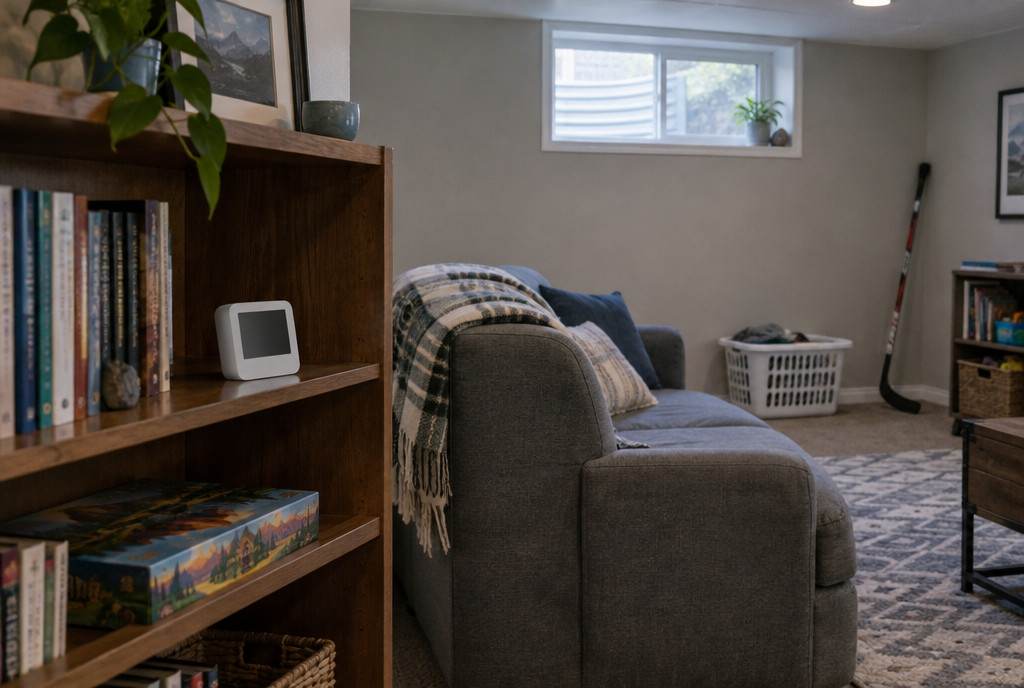
- Digital (electronic) monitors read continuously and show results on a screen or an app, and cost more (Lung Saskatchewan sells one for $189). For a long-term test, Health Canada says to use one that has passed C-NRPP performance testing, and it still has to run at least three months.
- Continuous monitoring after mitigation: a digital monitor left running lets you watch for changes between the follow-up long-term tests Health Canada recommends.
Kits and professionals in St. John's
- There's no provincial kit program; several NL public libraries lend radon monitors.
- The City of St. John's has run free radon kit programs for residents, including about 250 kits in its November 2025 round.
- For a professional measurement or mitigation, search the C-NRPP directory by your St. John's postal code; it lists certified measurement and mitigation professionals.
If your level is high: mitigation
Health Canada recommends fixing levels above 200 Bq/m³ within a year, and sooner the higher the level. The usual fix is a sub-slab depressurization system (a sealed pipe through the floor and a fan venting outside), which Health Canada says costs about $2,000 to $3,000 including material and labour and cuts radon by more than 80% in most homes. Hire a professional certified for mitigation under C-NRPP. After a system goes in:
- A C-NRPP professional runs a short test starting at least 24 hours after the fan is turned on.
- A long-term three-month test follows in the next fall or winter, done by a company other than the installer.
- With an active system, Health Canada recommends a long-term test within two years of activation and every five years after that, and again after renovations.
- Check the system's pressure gauge (manometer) regularly and never switch the fan off. It costs about $50 to $75 a year to run; a replacement fan is $200 to $300.
Rules and help in Newfoundland and Labrador
- Newfoundland and Labrador leaves building rules for new houses to municipal by-laws, so radon measures in new homes depend on the municipality.
- The Canadian Lung Association's Lungs Matter program offers up to $1,500 toward mitigation for households with low to moderate incomes or a lung cancer diagnosis.
Radon testing in St. John's: common questions
Is radon a problem in St. John's?
Health Canada's 2012 survey found 4% of 100 homes tested in the Eastern Regional Integrated Health Authority health region above the guideline. In the City of St. John's free test-kit program, about 345 kits went out in November 2024 and 278 homes completed testing over the winter; about one in ten of them were above Health Canada's 200 Bq/m³ guideline. The participants were volunteers, so it isn't a random survey. Any home can have high radon, so Health Canada recommends testing every home.
How long should a radon test take?
At least 91 days, in the heating season. Health Canada recommends 3 to 12 months; short tests can't tell you your long-term average.
Where can I get a radon test kit in St. John's?
There's no provincial kit program; several NL public libraries lend radon monitors. Hardware stores and lung associations also sell long-term kits, for about $30–$80 including the lab fee.
Digital radon monitor or alpha-track kit?
An alpha-track kit is the cheaper long-term test: it sits for three months or more and goes to a lab. A digital monitor shows readings as it goes and can keep running after mitigation; for a long-term result, use one that has passed C-NRPP testing and run it for at least three months.
What does radon mitigation cost?
Health Canada puts a sub-slab depressurization system at about $2,000 to $3,000 including material and labour, plus about $50 to $75 a year to run the fan. Hire a C-NRPP-certified mitigation professional.
Should I keep monitoring after mitigation?
Yes. Health Canada recommends a long-term test in the following heating season, another within two years of activation, and one every five years after that. A digital monitor running in between shows if anything changes.