How Dufferin County is built
- Before 1961 16%
- 1961–1990 38%
- 1991–2000 16%
- 2001 or later 30%
This page covers the eight towns and townships of the County of Dufferin, from Orangeville and Mono north to Shelburne, Melancthon and Mulmur.
Radon in Dufferin County
In Health Canada’s 2012 survey, 10.9% of 92 homes tested in the Wellington-Dufferin-Guelph Health Unit were above the guideline. The survey used the health regions of the time; today the area is served by Wellington-Dufferin-Guelph Public Health.
The larger 2024 Cross-Canada survey reports 12.4% (1 in 8) of homes at or above the guideline for Ontario as a whole. The two surveys aren't directly comparable: the 2024 study pooled about 69,000 volunteer tests, more of them in basements, which partly explains its higher numbers. Neither can tell you about a single house, because neighbouring homes can differ widely.
Guelph Public Library, Orangeville Public Library and Wellington County Library lend digital radon detectors for a free screening test. The health unit recommends a long-term test of at least three months between October and March, with a device on the C-NRPP approved list.
Long-term monitoring: how to test properly
Health Canada's measurement guide asks for a long-term test with at least 91 days in the heating season, when closed windows and the stack effect make readings higher, so the result is a conservative estimate of the yearly average. It recommends testing for 3 to 12 months.
- Alpha track detectors record radon's alpha particles on a plastic film; you mail them to a lab when the test ends.
- Electret ion chambers lose charge as radon ionizes the air inside; a lab reads the voltage drop.
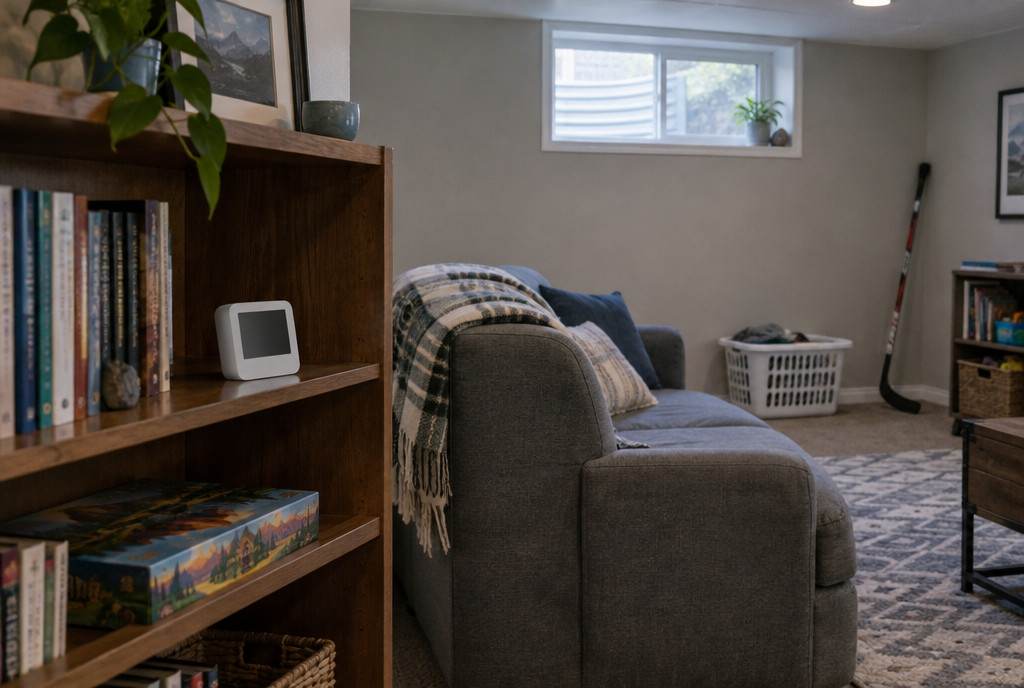
- Digital (electronic) monitors read continuously and show results on a screen or an app. For a long-term test, Health Canada says to use one that has passed C-NRPP performance testing, and it still has to run at least three months.
Place the detector on the lowest level where someone spends more than four hours a day, at least 30 cm above the floor and 30 cm from walls, and at least 1 m from vents, windows and doors; avoid kitchens, laundry rooms and bathrooms. A digital monitor left running after mitigation lets you watch for changes between the long-term tests below.
Kits, lending libraries and professionals
- Borrow a monitor. Take Action on Radon lists Orangeville Public Library and Grand Valley Public Library among the libraries that lend radon monitors; a borrowed digital monitor is good for screening, and a long-term test needs at least three months.
- There's no provincial free-kit program in Ontario; long-term kits, about $30–$80 including the lab fee (Windsor-Essex County Health Unit), are sold online and at hardware stores.
- For a professional measurement or mitigation, search the C-NRPP directory ↗ by postal code; it lists certified measurement and mitigation professionals, and you can confirm they cover Orangeville and the rest of Dufferin County.
If your level is high: mitigation
Health Canada recommends fixing levels above 200 Bq/m³ within a year, and sooner the higher the level. The usual fix is a sub-slab depressurization system (a sealed pipe through the floor and a fan venting outside), which Health Canada says costs about $2,000 to $3,000 including material and labour and cuts radon by more than 80% in most homes. Hire a professional certified for mitigation under C-NRPP.
After a system goes in:
- A C-NRPP professional runs a short test starting at least 24 hours after the fan is turned on.
- A long-term three-month test follows in the next fall or winter, done by a company other than the installer.
- With an active system, Health Canada recommends a long-term test within two years of activation and every five years after that, and again after renovations.
- Check the system's pressure gauge (manometer) regularly and never switch the fan off. It costs about $50 to $75 a year to run; a replacement fan is $200 to $300.
Since January 1, 2025, the Ontario Building Code requires new houses to include a soil-gas barrier and a radon rough-in. Tarion's new-home warranty covers radon remediation for seven years from possession, and the Canadian Lung Association's Lungs Matter program offers up to $1,500 toward mitigation for households with low to moderate incomes or a lung cancer diagnosis.
Read more: The radon testing guide.
Communities we cover in Dufferin County
Every town, village and hamlet below is part of this page, grouped by municipality (2021 Census population).
- Town of Orangeville 30,167
- Town of Mono 9,421
- Town of Shelburne 8,994
- Township of Amaranth 4,327
- Town of Grand Valley 3,851
- Township of Mulmur 3,571Mansfield
- Township of Melancthon 3,132
- Township of East Garafraxa 2,794Orton
Radon testing and long-term monitoring in Dufferin County: common questions
Is radon a problem in Dufferin County?
In Health Canada’s 2012 survey, 10.9% of 92 homes tested in the Wellington-Dufferin-Guelph Health Unit were above the guideline. The larger 2024 Cross-Canada survey reports 12.4% (1 in 8) of homes at or above the guideline for Ontario as a whole. Any home can have high radon, so Health Canada recommends testing every home.
How long should a radon test take?
At least three months, with at least 91 days in the heating season. Health Canada recommends 3 to 12 months; short tests can’t give your long-term average.
Where can I get a radon monitor or kit in Orangeville?
Take Action on Radon lists Orangeville Public Library and Grand Valley Public Library among the libraries that lend monitors. Long-term kits are also sold online and at hardware stores.
What does radon mitigation cost?
Health Canada puts a sub-slab depressurization system at about $2,000 to $3,000 including material and labour, plus about $50 to $75 a year to run the fan.
Should I keep monitoring after mitigation?
Yes. Health Canada recommends a long-term test the following heating season, another within two years of activation, and one every five years after that. A digital monitor running in between shows if anything changes.