How Saint-Jean-sur-Richelieu is built
- Before 1961 19%
- 1961–1990 41%
- 1991–2000 14%
- 2001 or later 26%
Why it matters in Saint-Jean-sur-Richelieu
In Quebec, 54% of households heat mainly with electric baseboards, 16% with a heat pump, 11% with a forced-air furnace and 4% with a boiler and radiators; electricity is the main heating energy for 70% of households, natural gas for 5% and wood for 4% (Statistics Canada, 2023).
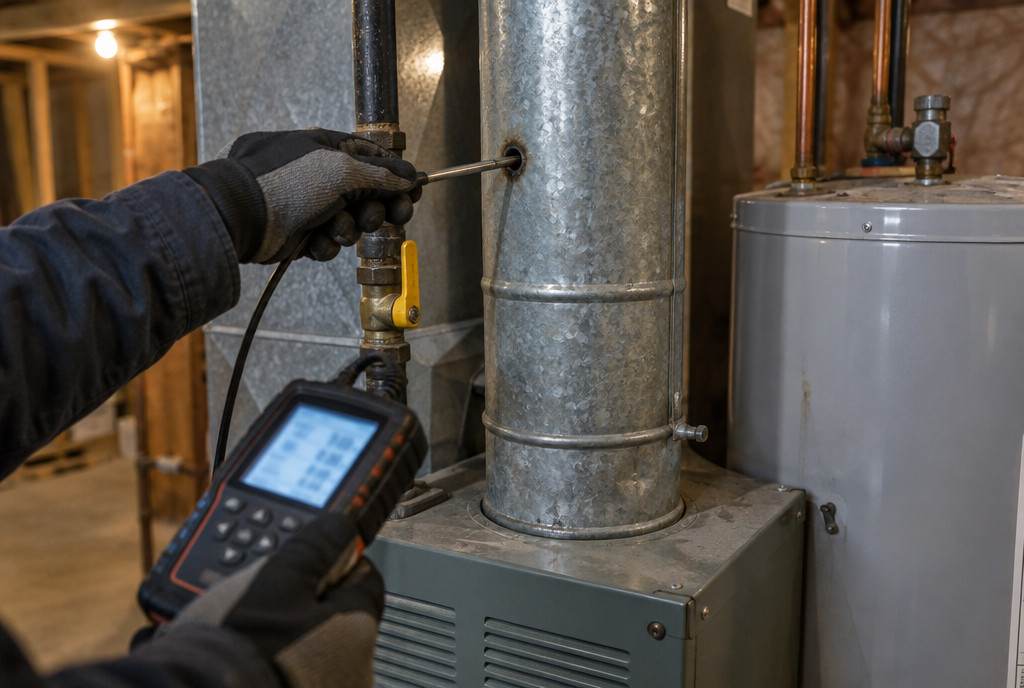
The risk rises after air sealing: a tighter house plus a strong exhaust fan or dryer can pull exhaust back down a chimney. That's why advisors test for spillage during an evaluation and why it should be repeated after serious tightening.
The CO alarm rule in Quebec
Quebec has no province-wide rule requiring CO alarms in existing houses: provincial rules cover larger multi-unit buildings, and for houses it's up to each municipality's by-law, so ask your local fire service.
What the check involves
- Worst-case depressurization: exhaust fans and the dryer on, doors set to make the appliance room as negative as it gets.
- A spillage and draft check at each appliance, with a CO reading.
- A plan if anything fails: often a sealed-combustion appliance or a fix to the venting, done by a licensed gas or oil technician.
NRCan-licensed service organizations serving Saint-Jean-sur-Richelieu
In Quebec, EnerGuide evaluations for existing homes run through the provincial Rénoclimat program; the organizations below are the ones NRCan lists for Saint-Jean-sur-Richelieu postal codes.
Energy advisors check for combustion spillage during an evaluation; fixing a venting problem is work for a licensed gas or oil technician.
- Expertbâtiment Services-Conseils
- Habite-Co 2000
- Les Services ecoPlus
- Legault-Dubois
Programs in Saint-Jean-sur-Richelieu
Combustion safety test in Saint-Jean-sur-Richelieu: common questions
Are CO alarms required in Saint-Jean-sur-Richelieu homes?
Quebec has no province-wide rule requiring CO alarms in existing houses: provincial rules cover larger multi-unit buildings, and for houses it's up to each municipality's by-law, so ask your local fire service.
Who does combustion safety testing?
Energy advisors check for spillage during an EnerGuide evaluation. Repairs to venting or appliances are done by a licensed gas or oil technician.
I have CO alarms. Isn't that enough?
Alarms warn you once CO is already in the house. A spillage test finds a venting problem before it produces CO.