How Halifax is built
- Before 1961 22%
- 1961–1990 42%
- 1991–2000 14%
- 2001 or later 22%
Why air leakage matters in Halifax
Halifax gets about 3,870 heating degree-days a year and has a winter design temperature of −15.9°C, according to NRCan's HOT2000 climate data for Shearwater. That's right around the middle of the 70 cities we cover.
Of Halifax's 121,700 houses (single-detached, semi-detached, row houses and duplexes), 22% were built before 1961 and 63% before 1991, according to the 2021 Census. Older houses usually test leakier than newer ones, and an EnerGuide report compares your result with homes of the same era, so you can see whether your house is typical or a problem.
After you seal: two checks
- Combustion safety. In the Halifax area, the main heating energy is oil for 23% of households. A tighter house changes how fuel-burning appliances vent, so the spillage check should be repeated after serious air sealing. Combustion safety testing in Halifax
- Radon. Sealing shifts the pressure balance between the house and the soil. Health Canada's 2012 survey found 13.6% of 103 homes tested in the Zone 6 health region above the guideline. The larger 2024 Cross-Canada survey reports 38.7% (1 in 3) of houses at or above the guideline for the Halifax, NS (Halifax CMA) metro area. Test before and after big air-sealing jobs. Radon testing in Halifax
What it costs in Halifax
A blower door test is part of every EnerGuide evaluation rather than a separate purchase. Efficiency Nova Scotia's Home Energy Assessment program charges a $199 program fee, waived for households under its income threshold, and covers the initial and final assessments. Moderate Income Rebate participants who paid up front get the $199 back when their rebates are issued.
How the test works
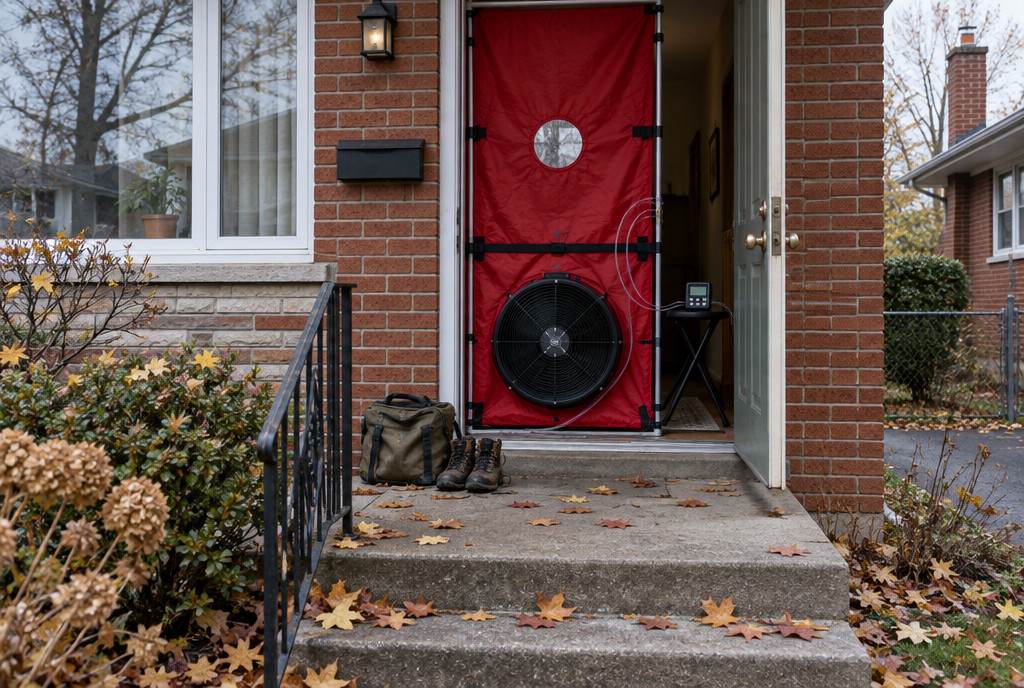
- A calibrated fan is fitted into an exterior door and pulls air out until the house is at 50 pascals, the standard test pressure.
- The result is air changes per hour at 50 Pa (ACH50): how many times an hour the whole volume of air would leak out and be replaced at that pressure.
- While the fan runs, you and the advisor walk the house and feel for leaks at the attic hatch, rim joists, pot lights, trim and plumbing and wiring penetrations.
- A second test after the work shows what changed, and it is what most rebates pay on.
NRCan-licensed service organizations serving Halifax
In Nova Scotia, EnerGuide home energy assessments are booked through Efficiency Nova Scotia's Home Energy Assessment program, which assigns one of its Delivery Agent Partners; NRCan's list shows no separate service organizations for Nova Scotia postal codes.
Programs that include a blower door test in Halifax
Blower door test in Halifax: common questions
Where can I get a blower door test in Halifax?
Book Efficiency Nova Scotia's Home Energy Assessment; the blower door test is part of every assessment.
How much does a blower door test cost in Halifax?
It is included in an EnerGuide evaluation. Efficiency Nova Scotia's Home Energy Assessment program charges a $199 program fee, waived for households under its income threshold, and covers the initial and final assessments. Moderate Income Rebate participants who paid up front get the $199 back when their rebates are issued.
What is a good blower door result?
Lower is better. Your EnerGuide report compares your air changes per hour at 50 Pa with homes of the same era, which is more useful than a single target number.
Does air sealing affect radon?
It can. Tightening a house changes the pressure difference with the soil, so test for radon before and after major air sealing.