How Grey County is built
- Before 1961 34%
- 1961–1990 36%
- 1991–2000 10%
- 2001 or later 20%
This page covers the nine member municipalities of the County of Grey, from Owen Sound and Meaford on Georgian Bay to Hanover, Durham and Dundalk inland.
Why mould shows up in Grey County homes
Environment and Climate Change Canada's 1981–2010 climate normal at Thornbury Slama (27.4 km from the middle of the area) is 4,188 heating degree-days a year, with a January mean of −6.3°C. On cold days, exterior corners, closets on outside walls and window frames get cold enough for condensation, which is where mould often starts.
Of the 36,295 houses in Grey County (single-detached, semi-detached, row houses, duplexes and mobile homes), 34% were built before 1961 and 69% before 1991, according to the 2021 Census. Older basements without a moisture barrier, and houses air-sealed without adding ventilation, are common trouble spots.
On census day (May 11, 2021), 16% of the 50,183 private dwellings in Grey County were not anyone's permanent home. A house or cottage that sits closed up for long stretches is worth a sniff test and a look in the basement each time you open it.
Mould inspection: when sampling helps
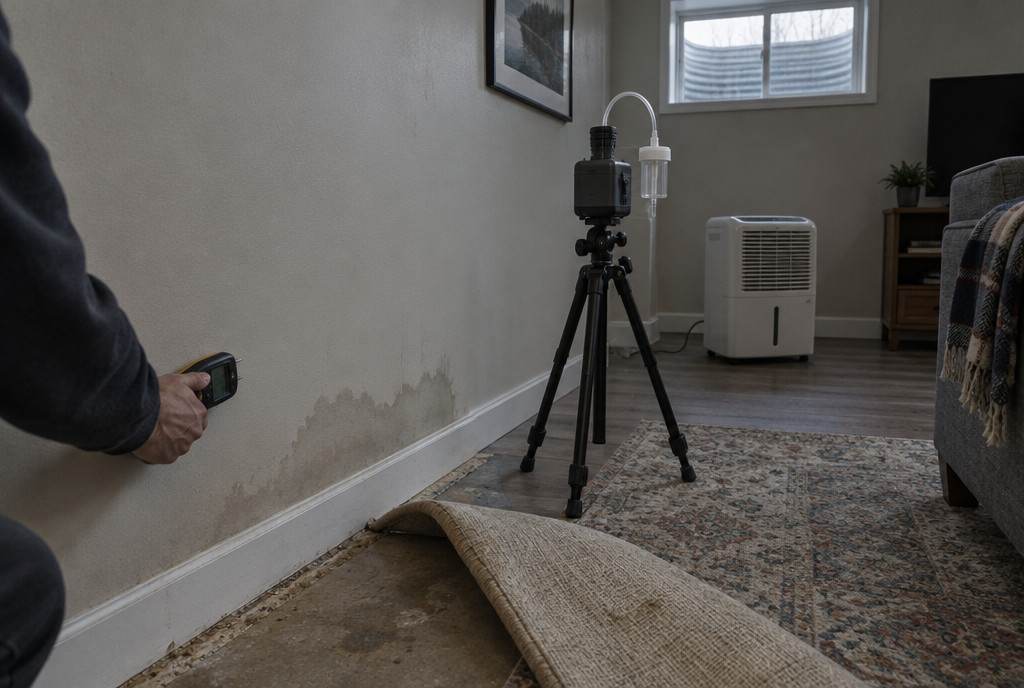
Start by looking and smelling: stains, discoloured patches, peeling paint and a musty odour, especially in basements, bathrooms, window frames and closets on outside walls. Health Canada says measuring mould concentrations or identifying species is usually unnecessary: if you can see or smell it, fix the moisture and clean up.
Air or surface sampling helps when you smell mustiness but can't find the source, after a leak or flood to check the cleanup worked, or before buying a house with signs of past water damage. Ask which lab analyzes the samples and look for one accredited under AIHA's EMLAP program.
Cleanup and remediation: the size rules
CMHC and Health Canada sort mould by size, and the size decides who should clean it up:
| Size | What counts | Who should clean it |
|---|---|---|
| Small | One to three patches, each smaller than 1 m² | A healthy homeowner, with water and unscented dish detergent (CMHC) |
| Medium | More than three patches, or patches between 1 and 3 m² (32 square feet) | Trained help; homeowners only with training and precautions |
| Large | A patch larger than 3 m², or many patches through the house | A qualified mould remediation contractor (CMHC) |
- Fix the moisture source first: a leak, poor drainage, or condensation from high humidity. Health Canada recommends 30–50% relative humidity.
- For a small cleanup, wear safety glasses or goggles, an N95 mask if possible and household rubber gloves. People at risk from mould shouldn't clean it and should stay away.
- Health Canada suggests professional help for extensive mould, especially growth that keeps coming back after cleaning.
Choosing a tester or contractor
Ask any tester which lab analyzes their samples and what the report will recommend; a good report points to the moisture source. For remediation, get two or three written quotes that describe containment, what will be removed and how the area is cleaned. No province has a mandatory mould standard for homes, and Health Canada sets no numerical limit.
Read more: The mould and indoor air quality guide.
Communities we cover in Grey County
Every town, village and hamlet below is part of this page, grouped by municipality (2021 Census population).
- City of Owen Sound 21,612
- Municipality of West Grey 13,131Durham
- Municipality of Meaford 11,485
- Township of Georgian Bluffs 11,100
- Municipality of Grey Highlands 10,424Feversham, Flesherton, Kimberley, Markdale, Maxwell, Priceville
- Town of The Blue Mountains 9,390Clarksburg, Thornbury
- Township of Southgate 8,716Dundalk
- Town of Hanover 7,967
- Township of Chatsworth 7,080
Mould and indoor air quality testing in Grey County: common questions
Do I need mould testing in Grey County if I can see mould?
Usually not. Visible mould needs cleanup and a fix for the moisture source. Sampling helps most when you suspect mould you can’t see.
How much mould can I clean myself?
CMHC says a healthy homeowner can clean one to three patches, each under 1 m², with water and unscented dish detergent. Larger areas need trained help or a remediation contractor.
When should I hire a mould remediation contractor?
For a single patch over 3 m², many patches through the house, or mould that keeps coming back after cleaning (CMHC, Health Canada).
Is there a legal mould limit for homes in Canada?
No. Health Canada sets no numerical limit; its guidance is to control moisture and clean up mould.