How Caledon is built
- Before 1961 10%
- 1961–1990 32%
- 1991–2000 21%
- 2001 or later 36%
This page covers the Town of Caledon, the rural northern part of the Region of Peel, including Bolton, Caledon East, Caledon Village, Palgrave and the hamlets around them. Brampton and Mississauga have their own pages.
Free testing through Peel Region
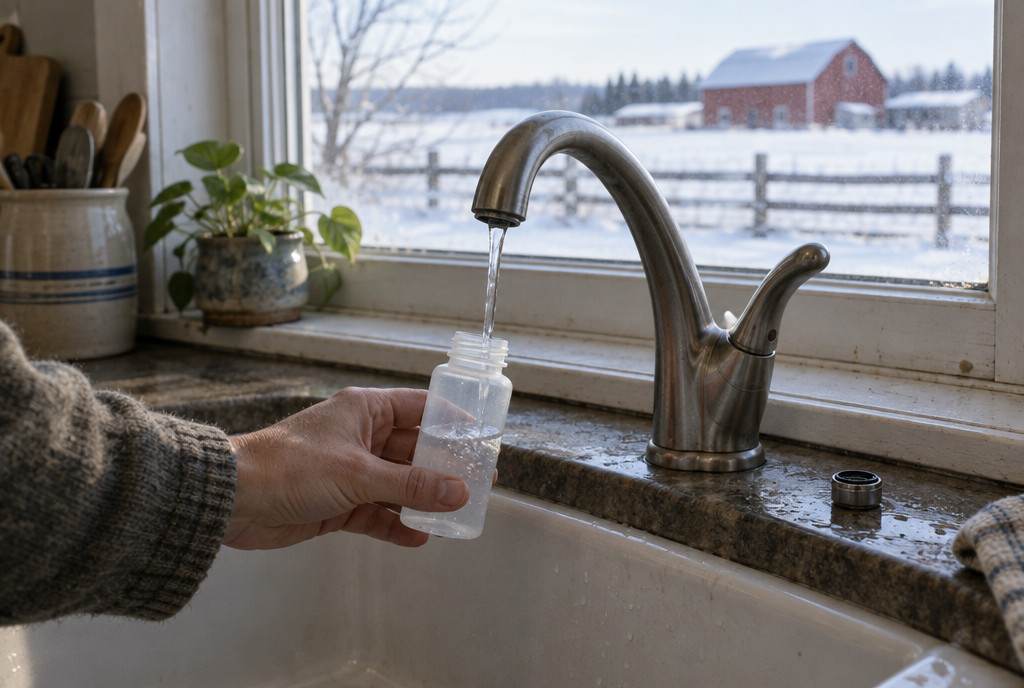
Free bacteria testing (E. coli and total coliforms) through the provincial Public Health Ontario program. Peel's well pages cover construction, maintenance and abandonment but give no testing locations; get bottles through Public Health Ontario, which says to contact your public health unit for a kit.
Peel Region says private well owners are legally responsible for the wells on their property.
What the free test covers, and what it doesn’t
Public Health Ontario's lab tests only for indicator bacteria: total coliforms and E. coli. Samples have to reach the lab within a day or two, so collect them early in the week and check the drop-off cut-off times. Chemistry (nitrate, sodium, metals) goes to a licensed private lab for a fee.
Reading the results, and what to do next
Ontario's guide to testing and treating private wells reads the counts (per 100 mL) like this:
- E. coli above 0: unsafe to drink, with evidence of animal or human waste getting into the well. Stop drinking the water and call the health unit right away.
- Total coliforms above 5, no E. coli: significant evidence of bacterial contamination, usually surface water getting in. The water may be unsafe to drink: call the health unit, inspect and repair the well, shock-chlorinate it if needed and retest.
- Total coliforms of 5 or fewer, no E. coli: some evidence of bacteria, which may not be significant at these low levels. Keep testing to track the pattern.
Boiling water at a rolling boil for at least one minute kills harmful organisms but doesn't remove dissolved contaminants. To disinfect, the province says to shock-chlorinate the well and the entire household plumbing system. Between tests, check that the well cap and the sealant around the casing aren't cracked or damaged, and keep the ground sloping away from the well: Ontario's Wells Regulation requires owners to maintain a well so surface water can't get in.
Why testing is worth the trip
Ontario's auditor general estimated in 2025 that about 1.3 million Ontarians rely on private wells, and that fewer than a third of well owners had tested in the previous 12 months (as reported by CBC). Well water can change with the seasons, after heavy rain or snowmelt, and after work on the well, which is why the health units ask for several tests a year.
What to test for
- Bacteria (total coliforms and E. coli), several times a year and after flooding, heavy rain or work on the well.
- Nitrate, especially near farmland or septic systems: the province flags nitrate above 10 ppm as a health risk for infants, and reverse osmosis or distillation treats it.
- Naturally occurring minerals such as arsenic, uranium and radium, which the province lists as long-term health risks; a private accredited lab tests for them.
Read more: The well water guide.
Communities we cover in Caledon
Every town, village and hamlet below is part of this page, grouped by municipality (2021 Census population).
- Town of Caledon 76,581Alton, Belfountain, Bolton, Caledon East, Caledon Village, Cheltenham, Inglewood, Palgrave
Covered on city pages: Brampton (Springbrook).
Well water testing in Caledon: common questions
Is well water testing free in Caledon?
Yes for bacteria. Free bacteria testing (E. coli and total coliforms) through the provincial Public Health Ontario program. Chemistry (nitrate, sodium, metals) goes to a licensed private lab for a fee.
Where do I get a well water bottle in Bolton?
Peel's well pages cover construction, maintenance and abandonment but give no testing locations; get bottles through Public Health Ontario, which says to contact your public health unit for a kit.
How often should I test my well?
Regularly; local health units commonly recommend spring, summer and fall.
Does the free test check for nitrate?
Chemistry (nitrate, sodium, metals) goes to a licensed private lab for a fee.
What if my well water test shows E. coli?
Ontario says any E. coli means the water is unsafe to drink. Stop drinking it, use bottled water, and call your public health unit right away; it will advise on repairs, shock chlorination and retesting.