How Saskatoon is built
- Before 1961 19%
- 1961–1990 44%
- 1991–2000 7%
- 2001 or later 30%
Why it matters in Saskatoon
In the Saskatoon area, 75% of households heat mainly with a forced-air furnace and about 12% with a boiler and radiators; natural gas is the main heating energy for 78% of households and electricity for about 12% (Statistics Canada, 2023).
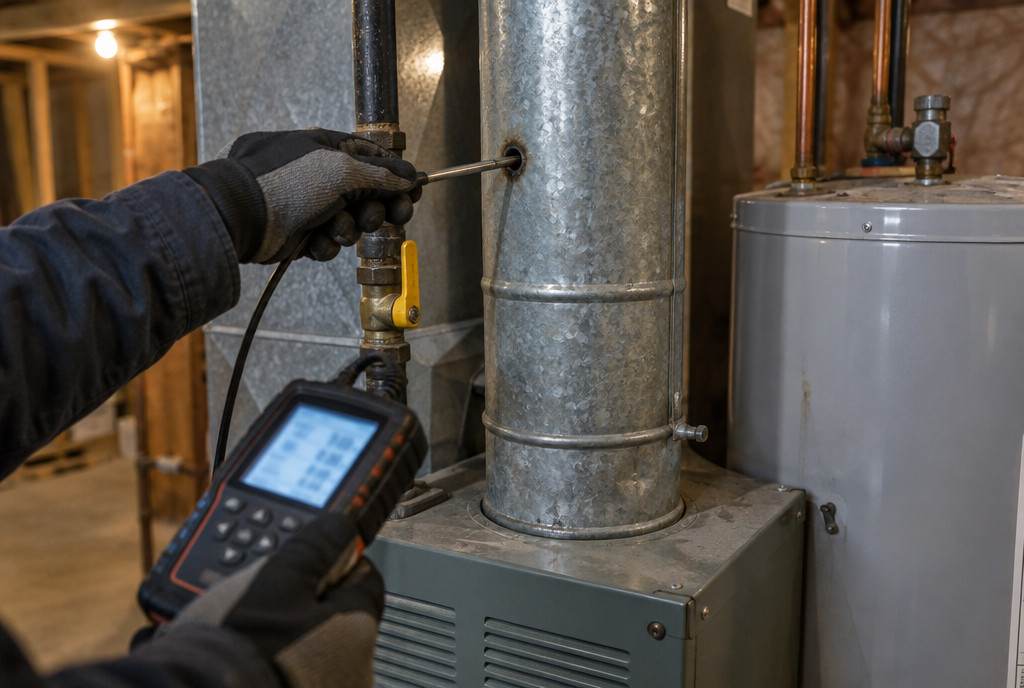
The risk rises after air sealing: a tighter house plus a strong exhaust fan or dryer can pull exhaust back down a chimney. That's why advisors test for spillage during an evaluation and why it should be repeated after serious tightening.
The CO alarm rule in Saskatchewan
Saskatchewan requires CO alarms in all residential buildings regardless of age (enforced since July 1, 2022), and from November 1, 2026, 'Henry's Law' requires one in every residential suite, including secondary suites.
What the check involves
- Worst-case depressurization: exhaust fans and the dryer on, doors set to make the appliance room as negative as it gets.
- A spillage and draft check at each appliance, with a CO reading.
- A plan if anything fails: often a sealed-combustion appliance or a fix to the venting, done by a licensed gas or oil technician.
NRCan-licensed service organizations serving Saskatoon
Energy advisors check for combustion spillage during an evaluation; fixing a venting problem is work for a licensed gas or oil technician.
- Buildingexpert
- Canada Energy Savings Comfort and Retrofit Strategies
- Clean Energy Solutions
- CoEfficient Building Science
- Energy Werx Profile
- Enerhold Engineering Solutions
- EnerQuality
- Green Think
- Isle Energy Consulting
- NRG Inspections and Consulting
- Sensible Home Inspections
- Sun Ridge Residential
- The Energuy Profile
- All Season Inspection Profile
- EnerVision
- Verdatech
- EnerSolution Profile
- Ecostep Energy Services
Combustion safety test in Saskatoon: common questions
Are CO alarms required in Saskatoon homes?
Saskatchewan requires CO alarms in all residential buildings regardless of age (enforced since July 1, 2022), and from November 1, 2026, 'Henry's Law' requires one in every residential suite, including secondary suites.
Who does combustion safety testing?
Energy advisors check for spillage during an EnerGuide evaluation. Repairs to venting or appliances are done by a licensed gas or oil technician.
I have CO alarms. Isn't that enough?
Alarms warn you once CO is already in the house. A spillage test finds a venting problem before it produces CO.