Article · verified October 2, 2026
When is an energy audit required in Ontario — and what standards govern it?
Half the confusion in this market is the word "required." Here's the honest split: the few cases where an audit is genuinely mandatory, the many where it's the paid gateway to rebates, the myth about selling your home — and the standards stack underneath it all.
Required, actually
Rebates: the Home Renovation Savings assessment path requires a pre- and post-retrofit EnerGuide evaluation — booked through one of the program's seven approved service organizations, with the follow-up done by December 31, 2026 — to unlock its bundle: the $600 assessment rebate, insulation to $7,700, windows at $100 per opening (homerenovationsavings.ca ↗). Financing: Toronto's HELP loans require the assessment for most projects (toronto.ca ↗). Large buildings: Ontario's EWRB regulation makes annual energy and water reporting mandatory for buildings of 50,000 square feet and up (ontario.ca ↗) — reporting rather than auditing, but the benchmark is what makes an ASHRAE audit the obvious next step, and our Toronto services article maps that side.
Not required — the selling myth
Ontario has no mandatory energy audit or label at time of sale. Ottawa signalled intent toward EnerGuide labelling at listing back in 2022, but as of September 2026 only voluntary labelling programs exist across Canada (NRCan's program list ↗). A voluntary label can still help a sale — documented efficiency is an asset — but nobody can lawfully tell you it's required to list. (Contrast: Austin, Portland, and Berkeley do mandate audits or scores at sale — a US pattern worth watching.)
The standards stack, decoded
| Standard | What it governs | Why you'd meet it |
|---|---|---|
| EnerGuide Rating System | Canada's official home energy rating (GJ/year; 0 = net-zero) | The rating and report every program references — NRCan ↗ |
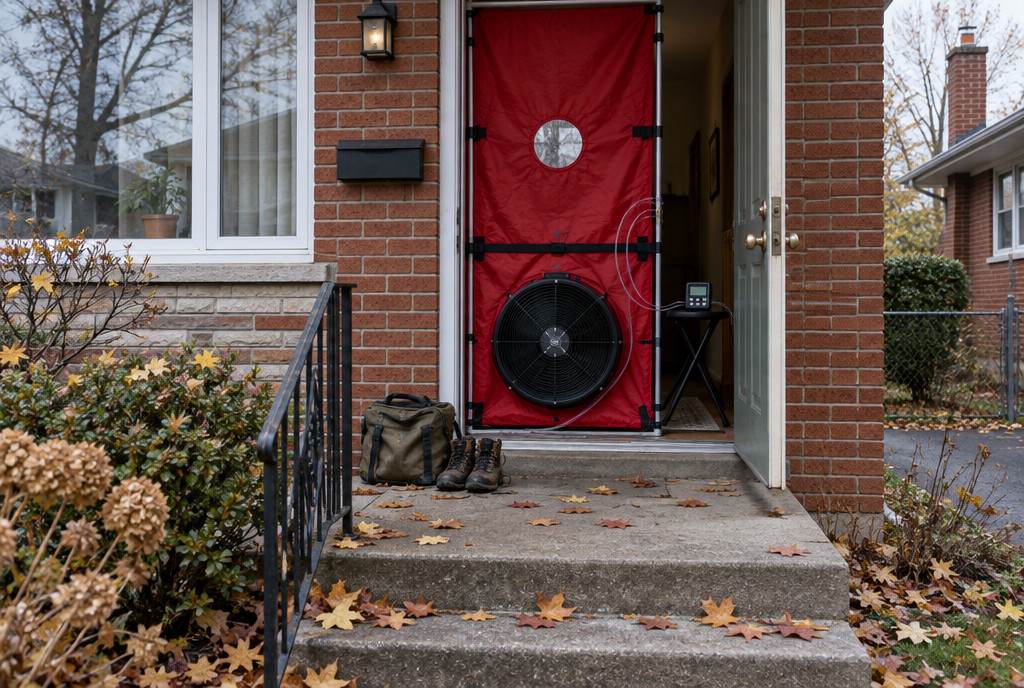
| CAN/CGSB-149.10 | Airtightness (blower door) test method | Makes leakage numbers comparable across homes and years |
| CSA F280 | Room-by-room heat-loss/heat-gain calculation | Correct heat pump and furnace sizing; required by several programs — details |
| OBC SB-12 | Energy efficiency for new houses under Ontario's Building Code | Governs new builds and many additions — ontario.ca ↗ |
| NBC 2020 tiers | National model code's tiered energy performance for new homes | The net-zero-ready trajectory provinces are adopting — Codes Canada ↗ |
| ASHRAE Standard 211 | Commercial audit levels 1–3 | The framework for building audits — ASHRAE ↗ |
Elsewhere in Canada, "required" means something different
The requirement patterns shift at every border — BC ties its Improvement Bonus to pre/post evaluations and builds new homes to the Step Code's tiers; Quebec routes requirements through Rénoclimat's own assigned evaluators. Switch the panel below to your region:
Requirements where you live
Live programs
The Home Renovation Savings Program is the live rebate engine: a $600 rebate toward your initial + follow-up EnerGuide assessments (paid once you finish two upgrades; only assessments from the seven HRSP-approved organizations qualify, with the follow-up done within 180 days or by December 31, 2026, whichever comes first), insulation up to $7,700, windows at $100 per opening on the assessment path, and heat pumps up to $7,500 ($12,000 ground-source) on the no-assessment stream. HomeRenovationSavings.ca ↗
Requirements & standards
Audits are required for: the HRSP assessment path (pre + post EnerGuide through one of the program's seven approved service organizations), and large buildings over 50,000 sq ft must report energy and water use annually under Ontario's EWRB regulation. New homes are built to the Building Code's SB-12 energy efficiency rules. Ontario EWRB (ontario.ca)
Live programs
Toronto stacks three layers: Home Renovation Savings rebates, the City's HELP loans up to $125,000 or 10% of assessed value (fixed rates the City resets every quarter), and the $600 assessment rebate through one of the seven HRSP-approved organizations. CMHC-insured recent buyers can add the 25% Eco Improvement premium refund. Toronto HELP (toronto.ca) ↗
Requirements & standards
HELP requires an EnerGuide assessment for most projects (heat-pump-only and solar-only are exempt). New construction follows the Toronto Green Standard on top of the Building Code, and 50,000+ sq ft buildings fall under provincial EWRB reporting. Toronto guide
Live programs
The utility Home Renovation Rebate program (BC Hydro/FortisBC) runs equipment and envelope rebates, and the Home Energy Improvement Bonus pays $20 per percentage-point EnerGuide improvement ($750–$2,000) when you complete 3+ eligible upgrades with pre and post evaluations within 18 months; a separate $300 Two Upgrade Bonus needs no evaluation (one bonus per home). Income-qualified households can access the CleanBC Energy Savings Program. Better Homes BC requirements ↗
Requirements & standards
The Improvement Bonus requires pre + post EnerGuide evaluations by a program-qualified advisor. Heat pump rebates require a CSA F280 heat-load calculation. New construction is governed by the BC Energy Step Code's tiered performance targets. BC Energy Step Code
Live programs
Rénoclimat delivers evaluations at $150 + tax (the $150 is refunded when you receive Rénoclimat assistance, and the first post-retrofit evaluation is free) with government-assigned advisors, feeding insulation and air-sealing subsidies; Hydro-Québec's LogisVert covers heat pumps and efficient equipment with no audit required. Rénoclimat (quebec.ca) ↗
Requirements & standards
Rénoclimat subsidies require its evaluation (booked through the program, not a chosen advisor). Novoclimat certifies high-efficiency new construction. LogisVert (Hydro-Québec)
Live programs
Manitoba is the strongest prairie market: Efficiency Manitoba pays a $400 EnerGuide evaluation rebate plus insulation and heating programs. Saskatchewan's HERR rebate ended in April 2026, and Alberta is municipal-only (PACE-style Clean Energy Improvement financing where offered). Efficiency Manitoba evaluation rebate ↗
Requirements & standards
Manitoba's evaluation rebate requires an EnerGuide evaluation through a listed service organization. Elsewhere on the prairies, audits are driven by bill savings, pre-purchase clarity, and financing eligibility rather than rebate mandates. Program tracker
Live programs
New Brunswick's Total Home Energy Savings Program charges $99 + HST for both evaluations; efficiencyPEI subsidizes assessments to $99 + HST via contracted partners; Efficiency Nova Scotia runs assessment-based rebates (up to $5,000, plus up to $5,000 more for moderate-income homes not heated by electricity) and free upgrades for income-qualified homeowners. Save Energy NB ↗
Requirements & standards
PEI's insulation rebates require the subsidized assessment first; NB and NS rebate streams are built around their evaluations. Oil-heated homes throughout the region see the fastest conversion paybacks in Canada. efficiencyPEI assessments
Common questions
Do I need an energy audit to sell my house in Ontario?
No. Ontario has no mandatory home energy audit or labelling requirement at time of sale — a federal intent to move that way was signalled in 2022 but no law exists as of September 2026. Voluntary EnerGuide labels can help at resale, but nothing compels one. Anyone telling you an audit is legally required to list is wrong.
When is an energy audit actually required in Ontario?
Four real cases: the Home Renovation Savings assessment path (pre + post EnerGuide evaluations for its bundled rebates), Toronto's HELP loans (most projects), Ontario's EWRB regulation (annual energy/water reporting for buildings 50,000 sq ft and larger — reporting, with audits as the natural follow-on), and lender or insurer conditions on some specific products. Everything else is voluntary — and usually still worth it.
What standard governs the blower door test?
Airtightness testing in EnerGuide evaluations follows the national CGSB standard for determining air leakage (CAN/CGSB-149.10), which is why numbers are comparable between homes and over time. Heat pump sizing follows CSA F280 heat-loss/heat-gain calculations, and new-home energy efficiency in Ontario is governed by the Building Code's SB-12 supplementary standard.
What are the National Building Code energy tiers?
The 2020 National Building Code introduced tiered energy performance levels for new homes — each tier stepping toward net-zero-ready construction. Provinces adopt them on their own schedules; BC's Energy Step Code pioneered the approach. For existing-home renovations, the tiers matter mostly as the direction of travel: today's voluntary retrofit is tomorrow's baseline.
Sources
- Home Renovation Savings — assessment requirement (verified October 2, 2026)
- City of Toronto — HELP assessment requirement (verified October 2, 2026)
- Ontario — EWRB large-building reporting
- NRCan — home labelling programs (voluntary status)
- Ontario's Building Code (SB-12 context)
- Codes Canada — National Building Code
- BC Energy Step Code
Meet the requirement, collect the rebates
We'll match you with a registered service organization whose assessment satisfies the programs you're targeting.
Email us what you’re planning, your postal code and the type of building (a house, a duplex or triplex, or a larger multi-unit building) — we’ll reply with registered service organizations for your area and which rebates apply.
Email dave@clickshift.ca